
Shraddh bhoj: how many to invite and what to serve at the meal
The year the family shraddh became mine to run, I overthought the wrong half of it entirely. I had spent a week getting the tithi right — I've written before about how badly I got the date wrong the first time — and then, two days before, I froze on a question nobody had thought to prepare me for: how many people am I actually feeding, and what do I put on the leaf? I had a caterer's instinct from every other function in my life, which is to plan big, and it was exactly the wrong instinct. My mother watched me start to make a guest list and said, quietly, "Beta, yeh bhoj hai, party nahi." That one sentence reset the whole thing.
A shraddh bhoj is not a headcount problem you solve by inviting generously. It is almost the opposite: a small, measured, deliberately simple meal, offered on one specific morning to a small circle, cooked with a purity most of our celebration food never bothers with. Getting it right is less about quantity and more about knowing who the meal is actually for and what belongs on the plate. This is the guide I wish someone had handed me that week.
Who the shraddh bhoj is actually for
Start here, because it changes everything downstream. Unlike a katha or a party, a shraddh bhoj has a fixed, traditional order of who eats, and it is not "everyone you know."
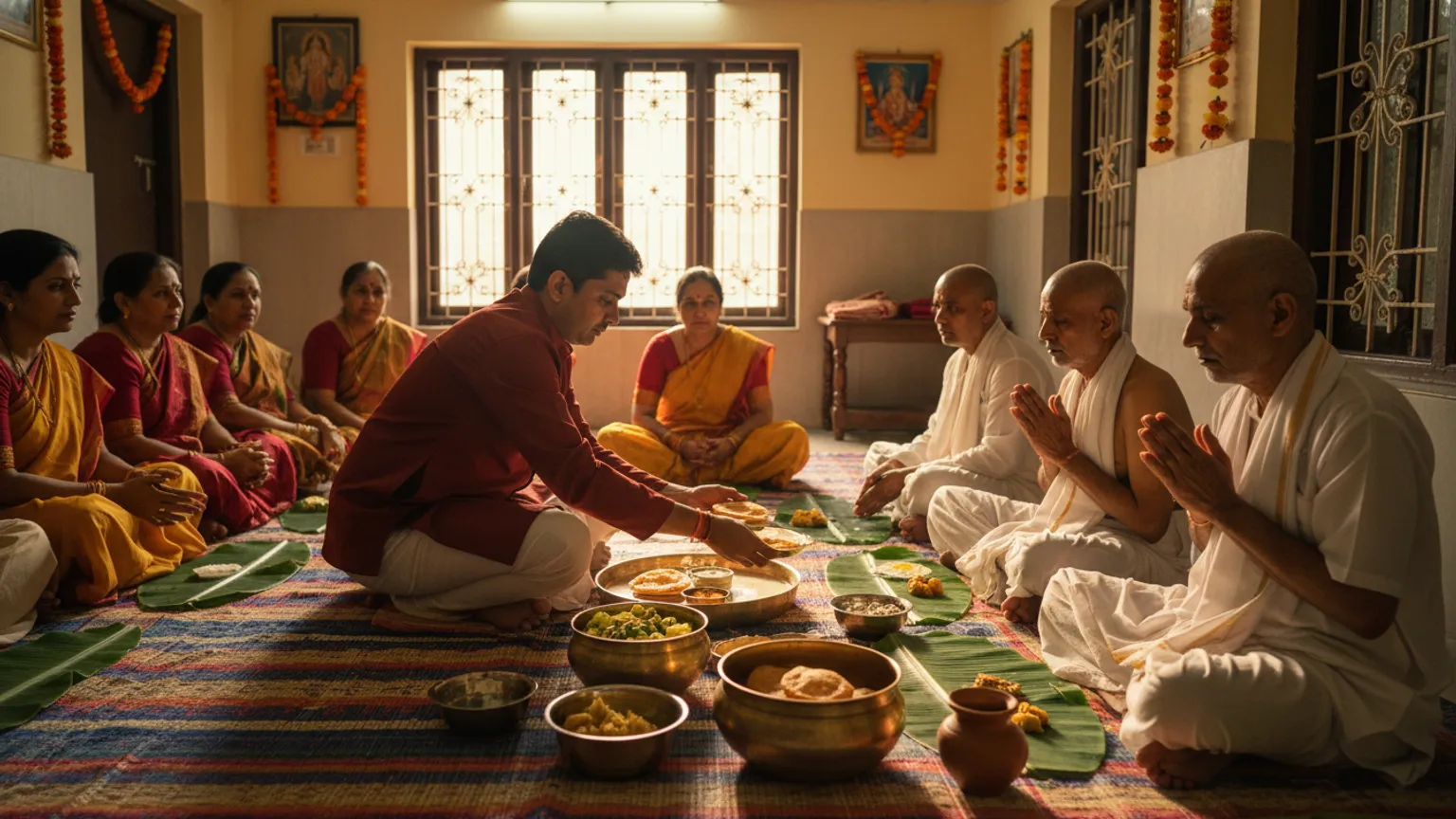
The brahmins come first. The heart of the bhoj is feeding the brahmin — or brahmins — who represent the pitru (ancestors). In many families this is the pandit who performed the tarpan and the ritual, sometimes with one or two others. They are served first, seated, and fed properly before anyone else in the house eats. Their satisfaction is, traditionally, the point of the meal.
Then the panch bali portions. Before the family eats, five small offerings are set aside — the panch bali — for the cow (gau), the crow (kaak), the dog (shwan), the devas, and the ants (pipilika). These are tiny portions of the cooked food, kept separate. In practice the crow's portion especially is watched for; many elders will not sit to eat until a crow has taken it. It sounds like folklore until you've stood on a terrace at noon waiting, and then it feels like something else.
Then the family. The immediate family — parents, you, siblings, whoever is present for the morning — eats after. This is a small, close circle by design. A shraddh is not an occasion you invite the extended clan and the neighbours to; those people you inform about the day, but the meal itself stays intimate.
Hold this order in your head and the "how many to invite" question almost answers itself. You are not building a guest list. You are settling two small numbers: how many brahmins, and how many family members are there that morning.
How many brahmins do you invite?
This is the question I actually froze on, so let me give you the plain answer I eventually got from our pandit and from asking older relatives.
There is no single rule, and anyone who tells you there is one is flattening a lot of regional and family variation. But the common conventions cluster like this:
- One brahmin is completely acceptable. For a great many families, the pandit who performs the shraddh is the one brahmin who is fed, and that is the whole bhoj. If your household is small and this is a quiet observance, one is not a shortcut — it is the norm.
- Many families keep the number odd — one, three, or five — rather than even. This is a widely followed preference, not an ironclad law, and your pandit will tell you what your family has done before.
- The number rarely needs to be large. Feeding a big group of brahmins is associated with more elaborate observances and specific traditions; the ordinary home shraddh does not require it. If someone is pushing you toward a large brahmin bhoj, ask why, and ask your own pandit before you assume it's expected.
The single most useful move, exactly as with the tithi, is to ask the oldest person in your family what your household has done in past years — and to ask the pandit when you book him. Don't reverse-engineer a tradition from a blog, mine included. Confirm it with the two people who actually know: your elder and your pandit.
The traditional menu, and what it leaves out
The food is satvik and simple, and the simplicity is not laziness — it's the spirit of the day. Cooked fresh that morning, at home where possible, without onion and without garlic. What goes on the leaf varies by region and community, but the common North Indian shape is remarkably consistent:
| Dish | Notes |
|---|---|
| Kheer (rice kheer) | Close to universal for shraddh. If one sweet defines the meal, it is this. |
| Puri | The everyday grain of the bhoj; served fresh and hot. |
| A seasonal sabzi | Often lauki (bottle gourd), kaddu (pumpkin), or a simple aloo — plain, no onion-garlic. |
| Rice and a plain dal | Chana or arhar in many homes; some families avoid masoor. Ask yours. |
| The departed's favourite dish | Where the family remembers one, it is cooked and offered. This is the most tender part of the whole meal. |
A few things the menu deliberately leaves out, and it's worth knowing them so nobody in the kitchen improvises:
- No onion and no garlic — this is the firmest of the conventions.
- Many families avoid masoor dal and certain other items on shraddh; because these vary, the safe move is one plain question to your pandit or eldest relative rather than a rule copied from the internet.
- It is not a multi-cuisine buffet. Resist the urge to "add a paneer dish and a noodle for the kids." That instinct belongs to a party; it does not belong here.
That last favourite-dish tradition is the one I'd urge you not to skip. The year I ran ours, my father mentioned — almost in passing — that his father used to love a particular besan sabzi that nobody had cooked in years. We made it. Watching my father eat it on that morning is the only part of the whole exercise I actually remember clearly. The logistics faded; that stayed.
How much to cook: quantities for a small bhoj
Because the circle is small, the arithmetic is small too — and the risk here is over-catering, not under. A shraddh bhoj cooked for fifty is not more devout; it's just wasteful, and waste runs against the meaning of the day.
Say you're feeding three brahmins and eight family members — eleven people eating, plus the small panch bali portions. Treat it as roughly twelve servings and cook to these finished, per-person amounts:
| Item | Per person | For ~12 |
|---|---|---|
| Kheer | 120–150 ml | ~1.8 litres |
| Puri | 4–5 pieces | ~55 pieces |
| Seasonal sabzi | 100–120 g | ~1.3 kg |
| Rice (uncooked) | 60–70 g | ~800 g |
| Dal (cooked) | 120–150 ml | ~1.6 litres |
Round gently upward on the kheer and puri — they're the two things people take a second helping of, and they're also what carries in the panch bali portions and any bit sent to a neighbour's elder. But do not inflate the whole meal "just in case." A modest, complete, properly cooked plate is the entire goal.
If your observance is larger — a big joint family gathering on Sarva Pitru Amavasya, say — the method for turning a real headcount into cooking quantities is the same one I laid out for pujas in the prasad and catering math guide. Use that math, then scale it down and strip out anything celebratory. The technique transfers; the abundance does not.
The messages: informing, not inviting
Here is where hosts get the register wrong. A shraddh is not something you send a cheerful invitation to. You inform the small circle, clearly and plainly, phone-first for elders — and you keep the brahmin arrangements to a direct, respectful ask. No emojis, no festivity, no group blast.
Copy these and edit the names, the tithi, the date and the timing.
Template 1 — confirming with the pandit (Hinglish)
Pranaam Panditji. Ghar par [koka] ji ka shraddh [tithi] tithi ko — English date [date], [day] subah kar rahe hain. Aap [time] baje aa payenge? Aur kitne brahman bhoj ke liye rakhein, yeh bhi bata dijiye taaki us hisaab se khaana banaayein.
Template 2 — informing close family of the day (Hinglish)
Pranaam. Is baar ghar par [koka] ji ka shraddh [tithi] tithi ko hai — [date], [day] ki subah. Panditji [time] baje aayenge, bhoj dopahar mein. Aap subah tak pahunch jaayein, bas yahi vinti hai.
Template 3 — the departed's favourite dish, asked of an elder (Hindi)
प्रणाम बुआजी। इस बार श्राद्ध के भोज में पिताजी की कोई पसंदीदा चीज़ बनाना चाहते हैं। आपको याद हो कि वे क्या बड़े चाव से खाते थे, तो बता दीजिए — वही बनाएँगे।
That third message does something no logistics can: it turns the meal from a checklist into a remembrance. It also, quietly, gets you the one dish that makes the morning matter. Send it early enough that the ingredients can be arranged.
When an elder you've informed goes quiet and you need to gently confirm they're coming, don't chase it like a birthday RSVP. The warm, phone-first, one-at-a-time approach I wrote about in following up with elders is exactly the tone a shraddh asks for — a call, not a group ping, and never any pressure.
The morning-of checklist
Run this once the tithi and the brahmin count are fixed. It's short on purpose.
- Brahmin count settled with the pandit — how many are fed, at what time
- Pandit's arrival time confirmed and the bhoj timing (usually midday) set around it
- Menu decided — kheer, puri, the plain satvik dishes, and the favourite dish if the family remembers one
- No-onion-no-garlic briefed to whoever is cooking, including any hired help
- Panch bali portions planned — small servings set aside before anyone eats
- Serving arrangement ready — leaves or thalis, a clean quiet space, family to eat after the brahmins
- Quantities kept modest — cook a complete plate, not a buffet
- Close family informed clearly of date, day and time; outstation relatives told early enough to travel
When there's nothing to organise at all
The honest part, and it's the same honesty the whole day asks for. For most families, a shraddh bhoj is one pandit, your parents, you, and a morning's careful cooking your mother has done a dozen times. There is no guest list, no coordination, no tool that belongs anywhere near it. A phone call to the pandit, a phone call to a sibling, and a quiet kitchen — that is the correct way to host it. Reaching for an app here would be slightly disrespectful to how intimate the meal is meant to be.
The one version that turns into real logistics is the large, scattered family aligning on a single morning — an extended clan across cities trying to agree on a date, travel and who arrives when. That kind of many-household coordination is the use case we built Inyeet for: one clear message per person over your own WhatsApp, and a running sense of who can actually make it, without re-scrolling five chat windows the night before. You can see how it works if that's genuinely your situation. But I'd say it plainly, the way my mother said it to me: if your shraddh is the small kind, keep it small. Use nothing. Let the day be what it is.
FAQ
How many brahmins should be invited for a shraddh bhoj?
There is no universal number. For many families a single brahmin — usually the pandit performing the ritual — is fed, and that is the complete bhoj. Where more are invited, an odd number (one, three, or five) is a common preference rather than a strict rule. The reliable move is to ask your pandit and the eldest member of your family what your household has done before, rather than assuming a large brahmin bhoj is expected.
What food is served at a shraddh bhoj?
A satvik meal cooked without onion or garlic. Kheer is close to universal, served with puri, a simple seasonal sabzi (often lauki, kaddu or aloo), rice, and a plain dal. Where the family remembers it, the departed's favourite dish is cooked and offered. Small panch bali portions — for the cow, crow, dog, devas and ants — are set aside before the meal is served. Keep quantities measured; excess runs against the spirit of the day.
Do I invite extended family and neighbours to the shraddh bhoj?
Generally no. The bhoj itself is intimate — the brahmins and the immediate family present that morning. Extended relatives are usually informed about the day rather than invited to the meal, and the observance stays small and quiet by design. A large gathering belongs to a party, not a shraddh.
The one thing to take away: a shraddh bhoj is measured, not generous. Settle two small numbers — how many brahmins, how many family — cook a simple satvik plate without onion or garlic, and don't forget the one dish the departed loved. That last dish is the part everyone will actually remember.
Related reading
Pitru Paksha 2026 dates and the shraddh tithi calendar, day by day
Pitru Paksha 2026 runs 26 September to 10 October. The full shraddh tithi calendar day by day, plus how to find your family's tithi and plan the bhoj.
Can you host a party, griha pravesh or wedding during Pitru Paksha?
Pitru Paksha is traditionally no time for shubh functions. A host's honest guide to griha pravesh, weddings and parties — should you hold, move, or go ahead?
Raksha Bandhan at home: the thali, the timing, and feeding everyone afterwards
A host's guide to Raksha Bandhan: why Bhadra sets your timing, what belongs on the thali, and how much mithai and lunch a house that fills in waves needs.