
Prasad math: how your headcount decides puja catering quantities
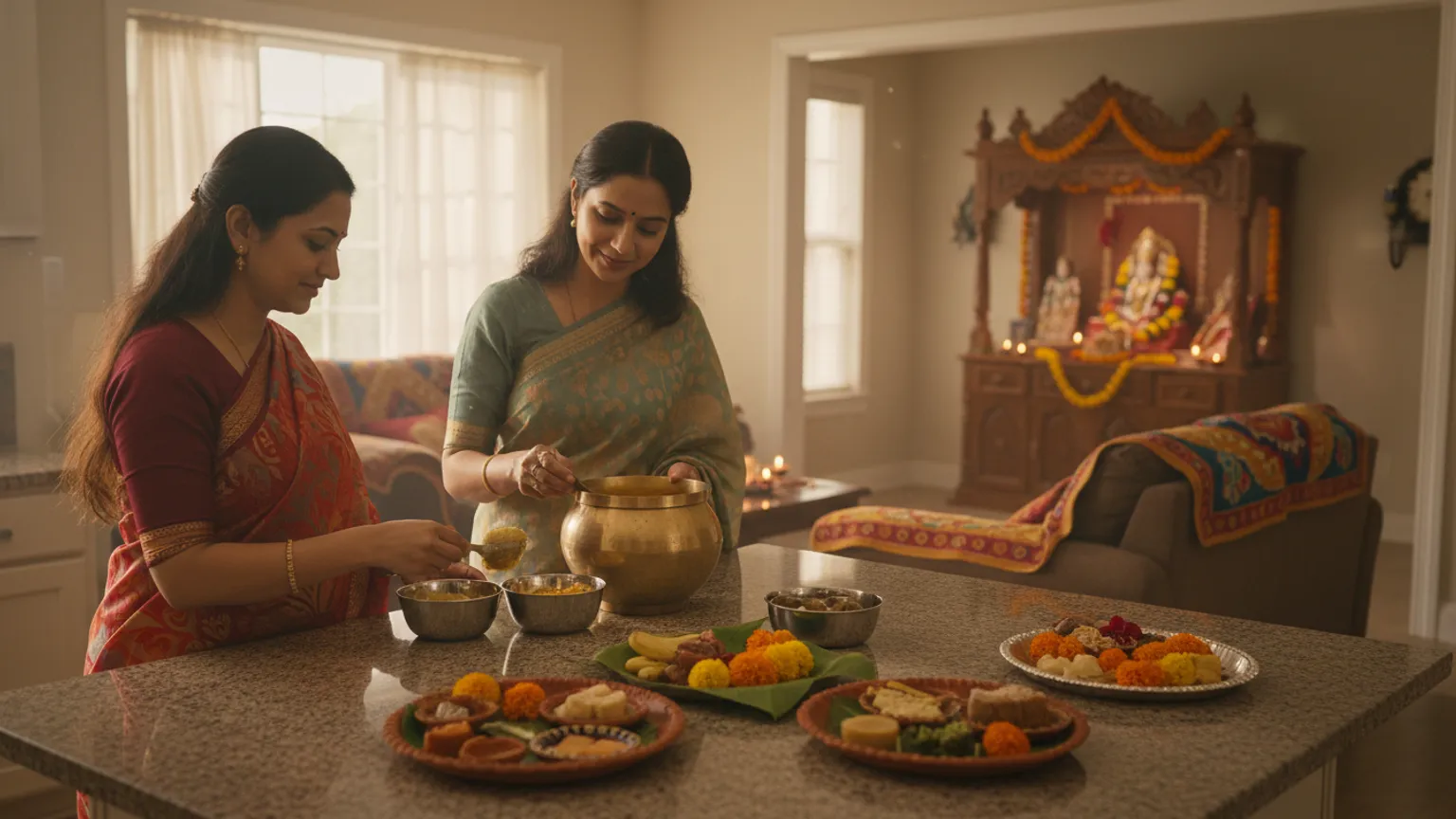
The first big puja I catered for myself — not the pandit, not the halwai, me with a calculator — was my father's retirement Satyanarayan katha and lunch. I did what most first-timers do: I looked at my guest list, saw "around 60 log", told the caterer "make for 60", and felt organised. On the day, 74 people came, the sheera ran out by the second batch of prasad, and my mother quietly sent someone to the market for more sooji and ghee while the aarti was still going. Nobody complained. But I saw the look on her face, and I never wanted to see it again.
That morning taught me something no invitation guide had: the guest count is not the catering number. There's a whole layer of arithmetic between "how many are coming" and "how much to make", and in a puja it splits two ways at once — the prasad that touches everyone, and the meal that only some stay for. This guide is the math I wish I'd had. Per-person quantities, a table you can act on tonight, the messages that get you an honest headcount, and — just as important — when to stop calculating and trust a notebook.
Prasad and the meal are two different counts
The single mistake I keep seeing is treating a puja like a party with one headcount. It isn't. A home puja has two audiences with two completely different sizes.
Prasad reaches the wider circle. Everyone who steps in for darshan takes prasad. Neighbours who drop by for ten minutes, the guard, the kids sent up with a bowl, the aunty who "bas prasad lene aayi thi" — they all count for prasad and none of them count for lunch. Prasad also travels: one katha guest carries a portion home for the mother-in-law who couldn't come. So the prasad number is almost always bigger than your invite list, and it's the one people quietly judge you on. Prasad khatam ho jaana feels worse than any other shortfall.
The meal reaches the smaller, committed circle. Lunch or dinner is for the people who actually sit down and stay. That's a firmer, smaller number, and it's the one your caterer bills you for. This is where over-ordering burns real money and under-ordering embarrasses you at the buffet.
Once you hold these as two separate numbers, everything gets calmer. You make prasad generously by a rule of thumb, and you count the meal carefully because it costs.
The per-person quantities I actually use
Here's the table I keep in my notes, built from years of home functions and a lot of asking halwais "isme kitne log kha lenge". Treat these as sensible starting points for a home puja with a proper lunch — adjust for your family's appetite and your region. Quantities are the finished, ready-to-serve amount per person.
| Item | Per-person quantity | Notes |
|---|---|---|
| Sheera / halwa prasad | 40–50 g | Make for your prasad count, not your lunch count. Round up. |
| Panjiri / dry prasad | 25–30 g | Travels well; good for the "carry home" portions. |
| Rice (for lunch) | 60–70 g uncooked | Cooked roughly triples. Pulao eats more; plain rice less. |
| Dal | 120–150 ml cooked | One good serving plus a top-up. |
| One sabzi | 100–120 g | Two sabzis? Roughly 80 g each, not 120 each. |
| Roti / puri | 3–4 pieces | Puris go faster than you think at a puja — people take extra. |
| Raita / curd | 60–70 g | |
| Sweet (meal, e.g. gulab jamun) | 2 pieces | Separate from the prasad sweet. |
| Water / soft drink | 300–400 ml | Higher in summer; a katha in May is a lot of thirst. |
Two things this table quietly fixes. First, when you serve two sabzis instead of one, you don't double the total — people eat about the same amount of food, just split across dishes. First-timers order 120 g of each and end up with trays of leftovers. Second, the sweet in the meal is separate from the prasad sweet; don't let the caterer fold them into one number, because the prasad has to serve the bigger circle.
Turn your headcount into two numbers
Here's the actual working, using round figures so you can follow the method, not memorise a result.
Say your firm lunch count is 60 adults and 12 children. Children eat roughly half an adult portion, so your meal number is about 66 "adult equivalents" — I plan food for 66, not 72, and not 60. For rice that's 66 × 65 g ≈ 4.3 kg uncooked. For puris, 66 × 4 ≈ 265 pieces, and I'd tell the halwai 280 because puris vanish.
Now the prasad. Everyone who comes for lunch takes prasad, plus the darshan-only crowd — the neighbours, the evening drop-ins, the staff, the travelling portions. On our functions that "extra" runs 20–40 people beyond the lunch list. So if 66 are eating, I make sheera prasad for about 95–100. That's 100 × 45 g ≈ 4.5 kg of finished sheera. It sounds like a lot until the aarti ends and you watch how fast a room clears a prasad tray.
The rule I live by now: count the meal, estimate the prasad up. Precision where it costs you money, generosity where it costs you a few hundred rupees and saves your family's face.
Getting an honest headcount (the hard part)
All the math above is worthless if your headcount is a guess. And a puja headcount is genuinely hard to pin down, because the two most common answers in Indian hosting — "dekhte hain" and "aayenge na, zaroor" — are both worth roughly half a person until confirmed. The caterer, meanwhile, wants a real number 24–48 hours out.
The fix isn't nagging. It's asking a specific, binary question with a reason attached. "Aa rahe ho?" invites a soft answer. "Lunch ke liye plate laga dein? Caterer ko aaj count dena hai" invites a yes or no, because you've made the cost of vagueness visible. Attaching the caterer to the deadline does most of the work — people don't want to be the reason food runs short.
Here are the messages I actually send. Copy, edit the timings and names, send to individuals, never a group.
Template 1 — first ask, with the meal question built in (Hinglish)
Namaste 🙏 Sunday, 2nd ko ghar par Satyanarayan katha rakhi hai. Katha & aarti: subah 10:30 se. Lunch: 1 baje se, ghar ka satvik khaana.
Sirf plate count ke liye pooch rahe hoon — aap kitne log lunch ke liye aa rahe hain? (Bacchon ka bhi bata dena.) Caterer ko Friday tak number dena hai.
Template 2 — the 48-hour nudge for non-responders (Hinglish)
Bhaiya bas ek chhoti si confirm karni thi 🙏 Kal caterer ko final count de raha hoon — aap kitne log lunch pe aa rahe ho? Sirf ek number bata do, plate ready rakhenge.
Template 3 — for elders, phone-first and warm (Hindi)
आदरणीय ताऊजी, रविवार को कथा एवं भोजन का आयोजन है। आप कितने सदस्य भोजन के लिए पधार रहे हैं, बस इतना बता दीजिए ताकि व्यवस्था ठीक से हो सके। आपका आना ही हमारे लिए सौभाग्य है।
Template 4 — the darshan-only invite (keeps them off the lunch count)
Aa nahi paaoge lunch pe? Koi baat nahi 🙏 Shaam ko darshan ke liye aa jaana, prasad zaroor le ke jaana. 5 se 7 baje tak ghar par hi hain.
That last one is doing quiet math for you. By offering an evening darshan-and-prasad window, you move the "maybe" people out of your expensive lunch count and into your cheap prasad count — exactly where they belong. The person feels warmly included, and your plate number stays honest.
Chasing soft answers is its own small art, and I've written the full playbook on it in why guests don't RSVP — the same tactics apply doubly when a caterer's cut-off is looming.
A headcount-to-kitchen checklist
Run this the day you have to give the caterer a number.
- Split your list into two columns: "eating lunch" and "darshan + prasad only." These are your two counts.
- Convert children to half portions for the meal number, not the prasad number (kids eat prasad like adults do).
- Add a prasad buffer of 20–40 for drop-ins, staff, and carry-home portions.
- Give the caterer the lunch number; give your kitchen the prasad number. Don't mix them.
- Confirm the puri/sheera items separately — these are the two things that always run short first.
- Ask the caterer their own buffer. Good ones already pad by 5–10%; you don't want to pad on top and pay twice.
- Keep one "extra sooji, ghee, sugar" kit at home so a prasad top-up is a stir, not a market run mid-aarti.
- Lock the number 24 hours out, not on the morning. A same-day change is where caterers charge or shrug.
When to stop calculating
Here's the honest part. For a small home katha — family plus a handful of neighbours, say fifteen people eating — none of this math matters. Your mother already knows how much sheera fifteen people eat, better than any table I can give you. Make a little extra, deliver prasad to the floor, done. No spreadsheet, no app, no headcount messages. Reaching for a tool here is like using a weighing scale to measure a pinch of salt.
The math earns its keep when the numbers get big and uncertain at the same time — forty-plus people across relatives, friends and neighbours, spread over a morning puja and an evening open house, where a wrong count costs real money or real embarrassment. That's the zone where holding two honest, live numbers actually beats memory. This is closely tied to how a griha pravesh splits its guests into waves and timings — the griha pravesh invitation guide walks through that wave structure, and it maps neatly onto separating your lunch count from your darshan count.
And the containment side — keeping a home puja from accidentally becoming a society-wide event that blows your prasad math apart — is its own skill; I covered it in the Satyanarayan katha at home guide.
If you are in the big-and-uncertain zone and tired of tallying "yes lunch / no / evening only" across three chat windows, that's the exact split we built Inyeet around: each guest gets their own link over your WhatsApp, marks whether they're coming and for how many, and a live dashboard holds the running count so you're reading a number instead of re-scrolling messages the night before. You can see the flow on how it works or get the app free. For a fifteen-person living-room katha, though — skip it, and trust your mother's estimate.
FAQ
How much prasad should I make per person?
For a distributed sweet prasad like sheera or halwa, 40–50 g of finished prasad per person is a comfortable serving. Crucially, calculate it against your prasad count — everyone who comes for darshan plus a buffer for drop-ins and carry-home portions — not your smaller lunch count. Running out of prasad feels worse than any other shortfall, so round up.
Why is my catering count different from my guest count?
Because a puja has two audiences. Prasad reaches everyone who steps in, including short darshan visits and portions carried home, so that number runs above your invite list. The meal only reaches people who sit and stay, which is smaller and firmer. Bill your caterer against the meal count; make prasad against the larger one.
How do I get people to confirm before the caterer's deadline?
Ask a specific, binary question and attach the reason: "Kitne log lunch ke liye aa rahe ho? Caterer ko kal count dena hai." Naming the deadline and the caterer makes vagueness feel costly, which nudges a real answer. For anyone still soft, offer an evening darshan-and-prasad window so they move off your expensive lunch count without any awkwardness.
The one thing to take away: a puja is two counts, not one. Make prasad generously against the wider darshan circle, and count the meal carefully against the people who actually stay — because that's the number your caterer bills. Get those two numbers honest, and nobody sends anyone to the market while the aarti is still going.
Related reading
Caterer count tiers: how a 20-guest error can cost ₹15,000
Caterers price in slabs, not per head. Here's how a 20-guest estimate error quietly costs thousands — plus the plate math and RSVP messages that fix it.
The forwarded-invite problem: who's actually coming to your event?
One invite you sent to 40 people quietly reaches 200. Why WhatsApp forwarding breaks your headcount — and how to keep an honest guest list without seeming rude.
When guests bring extra people: preventing the +4 surprise politely
The 'haan aa rahe hain' that quietly becomes six people. How to ask headcount without sounding stingy — with WhatsApp scripts, a table and a checklist.