
Society Ganpati versus home Ganpati: how the guest list changes
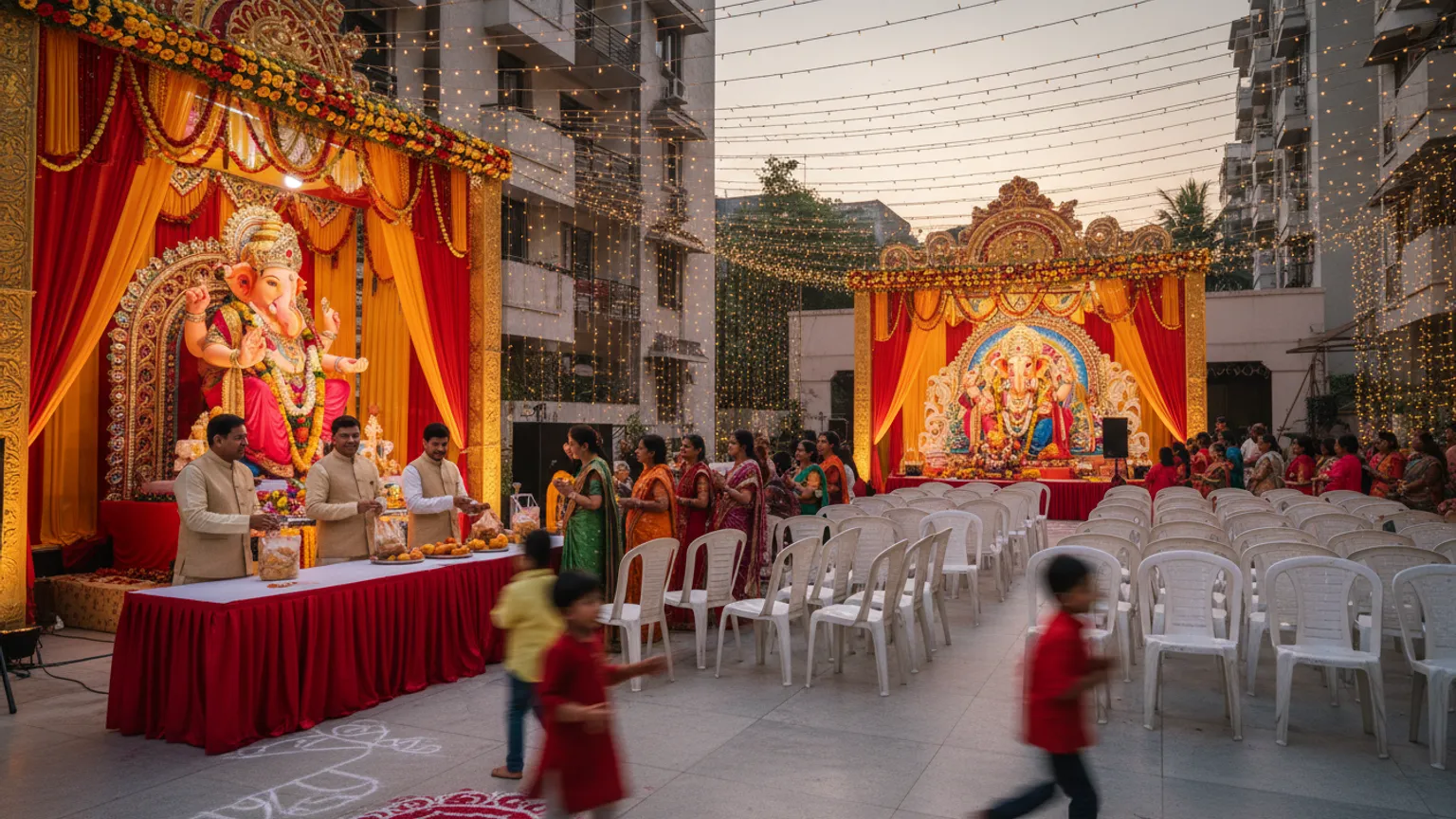
For four years our Ganpati was a home Ganpati — dedh din, my mother's sheera, forty-odd people I could name, a guest list that lived in my head. Then the year we moved into a bigger society, I made the mistake of nodding when someone asked if I'd "help with the mandal." By the second meeting I was holding a register of ninety-two flats, a contribution sheet, a volunteer roster and a cultural-programme schedule — and I understood, too late, that a society Ganpati is not a bigger home Ganpati. It is a completely different job.
The thing nobody tells a first-time committee member is that the whole shape of your guest management flips. At home, you own a guest list — a set of people you invite, and roughly that set arrives. In a society, there is no guest list at all. This guide is about that flip, dimension by dimension, so that whichever one you're doing this year, you plan for the right job.
The one idea: a list you own versus a crowd you coordinate
A home Ganpati is a guest-list problem. You decide who to tell, count households, and plan prasad, seating and door duty for the people you chose. The boundary of the event is your own address book — if you don't tell someone, they don't come. I've written the whole method — counting households, weighting for how people cluster onto the weekend — in estimating daily footfall at home.
A society Ganpati is a coordination problem wearing a guest-list costume. Nobody is "invited" — every resident already has the right to walk up to the pandal. What you actually manage is four separate lists, none of which is a guest list:
- The membership — every flat, because every flat is both a potential visitor and a potential contributor.
- The contributors (vanti / chanda) — who has paid toward the pandal, and who still needs a nudge.
- The volunteers — who is doing aarti, decoration, sound, prasad counter, visarjan procession, cleanup.
- The programme RSVPs — for the ticketed or seat-limited bits: the cultural night, the mahaprasad / bhandara, a satyanarayan katha with a sit-down meal.
A home host who tries to run a society Ganpati like a bigger guest list drowns. A committee member who tries to run a home Ganpati like a mandal turns a warm evening into a spreadsheet. Getting the job right starts with knowing which one you're in.
The two jobs, side by side
Here is the whole flip in one table. Read down the column that's yours this year.
| Dimension | Home Ganpati | Society Ganpati |
|---|---|---|
| Who "attends" | People you personally invited | Every resident, by right — plus their guests |
| The core list | One guest list (households you chose) | Four lists: members, contributors, volunteers, programme RSVPs |
| Headcount basis | Households × heads-per-circle | Flats × occupancy, plus an open public buffer |
| What "yes" means | This family is coming to my house | Almost nothing — attendance is assumed, not confirmed |
| Prasad / bhog | You cook or order for your footfall | Committee arranges bulk; per-plate math for the mahaprasad |
| Money | You pay for everything, silently | Contributions collected flat-by-flat; tracked and shown |
| RSVP that matters | Lunch / darshan-day count | Only the seat-limited events (cultural night, bhandara) |
| The hard part | Guessing who turns up | Chasing contributions and filling volunteer slots |
| Visarjan | Your family carries Bappa | A procession to marshal — route, time, vehicle, cleanup |
The two columns barely rhyme. The home column is about estimating an uncertain crowd; the society column is about administering a known membership. Same festival, opposite skill.
If it's a home Ganpati: it's still a guest list
Good news — you already know how to do this, it's just Ganpati-shaped. Decide your circles, invite them in waves, plan for the day the crowd actually clusters on. Three Ganpati-specific things to keep in mind:
- Darshan spreads across days; a guest list doesn't. Unlike a wedding where everyone comes to one slot, guests pick their own evening. So your "guest list" isn't really who — it's who, on which day. The choreography of nudging different circles toward different days is in managing darshan timings across the festival.
- Prasad runs per-day, not per-total. Count each day separately. The prasad and bhog math — including why your prasad count runs above your visitor count, because portions travel home — is the number that saves you.
- Neighbours are a buffer, not a list. You can't invite-count your building; estimate the aarti drop-ins as a lump. That single society-style buffer is the one place a home host borrows from the mandal playbook.
If your home Ganpati is small and familiar — dedh din, twenty people you speak to every week — skip all method and just make extra sheera. Estimation earns its place only when the crowd is both large and uncertain.
If it's a society Ganpati: stop thinking "guest list"
Here's where committee first-timers waste the most energy — trying to build one master list of "who's coming." You can't, and you don't need to. Nobody RSVPs to a pandal in their own compound. Replace the guest-list instinct with four smaller, sharper jobs.
1. The membership list is your spine, not your guest list. Start from the society's flat register — every flat, owner and tenant. You are not asking them "are you coming." You use this list to collect contributions, recruit volunteers, and push programme announcements. It's an address book for coordination, not an invite list.
2. Track contributions like the money it is. This is the genuinely hard part, and the one that breeds committee resentment every year. Someone has to know which flats have paid the vanti and which haven't, and chase the rest without turning it into a fight. Keep it visible — a simple flat-number-and-status list the whole committee can see beats one person's memory. A public "collected / still pending" number, updated honestly, does more for goodwill than any reminder message.
3. Volunteers are slots to fill, not bodies to count. Break the ten days into named roles and shifts — aarti, decoration, sound, prasad counter, cultural-night setup, visarjan marshals, cleanup. Then fill the grid. The failure mode is a group message saying "volunteers needed 🙏" that everyone reads and nobody answers. Name the slot and ask a specific person; a filled grid is worth ten broadcasts.
4. RSVP only for the seat-limited events. This is the only place a society Ganpati has a real RSVP: the cultural night with limited chairs, the mahaprasad or bhandara where the caterer needs a plate count, a sit-down satyanarayan katha. For these, and only these, you need a firm headcount by a deadline. The pandal itself never does. If your society is also doing a Dahi Handi in the same window, the same coordination muscles apply — that's in coordinating the society Dahi Handi gathering.
Notice what just happened: the overwhelming "who's coming to our society Ganpati" dissolved into four bounded jobs, only one of which even needs a headcount.
The messages, for each job
Templates you can copy tonight. Edit the names, flat numbers and dates. Send to individuals or the right group — never one blast for everything.
Home Ganpati — the day-asking invite (Hinglish)
Ganpati Bappa Morya! 🙏 Is saal Bappa humaare ghar aaye hain, [dates]. Aarti roz shaam 7:30 baje.
Aap kis din darshan ke liye aa rahe ho aur kitne log — bas itna bata dena taaki prasad us hisaab se ready rakhein. Flat 203, [society], visitor parking available. 🌺
Society — the contribution (vanti) ask, per flat (Hinglish)
Namaste 🙏 [Society] Ganeshotsav ke liye is saal ki vanti ₹[amount] per flat rakhi gayi hai (pandal, decoration, sound, prasad, visarjan sab milaakar).
Aap [Flat no.] se contribution GPay [number] par ya [volunteer] ko de sakte hain. Har flat ka status committee sheet par update hota rahega — transparency ke liye. Dhanyavaad!
Society — the volunteer slot ask, to a named person (Hinglish)
[Name] bhai/didi, ek chhota sa favour 🙏 — [date] shaam ki aarti aur prasad counter ke liye do log chahiye, 7 se 8:30. Aap us slot ke liye ho paoge? Grid par aapka naam likh doon toh confirm samjhein. Baaki din free hain aapke.
Society — the seat-limited programme RSVP (Hinglish)
🎉 [Society] Ganeshotsav — Cultural Night, [date] 7:30 PM, community hall.
Seating limited hai, isliye per-flat headcount chahiye. Aapke flat se kitne log aa rahe hain — bas ek number reply kar dena [date] tak, taaki chairs aur mahaprasad ka count sahi rahe. 🙏
The home template asks which day and how many. The society templates never ask "are you coming" — they ask for money, for a shift, or for a plate count. That's the whole difference, in one screen of messages.
A committee-side checklist
Run this if you're on the mandal this year.
- Membership pulled from the society flat register (owners + tenants)
- Vanti amount fixed and announced with what it covers
- Contribution status tracked flat-by-flat, visible to the whole committee
- A public "collected / pending" figure updated honestly through the ten days
- Volunteer grid built as named roles × shifts, then filled by asking specific people
- Seat-limited events (cultural night, mahaprasad) given a real RSVP deadline
- Mahaprasad / bhandara plate count locked with the caterer 48 hours out
- Visarjan route, time, vehicle and marshals assigned; cleanup crew named before visarjan
Only two lines on that list are about headcount. The rest is coordination — which is exactly why a society Ganpati is a different job.
When you're doing both (the hybrid trap)
Plenty of people run a small home Ganpati and sit on the society committee — the dedh-din Bappa upstairs, the ten-day pandal downstairs. The mistake is letting the two bleed into one exhausted to-do list. Keep them in separate boxes: the home one is your family's guest list, small and warm; the society one is a shared administrative job with a team. Your relatives coming for home darshan are not the society's problem, and the vanti register has no business in your own aarti. Two jobs, two lists, two hats — worn on purpose, not at once.
Where a tool helps, and where it doesn't
Honest version first: if you're doing a quiet home Ganpati for twenty people you know, you need nothing but your phone and your mother's estimate of how much sheera to make. No app, including ours.
The society side is where tracking earns its place — there you genuinely have four lists to hold, and a WhatsApp scroll is the wrong tool for a contribution register or a volunteer grid that ten people need to see. A shared, visible status — who's paid, which slots are filled, how many RSVP'd for the cultural night — is what stops a committee from re-counting the same numbers in six different chats. That live shared count is what we built Inyeet to hold; if a big-society Ganeshotsav is your job this year, join the early-access list. If a home Ganpati and a good guess are doing the work, keep them — genuinely.
FAQ
Is a society Ganpati just a bigger home Ganpati?
No — it's a different job. A home Ganpati is a guest-list problem: you invite people and roughly that set arrives. A society Ganpati has no guest list; every resident attends by right. What you manage instead is a membership register, a contribution list, a volunteer roster and RSVPs for the seat-limited events. The skill flips from estimating a crowd to administering a membership.
Do residents need to RSVP for a society Ganpati?
Not to the pandal — attendance there is open and assumed. The only real RSVP is for seat-limited events: the cultural night with fixed chairs, or a mahaprasad where the caterer needs a plate count. For those, ask each flat for a number by a firm deadline. Everything else, skip the headcount.
What's the hardest part of running a society Ganpati?
Neither hard part is attendance. First, tracking contributions flat-by-flat without it turning into resentment — which is why a visible, honest "collected / pending" status matters so much. Second, filling volunteer slots: name a specific role and shift and ask a specific person, never broadcast "volunteers needed" to a group where everyone assumes someone else will answer.
The one thing to take away: a home Ganpati is a guest list you own; a society Ganpati is a membership you coordinate. Don't run either like the other. At home, count households and plan per day. On the committee, drop the guest-list instinct entirely and run four smaller jobs — members, contributions, volunteers, and RSVPs for the seat-limited events only. Ganpati Bappa Morya.
Related reading

How many people come for Ganpati darshan: estimating daily footfall at home
How many people actually come for Ganpati darshan? A host's method to estimate daily footfall at home, a per-day forecast table, and templates to gauge it.

Caterer count tiers: how a 20-guest error can cost ₹15,000
Caterers price in slabs, not per head. Here's how a 20-guest estimate error quietly costs thousands — plus the plate math and RSVP messages that fix it.
The forwarded-invite problem: who's actually coming to your event?
One invite you sent to 40 people quietly reaches 200. Why WhatsApp forwarding breaks your headcount — and how to keep an honest guest list without seeming rude.