
Ganpati sthapana invites: managing darshan timings across three days
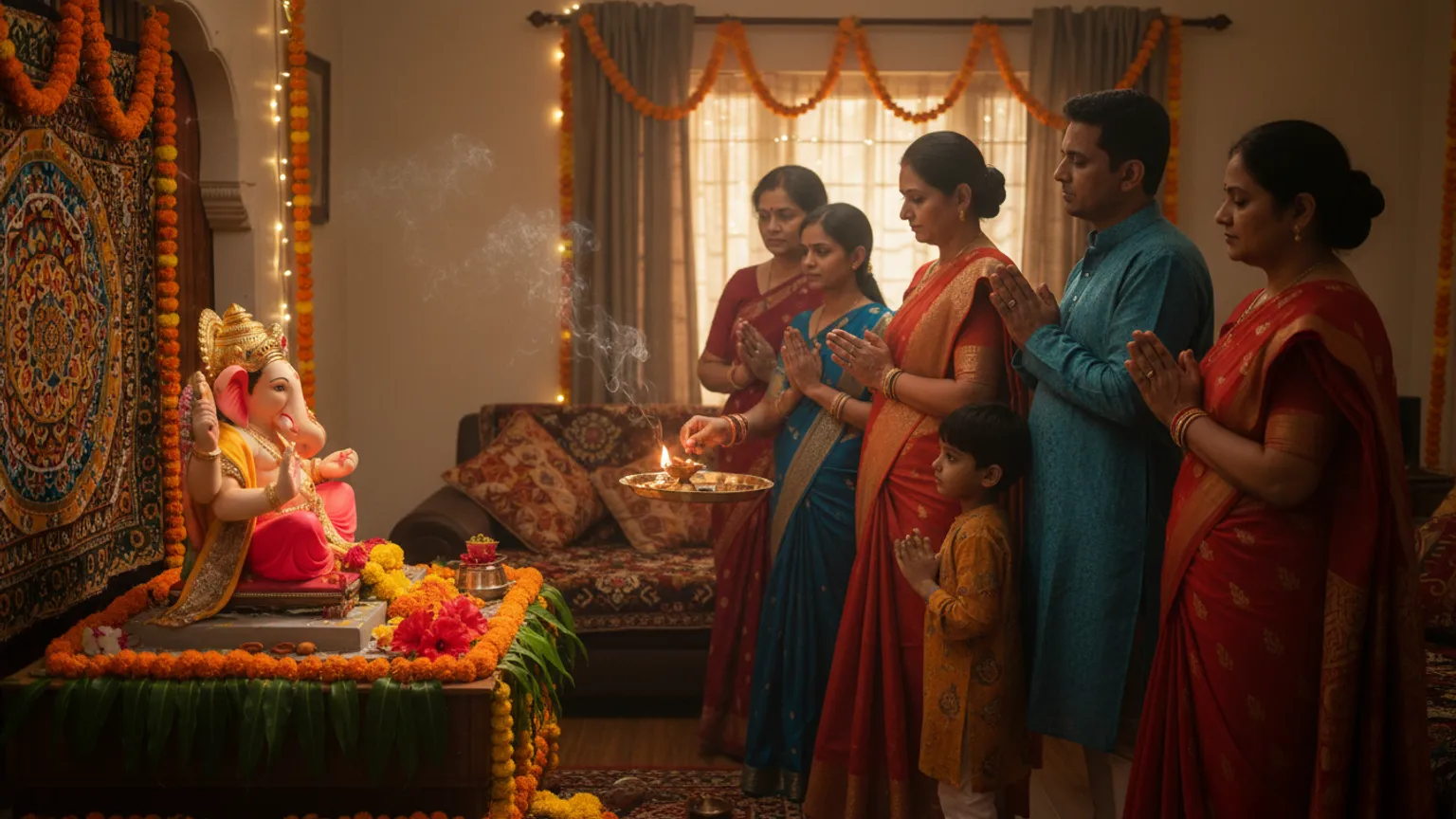
The first year we brought Bappa home for three days, I made a mistake so simple I still laugh about it. I sent one message to everyone — family, friends, neighbours, my office group — saying "Ganpati aa gaye hain, ghar aa jaao, darshan kar lena." I meant it warmly. What I got was Saturday evening, day one, with forty-two people trying to fit into a living room built for twelve, three aunties waiting for aarti that had already happened at 7, and my wife doing modak duty for a crowd we had food for on paper but not on plates.
Meanwhile Sunday and Monday — the two other days Bappa was with us — the house was nearly empty. Everyone had come at once, on the same evening, because that's the only signal my message had given them.
That's the whole problem with a multi-day Ganpati at home. It isn't like a wedding with one date and one venue. Bappa is in your house for three days, which means darshan is a window, not an event — and if you don't gently spread people across that window, everyone defaults to the first evening. This guide is how I choreograph three days of darshan now: who I point to which day, how I write the aarti timings so nobody misses them, and the exact WhatsApp messages that do the spreading for me.
The three-day mindset: darshan is a window, not a slot
When Bappa comes for a day and a half, you have one big evening and you plan for a crowd. But three, five, or seven days changes the math completely. You now have several aarti slots, morning and evening, across multiple days — and your job as host is to think of them as lanes to distribute traffic into, not one finish line everyone races toward.
Here's the reframe that fixed it for me: I stopped inviting people to "Ganpati" and started inviting them to a day. Not "come for darshan" but "Sunday evening ki aarti ke liye aa jaao." The moment your message names a specific day and aarti, people slot themselves in — and they spread out naturally, because you've given different people different days.
Three practical reasons this matters more than it sounds:
- Your living room has a real capacity. A home Ganpati happens where you live, not in a hall. Twelve people comfortably, twenty in a squeeze. Spreading darshan across days is the only way a small flat hosts eighty people over three days without one terrifying evening.
- Aarti is the anchor everyone actually wants. Most guests aren't coming for a two-hour visit. They want to be there for the aarti, take prasad, do darshan, and head home. If they don't know the aarti time, they arrive at random and miss the one moment they came for.
- Prasad and modak run on a per-day count, not a total. You make fresh prasad each day. Knowing roughly how many are coming which day is what keeps you from making 80 modaks for Saturday and 10 for Monday.
Map your circles to your days
Before I send a single message, I split the guest list the same way I would for any home puja — but then I assign each circle a preferred day. This is the core move. You are not telling people they can't come another day; you're giving each group a default so the load spreads on its own.
Here's how I think about it for a standard three-day Ganpati:
| Day | Aarti slot I point them to | Circle I nudge toward this day | Why |
|---|---|---|---|
| Day 1 (sthapana day) | Evening aarti after pran pratishtha | Immediate family, the relatives who help with setup, one or two closest friends | Day 1 is emotional and busy with the sthapana itself — keep it to the people who are part of it, not a full house. |
| Day 2 | Morning aarti + evening aarti | Extended family, close friends, outstation folks who can only do one trip | The relaxed middle day. Most social visiting should land here — there's time, space, and a proper aarti both ends of the day. |
| Day 3 (visarjan day) | Morning aarti before visarjan | Neighbours, society friends, colleagues, anyone local who just wants a quick darshan | Day 3 has a natural deadline (visarjan), so a "morning darshan se pehle aa jaana" invite works beautifully for drop-in local guests. |
A note from experience: don't over-engineer this. You're not running an airline. If your favourite cousin can only come Saturday with everyone else, that's fine — the goal is to tilt the crowd across three days, not to police it. Even shifting a third of your guests off day one turns chaos into a warm, full-but-breathing house.
What every Ganpati darshan invite must carry
Whether it's a designer card photo or a plain text, the same missing details cause the same repeat calls. Put these in:
- The specific aarti timings — both slots. "Subah ki aarti 8:00 AM, shaam ki aarti 7:30 PM." This one line prevents ninety percent of "kitne baje aayein?" messages.
- Which day you're nudging them toward — softly. "Sunday evening perfect rahega" is enough. It reads as a suggestion, not a rule.
- How many days Bappa is staying, so people know their options. "Bappa 3 din humaare saath hain (Sat–Mon)."
- Address with a landmark and a Maps pin. For neighbours this is a formality; for the friend coming across town it's everything.
- Parking, especially in a society. "Visitor parking basement mein, guard ko bata dena Roy ke ghar aaye ho."
- Visarjan timing on day three, if you want people to join the send-off. That procession is half the joy — invite people to it explicitly.
The WhatsApp templates I actually send
Edit the days, timings, and flat number, and send. Two soft rules I follow: send in circles (don't blast one message to all), and always name a day.
Template 1 — immediate family (day 1, sthapana)
Bappa ghar aa rahe hain! 🙏 Sthapana Saturday subah 10:30 baje muhurat par. Aap log family ho, toh subah se aa jaana — setup aur pran pratishtha mein saath rahoge toh maza aayega.
Shaam ki aarti: 7:30 PM. Address: Flat 203, Siddhi Apartments, Agarwal Sweets ke paas, basement parking. Bappa 3 din humaare saath hain (Sat–Mon), aaram se aana jaana.
Template 2 — extended family & friends (nudge to day 2)
Ganpati Bappa Morya! 🌺 Is saal Bappa 3 din humaare ghar (Sat–Mon). Hum sabko darshan ke liye bula rahe hain.
Sunday sabse acha rahega — aaram se milenge, khaana bhi banega. Aarti timings: subah 8:00 AM aur shaam 7:30 PM (kisi bhi aarti mein aa sakte ho).
Flat 203, Siddhi Apartments, opposite Agarwal Sweets. Maps pin: [paste link]. Visitor parking available. Bas ek line bata dena kis din aa rahe ho, taaki prasad ka count rakh sakein. 🙏
Template 3 — neighbours & colleagues (day 3, quick darshan)
Namaste! Humaare ghar Ganpati bithaaye hain is saal. Aapko darshan ke liye zaroor bulana tha.
Monday subah visarjan se pehle 8:00 AM ki aarti hai — jaldi darshan karke prasad le lena, 10 minute ka kaam. Flat 203, Siddhi Apartments (Dr. Sharma clinic wali building).
Aur agar visarjan mein saath chalna ho, hum 11 baje niklenge — bahut anand aata hai. 🙏
Template 4 — day-before nudge to your day-2 people (Hinglish)
Kal Bappa ke darshan ke liye aana hai, yaad hai na? Shaam 7:30 ki aarti best rahegi. Modak ready rahenge 😄 Agar plan Sunday ki jagah kisi aur din shift ho gaya ho toh bas ek message kar dena — count adjust kar lenge.
A darshan-day host checklist
Print this or save it. It's the list that keeps a three-day Ganpati from swallowing your whole week.
- Aarti timings finalised for all three days and written into every invite
- Guest list split into circles, each circle nudged toward a day
- Rough per-day headcount noted somewhere with columns — not the chat scroll
- Prasad/modak planned per day, not one big total (the per-day math is here)
- Parking line added for society/apartment guests
- Visarjan time and meeting point shared with anyone joining the procession
- Someone assigned to do aarti on time even if guests are late — you set the clock, not the crowd
The tracking honesty (and when you don't need an app)
Here's the part most guides skip. If you're doing a quiet home Ganpati and inviting fifteen people you speak to every week, you do not need any tool — including ours. A paper list on the fridge with three columns for three days works perfectly, and it's genuinely nicer.
The math changes when you're spreading eighty-plus people across three days and four aarti slots. That's when "kaun kis din aa raha hai" stops fitting in your head and the chat scroll actively lies to you — a "haan aayenge" from Tuesday tells you nothing about which day. This precise problem — many guests, several time windows, a live count per slot — is what we built Inyeet for: each guest gets a personal link over your own WhatsApp, picks the day they'll come, and you watch a live per-day dashboard instead of counting emojis. If that sounds useful you can get the app free; if a fridge list is doing the job, keep the fridge list.
One more hard-won note, the same one I make for every home puja: elders will call to confirm regardless of how clear your message is, and some will just show up on day one out of habit. Take it as a blessing, mark them down, and adjust. The point of spreading darshan across three days isn't control — it's so that on each of those three evenings, when the aarti thali goes around and the whole room sings Sukhkarta Dukhharta together, there's actually room to stand, sing, and mean it.
For the wider etiquette of inviting neighbours to a home puja without accidentally opening it to all eighty flats, I've written a full piece on the Satyanarayan katha society trap — the diplomacy there applies almost exactly to Ganpati.
Ganpati Bappa Morya. May your house be full, your modaks plenty, and your aarti never rushed.
Related reading
Ganpati invitation message for WhatsApp: 50+ templates in Marathi, Hindi and English
Ready Ganpati invitation messages for every moment — sthapana, darshan, aarti, mahaprasad, Gauri and visarjan — in Marathi, Hindi and English, each written to get a countable reply instead of a thumbs-up.
Gauri aavahan: the day your Ganpati guest list doubles
Gauri brings married daughters and half the family back home mid-Ganpati — the day a host's guest list quietly doubles. A plan for who comes and feeding them.
Society Ganpati versus home Ganpati: how the guest list changes
Society Ganpati and home Ganpati are two different hosting jobs. How the guest list, headcount, prasad and coordination change between them, with templates.