
Navratri bhog and prasad quantities: planning nine days of aarti visitors
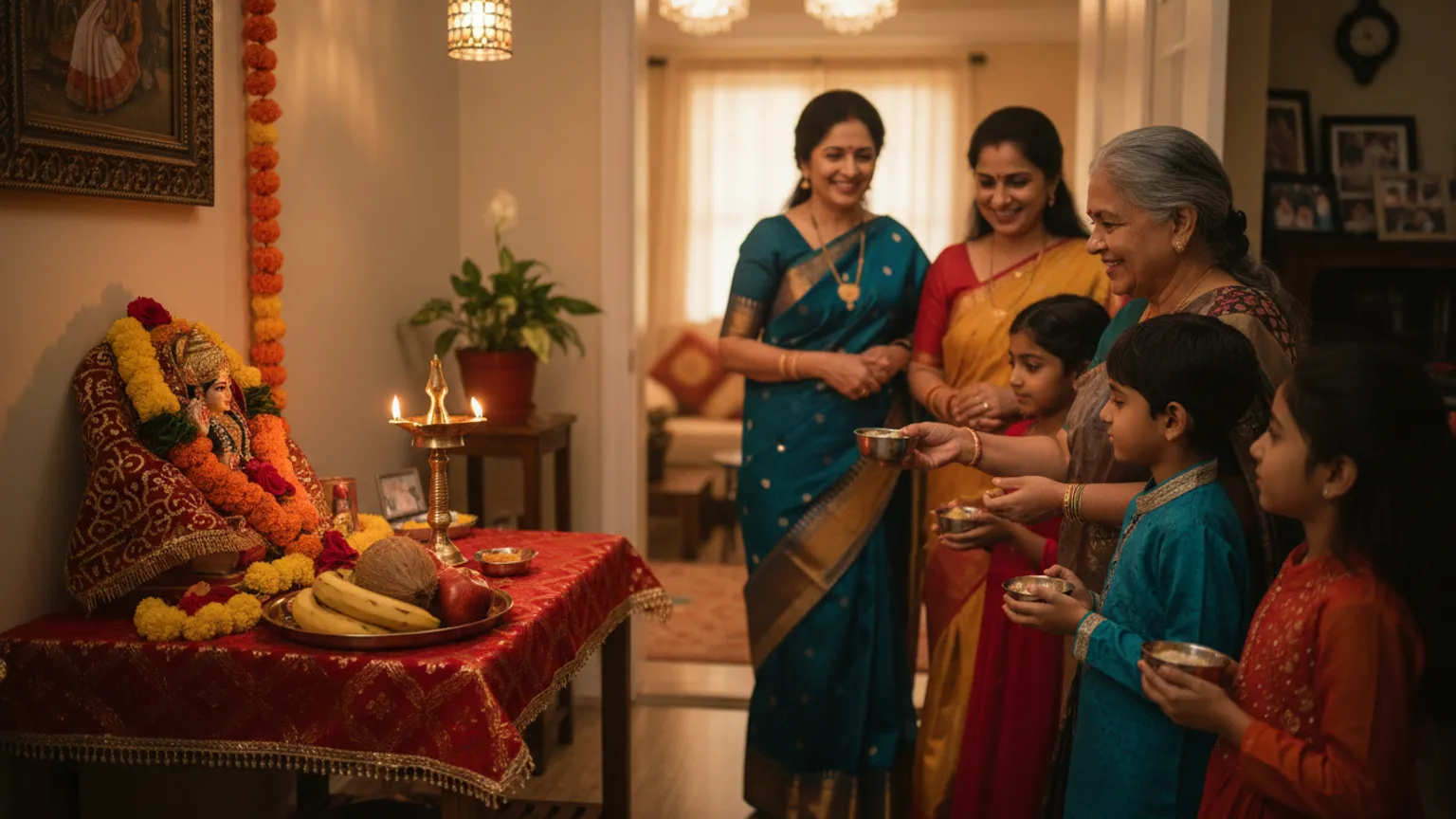
The first year we kept an akhand jyoti at home for all nine days of Navratri, I planned it like a party. I made a big batch of halwa on Pratipada, felt organised, and assumed the crowd would come, eat, and be done. What actually happened was gentler and much harder to plan for: three neighbours the first evening, nobody the second, my building's watchman and his kids the third, then a slow, unpredictable trickle every evening for nine days as word spread that "unke ghar jyoti jal rahi hai." By Panchami my halwa was stale and my improvising constant. My mother watched me and said, "yeh ek din ka kaam nahi hai, beta — roz thoda banana padega."
That is the whole difference. A Satyanarayan katha or a griha pravesh is one big day with one big number. Navratri, if you keep a ghat or a jyoti at home, is nine small days with nine small, shifting numbers — and the prasad math that works for a single event actively misleads you here. This is the guide I wish I'd had: how bhog and prasad are two separate quantities, a nine-day bhog pattern you can adapt, how much distributed prasad to plan per evening visitor, and the messages that turn a random trickle into a predictable window. If you haven't fixed which shape of Navratri your house is running this year, the nine-day calendar for hosts is here — settle that first, then plan the food against it.
Bhog and prasad are two different numbers
The mistake I made — and the one I still see most — is collapsing bhog and prasad into a single "kitna banana hai." They are two different jobs with two different sizes.
Bhog is the naivedya offered to the Devi. It is small, symbolic, and fixed by your family's tradition, not by your guest count. A katori of kheer, one coconut, a few pieces of fruit, a small thali of the day's offering placed before the idol during aarti. Whether one person comes for darshan or thirty, the bhog on the altar is roughly the same. You are cooking for the goddess, not the crowd.
Prasad is what you distribute afterwards. The halwa, panjiri, batasha or fruit that everyone who steps in for aarti carries away. This number moves every evening with your footfall, and it is the one that actually decides how much you cook.
Hold these apart and the nine days get calm. The bhog is a small, near-constant daily ritual you plan once for the whole navratra; the prasad is a variable you estimate evening by evening. Mix them up — cook "bhog for sixty" — and you either waste food or run the prasad tray dry while the aarti is still going, which during Navratri feels like a real failure of hospitality.
A nine-day bhog pattern you can adapt
Many North Indian households offer a different bhog to each of the nine forms of Durga across the navratra. The pattern below is a widely followed one, but I want to be honest: the associations vary by region, community and family, and some houses offer the same simple bhog every day. Treat this as a starting template to confirm with your elders, not a rule — the point of the table is to help you shop once for the whole festival rather than scramble each morning.
| Day | Devi form | A commonly offered bhog | What you actually buy/make |
|---|---|---|---|
| 1 (Pratipada) | Shailaputri | Desi ghee | A small tin of pure ghee |
| 2 (Dwitiya) | Brahmacharini | Sugar / mishri | Shakkar or mishri, a small bowl |
| 3 (Tritiya) | Chandraghanta | Kheer / milk | Milk kept aside; a katori of kheer |
| 4 (Chaturthi) | Kushmanda | Malpua | 2–4 small malpuas |
| 5 (Panchami) | Skandamata | Banana | A small bunch of kele |
| 6 (Shashthi) | Katyayani | Honey / laddoo | A jar of honey or a few laddoos |
| 7 (Saptami) | Kalaratri | Jaggery / gud | A piece of gud |
| 8 (Ashtami) | Mahagauri | Coconut / nariyal | One or two whole coconuts |
| 9 (Navami) | Siddhidatri | Halwa, puri, chana (with kanya pujan) | The kanya-pujan meal |
Two practical notes on this. First, most of these bhog items are tiny — you are placing a katori or a single fruit before the idol, not cooking a dish for the room. Buy the whole nine-day list in one shop and you have removed nine small daily errands. Second, Ashtami and Navami are the exception: that is when kanya pujan turns the bhog into a real meal for the little girls (puri, chana, halwa), and the quantities there are a different exercise entirely. I've written that one out separately — see how many girls to invite and what to prepare for kanya pujan — because it deserves its own math and doesn't belong in a daily-prasad table.
How much distributed prasad per aarti visitor
Now the number that moves: the prasad you hand out at each evening's aarti. These are the finished, ready-to-serve amounts I plan per visitor for a daily home aarti, where people come for ten minutes, take prasad, and leave — not a sit-down meal.
| Prasad item | Per visitor | Notes |
|---|---|---|
| Sooji halwa / sheera | 30–40 g | The daily workhorse; make fresh in small batches |
| Panjiri / dry prasad | 20–25 g | Travels well; good for carry-home portions |
| Batasha / mishri / dry sweet | 2–3 pieces | Near-zero effort, saves you on a heavy-footfall night |
| Fruit (banana, apple slice) | 1 piece | The safe fallback, and doubles as bhog |
| Chana / sundal (if you make it) | 2–3 tbsp | Common in South Indian and Gujarati homes |
Notice the quantities are smaller than a puja meal prasad — a darshan visitor at a daily aarti takes a token portion, not a katori-full. The trap is planning each evening like it's the big day. It isn't. Nine modest evenings and one or two big ones is the real shape, which brings us to the harder question: how many people actually come each night.
Estimating the daily footfall
There is no formula for this, and anyone who gives you one is guessing. But years of watching my own aarti and my neighbours' taught me the shape of the curve, even when the exact heads change. It is not flat. A modest home jyoti with an open evening aarti tends to run like this — illustrative planning figures, not a survey, just the rhythm I plan around:
| Days | Typical footfall | Why |
|---|---|---|
| Pratipada–Tritiya (1–3) | Low, family and a few neighbours | Word hasn't spread; weekday evenings are quiet |
| Chaturthi–Saptami (4–7) | Medium, building trickle | Regulars settle into a routine; one weekend evening spikes |
| Ashtami–Navami (8–9) | Peak | Kanya pujan, the biggest darshan nights, everyone comes |
The two levers that actually move an evening are the weekend and the last two days. An Ashtami on a Saturday is your single largest night; a Tritiya on a Tuesday might be six people. So I don't plan one number for all nine days — I plan small for the early weekday evenings, generous for the weekend, and I treat Ashtami and Navami as separate events with their own headcount. Under-making early costs nothing; over-making on day one gives you stale halwa by day three.
If your crowd is genuinely large and growing — a popular society jyoti with forty-plus some evenings — footfall stops being a food problem and becomes a containment one. I covered that side in managing daily footfall at a home darshan; it's written around Ganpati, but the drop-in dynamics are identical.
The base kit that turns a top-up into a stir
The one thing that made nine days sane for me was a small standing kit, so a busier-than-expected evening was a fresh batch, not a market run. Navratri prasad is made from a few staples, and one kit covers almost every top-up:
- Sooji, ghee, sugar — two extra halwa batches on hand, always.
- Batasha or a packet of dry sweet — the emergency prasad for the night twelve extra people arrive; you hand these out and nobody knows you were caught short.
- Fruit and a jar of dry panjiri made once, early — both keep, both double as carry-home portions.
Restocking mid-festival without panic is common enough that I wrote it up separately — restocking prasad mid-festival — but the short version is that a small home kit beats any day-of scrambling. And if some evening visitors are fasting, as many are during Navratri, their prasad has its own rules — sendha namak, no regular grains — so the usual halwa may not work for a strict faster. That question is its own guide: what to serve when half the room is on vrat.
Messages you can copy and send
The one thing that turns a random nine-day trickle into something you can plan for is telling people when the aarti is, so they come in a window instead of at random through the evening. And for Ashtami/Navami, getting an actual headcount for kanya pujan. Copy these, fix the timings, send to individuals or your building group as noted.
The nine-day aarti window, sent once to the building/family group (Hinglish):
Jai Mata Di 🙏 Is baar ghar pe akhand jyoti rakhi hai, poore nau din. Roz shaam ki aarti 7:00 baje hai — jo bhi darshan ke liye aana chahe, us time aa jaayein, prasad zaroor lena. Ashtami-Navami ka alag se bata denge.
The Ashtami / kanya pujan headcount ask, sent to individuals (Hinglish):
Ashtami [date] ko kanya pujan rakha hai, subah [time]. Aapke ghar se kitni kanya aur ek balak (langoor) bhej sakte hain? Bas count bata dijiye taaki puri-chana-halwa uss hisaab se ban jaaye 🙏
For elders, phone-first and warm (Hindi):
आदरणीया ताईजी, इस नवरात्रि घर पर अखंड ज्योति है। शाम की आरती सात बजे होती है — जब भी सुविधा हो, दर्शन के लिए अवश्य पधारिए। आपका आना ही आशीर्वाद है।
The first message is doing the real work: by naming a single aarti time, you convert nine evenings of "koi bhi kabhi bhi aa jaata hai" into a predictable half-hour when you actually need the prasad ready. You make one fresh batch at 6:45 instead of reheating stale halwa all evening. Chasing soft answers for the kanya-pujan count is its own art, and the tactics in why guests don't RSVP apply directly when you need a real number by Ashtami.
A nine-day prasad checklist
- Bought the whole nine-day bhog list in one shop — ghee, mishri, coconut, fruit, and the rest
- Confirmed the bhog pattern with your elders — associations vary by family and region
- Planned prasad small for early weekday evenings, generous for the weekend
- Treated Ashtami and Navami as separate events with their own headcount
- Got a kanya-pujan count by Saptami evening, per household
- Kept a base kit — sooji, ghee, sugar, batasha, fruit — for any top-up
- Made the dry panjiri once, early, for carry-home portions
- Sent the fixed aarti time so visitors come in a window
- Checked which visitors are fasting — their prasad has different rules
When not to overthink this
Here is the honest part, because Navratri does not need to become a logistics operation.
If your jyoti is a quiet family affair — you, your parents, and the same four neighbours every year — you need none of this. Your mother already knows how much halwa those four families take, and the "planning" is a bowl of fruit and a fresh katori of sheera at aarti time. Make a little extra, keep the fruit handy, and enjoy the nine days.
Where planning earns its place is the larger, looser jyoti — a society or extended-family setup where forty people pass through on Ashtami, the kanya-pujan count is scattered across three WhatsApp threads, and you can't tell whether Saturday's aarti is fifteen people or fifty. That is where holding a live count beats re-scrolling chat history, and it's the shape Inyeet is built for — each family confirms their kanya-pujan numbers on a private link and you read one total. For a bigger multi-family gathering it earns its keep; for the familiar aarti for four, your own memory already wins.
FAQ
How much prasad should I make for a daily Navratri aarti?
Plan roughly 30–40 g of a distributed sweet like halwa per visitor, plus fruit and a dry sweet like batasha as backup — but make it in small daily batches rather than one big batch, because footfall shifts every evening. Early weekday aartis are usually quiet; Ashtami, Navami and weekend evenings are the peaks. Keep a base kit of sooji, ghee and sugar at home so a busier night is a fresh batch, not a market run.
What is the difference between bhog and prasad in Navratri?
Bhog is the naivedya offered to the Devi during aarti — small, symbolic and fixed by tradition (a katori of kheer, a coconut, some fruit), the same whether one person or thirty comes. Prasad is what you distribute to visitors afterwards, and that quantity tracks your daily footfall. Plan the bhog once for the whole navratra; estimate the prasad evening by evening.
What bhog is offered on each of the nine days of Navratri?
A widely followed North Indian pattern offers ghee, sugar, kheer, malpua, banana, honey or laddoo, jaggery, coconut, and finally the kanya-pujan meal across days one to nine. But the associations vary by region and family, and many homes simply offer the same bhog daily — confirm the pattern with your own elders rather than treating any list as fixed.
Shubh Navratri — may your jyoti burn steady for all nine nights, your prasad tray never run dry at aarti, and no neighbour leave your door without something sweet in hand.
Related reading
Navratri fasting guests: what to serve when half the room is on vrat
A host's guide to feeding a mixed Navratri table: what vrat food actually allows, a falahari menu that works, quantities, and messages to ask who's fasting.

Kanya pujan 2026: how many girls to invite, what to prepare
Kanya pujan falls on Ashtami/Navami, 18–19 Oct 2026. A host's guide to how many girls to invite, the numbers that matter, and quantities to prepare.
Navratri 2026 dates and the nine-day plan for a home host
Navratri 2026 runs 11 to 20 October: the full nine-day tithi calendar, how hosting differs by tradition, and where guest-list pressure actually lands.