
Navratri fasting guests: what to serve when half the room is on vrat
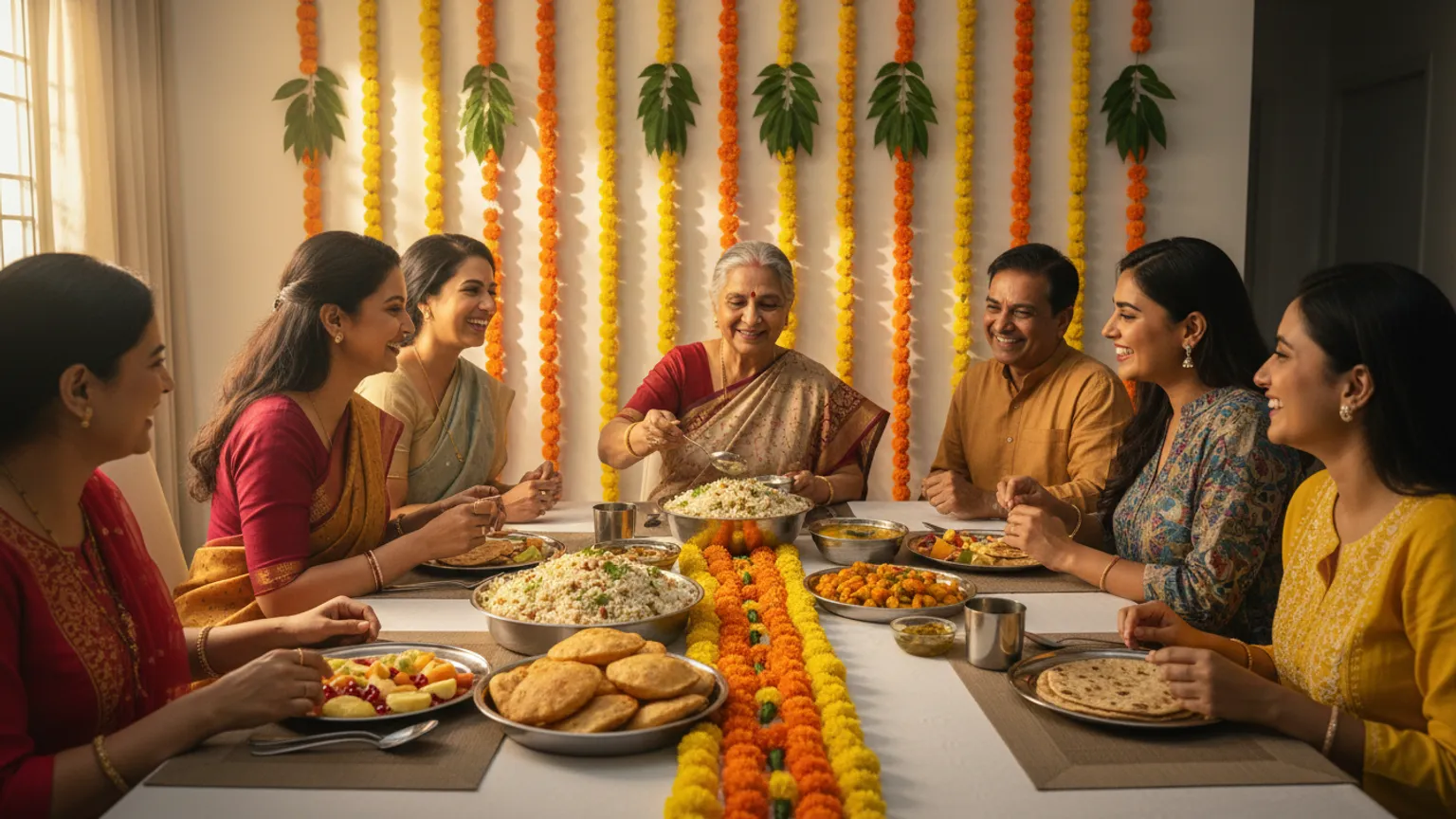
The first Navratri after my wife and I started hosting properly, I made a mistake I still think about. My bua was on a nine-day nirjala-by-day, phalahar-by-night vrat, the strict kind, and I'd proudly set aside a bowl of aloo sabzi for her. What I hadn't thought about was that the same aloo had been cooked in the regular pot, with regular namak and a chhaunk of onion, because that's how the rest of the sabzi was going out. She didn't say a word. She just quietly ate the fruit on the table and drank water, and it was my mother who pulled me aside later and said, "uske liye alag se nahi banaya tha kya?"
That's the whole problem in one sentence. On a normal day, feeding a house full of people is a quantity question. During Navratri, for the nights when half your guests are fasting, it becomes a rules question — and the rules are neither obvious nor the same for everyone at the table. This post is the one I wish I'd read before that dinner: what vrat food actually permits, a falahari spread that genuinely works for a crowd, how much of it to make, and how to serve it without an awkward moment. If you haven't settled which shape of Navratri your household is even running this year, the nine-day calendar and regional split is here — read that first, then come back to the food.
Why "are you fasting?" is not a yes-or-no question
The trap for a host is assuming vrat is one thing. It isn't. In the same room on Ashtami evening you can have:
- Someone on a nirjala vrat — no food or water until the fast breaks, then only phalahar.
- Someone eating phalahar (falahari) all day — vrat-permitted food, as much as they like.
- Someone fasting only on the first and last days, eating normally the rest.
- Someone who eats one normal meal and keeps the evening phalahari.
- Someone not fasting at all, who'd quite like a proper dinner.
And cutting across all of that: some families' vrat rules are strict (no turmeric, no onion-garlic, sendha namak only, no "regular" grains of any kind) and some are relaxed (tomatoes fine, normal tea fine). None of these people is wrong. They're just not on the same fast, and you cannot cook one dish that satisfies all of them. The honest first move, which I'll give you the exact words for later, is to ask per person what they're doing — never assume a couple fasts the same way, and never assume this year matches last year.
What vrat food actually allows
Before any menu, the rules. This is the North Indian falahari baseline most of my family follows; treat it as a starting point and confirm against your own guests' traditions, because regional and family variations are real.
| Allowed on most vrats | Avoided on most vrats |
|---|---|
| Sendha namak (rock salt) only | Regular table/iodised salt |
| Kuttu (buckwheat), singhara (water chestnut), rajgira (amaranth) flours | Wheat, maida, besan, all regular flours |
| Samak / sama ke chawal (barnyard millet) | Rice and all regular grains |
| Sabudana, makhana, peanuts, dry fruits | Dals and legumes (chana, rajma, moong) |
| Potato, sweet potato, arbi, lauki, pumpkin, raw banana | Onion and garlic |
| Fruit, milk, curd, paneer, ghee | Most masalas; many also skip haldi |
| Cumin, black pepper, green chilli, ginger, coriander leaf | Mustard oil (many prefer ghee or peanut oil) |
Two things on this table catch almost every first-time host off guard. The first is salt: a faster's entire plate has to be cooked in sendha namak, which means you can't just spoon the regular sabzi onto their plate — the salt itself breaks the vrat. The second is cross-contamination: one regular spoon dipped into the vrat bowl, one kuttu puri fried in the same oil as the onion pakoras, and a strict faster genuinely cannot eat it. The vrat food isn't just a separate recipe; it needs a separate corner of the kitchen.
A falahari menu that actually feeds a crowd
Here's the spread I now build around, grouped by what each dish does. The beauty of a good falahari table is that most of it is food non-fasting guests happily eat too — so you're not really cooking two full dinners, you're cooking one vrat-safe dinner and adding a couple of regular items for the people who want roti and dal.
| Course | Dish | Notes |
|---|---|---|
| The anchor (pick one or two) | Sabudana khichdi, samak rice pulao | Filling, crowd-friendly, reheats well |
| The "roti" | Kuttu ki puri, singhare ke atte ki puri | Fry these first, in clean oil, before anything with onion |
| The sabzi | Vrat wale aloo (jeera, sendha namak), lauki ki sabzi | Keep one dry, one with gravy |
| The fried treat | Sabudana vada, aloo tikki (sendha namak) | What kids and non-fasters raid first |
| Cooling side | Vrat wali curd, aloo raita with sendha namak | Balances the fried items |
| Sweet | Makhana kheer, sabudana kheer, rajgira ladoo | Doubles as prasad for many households |
| Fruit | Seasonal fruit chaat with sendha namak + black pepper | The safe fallback for the strictest faster |
Then, only if you have non-fasting guests, add a small regular track alongside — plain dal, a roti or rice, one normal sabzi. That's it. You do not need a full second menu; you need the falahari spread to be generous and complete on its own, with a couple of regular additions for the people who aren't fasting.
How much to make
Quantities for a falahari meal run a little higher per head than a normal one, for a reason nobody warns you about: fasting guests breaking a day-long vrat eat more than they would at a regular dinner, and the food is lighter, so it goes faster. Here's roughly what I plan per adult for a sit-down Navratri dinner:
| Item | Per fasting adult | For 15 guests (mixed) |
|---|---|---|
| Sabudana khichdi / samak pulao | 1 generous bowl (~200g cooked) | ~3 kg cooked |
| Kuttu / singhara puri | 4–5 pieces | ~60–70 pieces |
| Vrat aloo / lauki sabzi | 1 bowl | ~2 kg combined |
| Sabudana vada / tikki | 3–4 pieces | ~50 pieces |
| Curd / raita | 1 small bowl | ~1.5 kg |
| Kheer / sweet | 1 katori | ~2 litres |
| Fruit | 1 plate | 2–3 kg assorted |
For the "15 guests" column I've assumed most are eating phalahar — scale the regular dal-roti track to however many are not fasting, which is usually the smaller half. The single most common mistake is under-making the puris and vadas: they're the first things to disappear, fasting guest or not. Make more of those and slightly less of the heavy khichdi.
Serving it without an awkward moment
The cooking is half the job. The serving is where my bua's quiet dinner actually went wrong, and it's entirely avoidable.
- Label the sendha-namak dishes. A small folded-paper tent that says "vrat" on the vrat bowls removes all doubt for the faster and stops a well-meaning relative from mixing tracks.
- Give the vrat track its own serving spoons, and say so out loud once: "yeh saara vrat ka hai, alag chammach hai." A strict faster is watching for exactly this and will relax visibly when you mention it.
- Serve the fasters first, or set their corner of the table first, before the regular food comes out and the spoons start travelling.
- Fry vrat puris and vadas before the onion items, in clean oil. If you only have one kadhai, do the vrat frying first, full stop.
- Keep fruit and a sealed packet of dry fruit aside for the nirjala-by-day guest who may only want that — it's the one plate that's safe no matter how strict the vrat.
None of this is hard. It just has to be decided before the guests arrive, not improvised when someone's already sitting down in front of the wrong plate.
Messages you can copy and send
The whole thing hinges on knowing, a day or two out, who is fasting and how strictly. These are the lines that get a straight answer instead of a vague one.
Asking the family group, per person, without making it a big deal (Hinglish):
Is Navratri [date] ko ghar pe khaana rakha hai 🙏 Taaki sabke hisaab se bana sakein — zara bata dijiye aap log vrat pe hain ya nahi, aur agar hain toh phalahar chalega ya sirf fruit? Har ek ka alag bata dena, couples bhi — taaki kisi ko adjust na karna pade.
The one-line reconfirmation the evening before (Hinglish):
Kal ke liye bas confirm kar rahi hoon — [name] aap vrat pe rahenge kal? Sendha namak wala alag se bana rahe hain, toh count pakka karna hai.
For a guest you know keeps a very strict vrat, sent privately (Hindi):
नमस्ते। कल आपके लिए सेंधा नमक में अलग से बना रहे हैं, बर्तन और चम्मच भी अलग रखेंगे। अगर कुछ आप नहीं लेते — जैसे टमाटर या हल्दी — तो बता दीजिए, उसी हिसाब से रख लूँगी।
That last message does more than plan a plate. It tells a strict faster that their rules have been taken seriously, which is the actual hospitality here — the food is almost secondary. For the full system of asking and tracking food preferences across a larger gathering, including the Jain guest who needs both no-onion-garlic and no-root-vegetables, I've written the preference-tracking method separately.
When not to overthink this
Two honest notes to close, because the internet will happily tell you to turn a family dinner into a logistics operation.
If your Navratri gathering is six relatives who fast the same way every year and you already know exactly who takes sendha namak and who doesn't, you don't need a single message or a tracking sheet. You need to cook the food you've always cooked and set out separate spoons. That's the whole task. Don't manufacture complexity a warm, familiar table doesn't have.
Where it genuinely gets hard is the larger, looser gathering — twenty-plus people across several families, where four are on some version of vrat, one's Jain, a couple are bringing guests you haven't met, and the confirmations are scattered across three WhatsApp threads by the night before. That's the one case where pulling it into one place helps, and it's the specific shape Inyeet is built for — each guest confirms on their own private link, marks whether they're fasting, and you get a single count instead of reconstructing it from chat history. For the bigger multi-family festival table it earns its place; for the familiar dinner for six, a notebook and your own memory already win.
A short host checklist
- Asked per person, not per family, who's fasting and how strictly
- Confirmed the strict cases — sendha namak only, no haldi/tomato, etc.
- Reconfirmed the evening before — vrat plans shift mid-week
- Sendha namak bought and the regular salt kept well away from the vrat pot
- Vrat puris and vadas fried first, in clean oil
- Separate serving spoons for the vrat track, and said so out loud
- Fasting guests' plates set first, before the spoons start travelling
- Fruit and dry-fruit kept aside for the strictest faster
- Made extra puris and vadas — they go first, every time
FAQ
What food is allowed during a Navratri vrat?
Most North Indian vrats permit sendha namak (rock salt), buckwheat (kuttu), water chestnut (singhara) and amaranth (rajgira) flours, barnyard millet (samak), sabudana, potatoes and a few other vegetables, fruit, and dairy — while avoiding regular salt, all grains and dals, onion, garlic, and most masalas. Rules vary by family and region, so confirm with each guest rather than assuming one standard.
Can fasting and non-fasting guests eat the same Navratri meal?
Largely yes — a good falahari spread (sabudana khichdi, kuttu puri, vrat aloo, fruit) is food everyone enjoys, so you cook one vrat-safe dinner and simply add a small regular track of dal, roti or rice for the people who aren't fasting. The one rule: keep the vrat dishes in sendha namak with their own serving spoons so a strict faster can eat safely.
How do I serve a strict faster without breaking their vrat?
Cook their food separately in sendha namak, fry it in clean oil before any onion-garlic items, give the vrat dishes their own spoons, and set their plate before the regular food starts circulating. Labelling the vrat bowls and saying out loud that they're separate reassures a strict faster more than the food itself does.
Shubh Navratri — may your sendha namak be bought in time, your puris outlast the crowd, and no one at your table quietly eat only the fruit because you forgot to ask.
Related reading
Navratri bhog and prasad quantities: planning nine days of aarti visitors
How much Navratri bhog and prasad to make across nine days of aarti drop-ins: daily per-person quantities, a nine-day bhog table and WhatsApp headcount lines.

Kanya pujan 2026: how many girls to invite, what to prepare
Kanya pujan falls on Ashtami/Navami, 18–19 Oct 2026. A host's guide to how many girls to invite, the numbers that matter, and quantities to prepare.
Navratri 2026 dates and the nine-day plan for a home host
Navratri 2026 runs 11 to 20 October: the full nine-day tithi calendar, how hosting differs by tradition, and where guest-list pressure actually lands.