
Satyanarayan katha at home: inviting neighbours, not the whole society
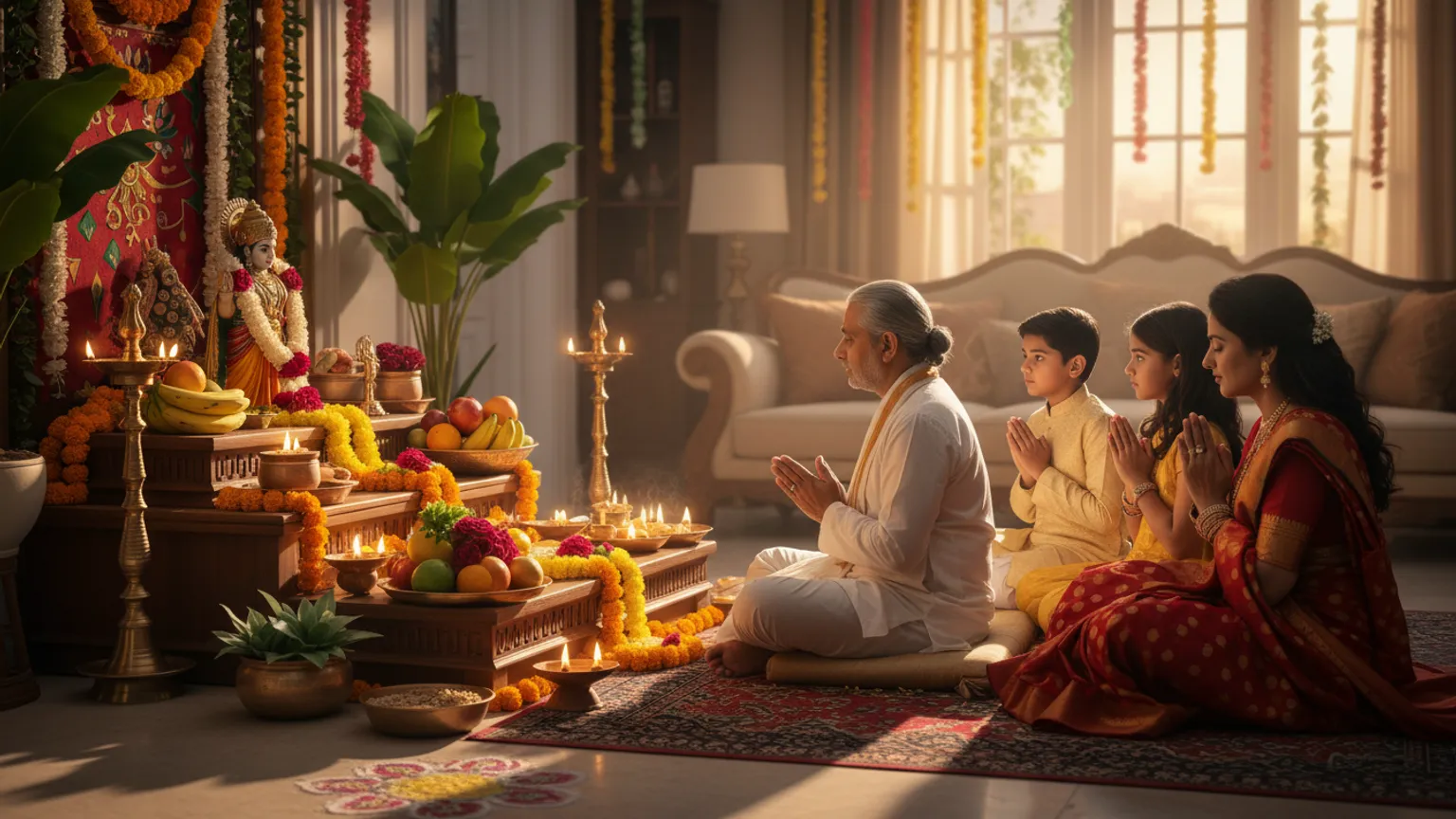
We do a Satyanarayan katha at home every year after Purnima, and the first year in our new society I made a small, avoidable mistake. My mother wanted to invite "do-teen close neighbours" — the aunty from 4B who checks on my parents, the couple from the ground floor who lend us their extra chairs, the Nairs next door. Simple. Except I dropped the invite in the building's WhatsApp group at 9 PM, thinking I'd tag just those three. By morning, six other flats had replied "we'll come 🙏", two asked "kitne baje?", and one uncle wrote "society ka function hai kya?" It was not. It was a two-hour puja in our living room with space for maybe eighteen people sitting on the floor.
That katha taught me the single hardest thing about a home puja in an apartment: the guest list and the building are the same physical space, and one careless message erases the line between "some neighbours" and "poori society". This guide is about drawing that line kindly — who to actually invite, how to invite them so it stays contained, the prasad diplomacy that keeps everyone sweet, and copy-paste messages you can send tonight.
Why a home katha is not a "society event"
A Satyanarayan katha is intimate by design. The pandit sits, the katha is read in five adhyays, everyone listens, then aarti and prasad — sheera or panjiri, usually. It runs on quiet, on people sitting close, on the smell of ghee and tulsi in a room that is your actual home. It is not a hall booking. Twenty people is already a full living room; forty is a fire-safety conversation with your society secretary.
So the goal is not "invite everyone and hope half come". The goal is the opposite of most event planning: invite a small, deliberate circle to be present for the katha, and offer everyone else the one thing that actually matters to them — prasad. In an Indian society, being remembered with prasad is the real invitation. Most neighbours don't want to sit through two hours of a puja that isn't their family's; they want to feel included, and a bowl of warm sheera at their door does that better than a seat ever could.
Once you separate "present for the katha" from "included via prasad", the whole thing gets calm.
The three circles inside one building
Here's the split I now use every year. It looks obvious written down, but the mistake I made was treating the building as one list.
| Circle | Who | What they get | How you invite |
|---|---|---|---|
| Circle 1: Katha guests | Family, the 3–5 neighbours you're genuinely close to, anyone your parents specifically name | A personal invitation to sit for the katha and aarti, then prasad and food | One-to-one message or a knock on the door. Never the society group. |
| Circle 2: Prasad circle | Neighbours on your floor, the families you nod to daily, the watchman and building staff | Prasad delivered to their door after aarti, with a warm word | No advance invite needed. A short "aaj katha thi, prasad laaye hain" at the door. |
| Circle 3: The rest of the society | The 70 flats you don't really know | Nothing, and that's completely fine | No message at all. Silence here is not rudeness; it's the norm. |
The reason the society WhatsApp group is dangerous is that it collapses all three circles into one audience. A message there is read by Circle 3, who then either feel obliged to come or, worse, feel snubbed when they realise others were "invited". Keep the group out of it entirely, and the problem disappears.
The rule that keeps it contained: invite people, not addresses
The single practice that fixed this for me: I invite named people through a channel only they see. A message that says "Sharma ji, aap dono ko katha ke liye bula rahe hain" in a one-to-one chat cannot spread. A message in a group can, and will.
Three concrete habits that follow from this:
- Never post the katha in the society group. Not even "some neighbours". If your society has a norm of announcing functions, a home puja is exactly the kind you keep private.
- Invite Circle 1 individually — by name. A knock on the door for the elders, a personal WhatsApp for everyone else. Ten personal messages take fifteen minutes and save you the whole "kitne log aa rahe hain, pata nahi" panic.
- Don't pre-announce prasad. Prasad is a lovely surprise at the door, not an RSVP item. The moment you say "sabko prasad milega" in the group, you've turned a kind gesture into an expectation with a headcount.
This is the same logic behind why a personal invite always beats a broadcast — a message sent to one named person feels like a conversation, and people actually reply. I wrote about that psychology in more detail in why guests don't RSVP, and it applies doubly inside a building where everyone can see everyone.
Messages you can copy tonight
Edit the timings, the flat number and the names, and send. All of these go to individuals, never a group.
Template 1 — close neighbours, katha invite (Hinglish)
Namaste Aunty 🙏 Is Sunday, 27th, ghar par Satyanarayan katha rakhi hai. Aap dono ko humaare saath baithne ke liye pyaar se bula rahe hain.
Katha: shaam 6:00 baje se, uske baad aarti aur prasad. Flat 4B, hamaare wala tower.
Zyaada kuch nahi, bas thodi der aake baith jaaiye — accha lagega. Koi bhet-vet ki zaroorat bilkul nahi.
Template 2 — elders, more formal Hindi
आदरणीय शर्मा जी एवं परिवार,
रविवार, २७ जुलाई को हमारे घर पर श्री सत्यनारायण भगवान की कथा एवं पूजन का आयोजन है। आप सपरिवार सादर आमंत्रित हैं।
कथा: सायं ६:०० बजे से, तत्पश्चात आरती एवं प्रसाद। फ्लैट ४बी।
आपकी उपस्थिति से पूजा को शुभता मिलेगी। कृपया अवश्य पधारें।
Template 3 — a friend/cousin who'll come and help (casual)
Bhai Sunday ko ghar pe Satyanarayan katha hai, 6 baje. Tu aaja thoda pehle, chairs aur prasad ke plates mein help chahiye hogi 😄 Reh bhi lena, khaana ghar ka hai.
Template 4 — prasad at the door, said in person (no message needed, but the words)
"Aaj ghar pe Satyanarayan katha thi — aapke liye prasad laaye hain. Bhagwan ka bhog hai, le lijiye 🙏"
Template 5 — gentle decline for someone who heard and asked to come, but the room is full
Aap yaad rahe, yeh dekhkar bahut accha laga 🙏 Is baar katha bahut chhoti aur ghar par hi rakhi hai, jagah kam hai — isliye sirf ghar ke aur do-char logon ke saath kar rahe hain. Prasad zaroor bhijwaayenge. Agli baar aaram se saath baithenge.
That last one is the most useful message in this whole guide. When a Circle 3 neighbour somehow hears and says "hum bhi aayein?", you don't refuse — you explain the room is small and promise prasad. It converts a potential snub into a warm second gesture, and nobody's feelings get hurt.
A quick hosting checklist for a home katha
The invite is only half of it. Here's the short list I run through the day before, so the small guest list actually fits and flows.
- Confirm the pandit's time and ask how long the katha runs — most take 90 minutes to two hours. Put the real start time in your invites, not "evening".
- Count your floor space, not your affection. Lay out how many can sit comfortably. That number is your Circle 1 cap.
- Prasad quantity = katha guests + prasad circle + building staff. Make a little extra; someone always sends a child up with an empty bowl later.
- Tell the guard in advance who's expected, so close neighbours aren't stopped at the gate. In many societies visitors need approval on the security app.
- Keep footwear sorted. A puja means a shoe pile at the door — one mat outside saves your corridor from chaos.
- Decide the food line. Full meal after, or just prasad and chai? Say it in the invite so nobody arrives hungry expecting dinner, or leaves early thinking there's none.
- Assign one person to prasad delivery to the doors right after aarti, while it's warm.
If your katha is genuinely small — say, family plus three neighbours who all confirmed with a phone call — you don't need any tool for this. A notebook and your own memory handle twelve people fine. This is one of those cases where I'll happily tell you an app, including ours, is overkill.
When the list grows past the living room
Some kathas aren't small. A first-katha-in-a-new-home, a katha combined with a birthday or an anniversary, a joint one where two families and a wider friend circle come — suddenly you're at forty-plus people across relatives, close friends and a handful of neighbours, and it's spread over a booked community hall in the society rather than your flat. That's a different scale, and the containment problem flips: now you do need a clean count, because the caterer and the hall both want numbers.
That larger version is closer to a griha pravesh in its logistics — waves of guests, a real RSVP deadline, timings for each part. If that's your situation, the griha pravesh invitation guide walks through the wave-by-wave approach and the timing splits in detail; it maps almost one-to-one onto a big katha.
And if you've reached the point where you're sending personal invites to fifty people and trying to hold one honest headcount, that's the exact mess we built Inyeet for — you send each guest their own link over your own WhatsApp, and a live dashboard shows who's opened, said yes, and how many are coming, so you're not scrolling three chats on Thursday night. You can see how that flow works on how it works, or get the app free. For a twelve-person living-room katha, though, skip it — that's what the templates above are for.
FAQ
Is it rude to invite only some flats in my building?
No. A home Satyanarayan katha is a family religious function, not a society event. Nobody expects the whole building to be invited into your living room. What is expected — and appreciated — is that neighbours you're close to are asked personally, and that prasad reaches a wider circle. Do those two things and you're being generous, not exclusive.
Should I put the katha in the society WhatsApp group?
Better not. The group is read by everyone, which turns a private puja into an open one and invites both crowding and hurt feelings. Message the people you actually want individually. Save the society group for things that genuinely concern the whole building.
How much prasad should I make?
Count your katha guests, add the neighbours on your floor and the building staff, then make a little extra. Prasad is the part of the katha that travels furthest — someone always mentions it to a family member who then sends a bowl up. Running out feels worse than making too much, and extra prasad is never wasted.
The one thing to take away: in an apartment, your guest list and your building overlap, so invite named people through private channels, and let prasad carry the wider warmth. Keep the katha itself to the circle your living room can actually hold, promise prasad to everyone who asks, and stay off the society group entirely. Do that, and the only thing filling your home that evening is the smell of ghee and a room full of people who genuinely wanted to sit with you.
Related reading
Ganpati sthapana invites: managing darshan timings across three days
How to invite people to a three-day home Ganpati without one crowded evening — a darshan schedule by circle, aarti timings, and ready WhatsApp templates.
Prasad math: how your headcount decides puja catering quantities
Turn a puja guest count into real prasad and catering quantities — per-person math, a ready quantity table, WhatsApp headcount templates, and honest trade-offs.
Ganpati invitation message for WhatsApp: 50+ templates in Marathi, Hindi and English
Ready Ganpati invitation messages for every moment — sthapana, darshan, aarti, mahaprasad, Gauri and visarjan — in Marathi, Hindi and English, each written to get a countable reply instead of a thumbs-up.