
Ganesh Chaturthi puja samagri list with quantities for a home setup
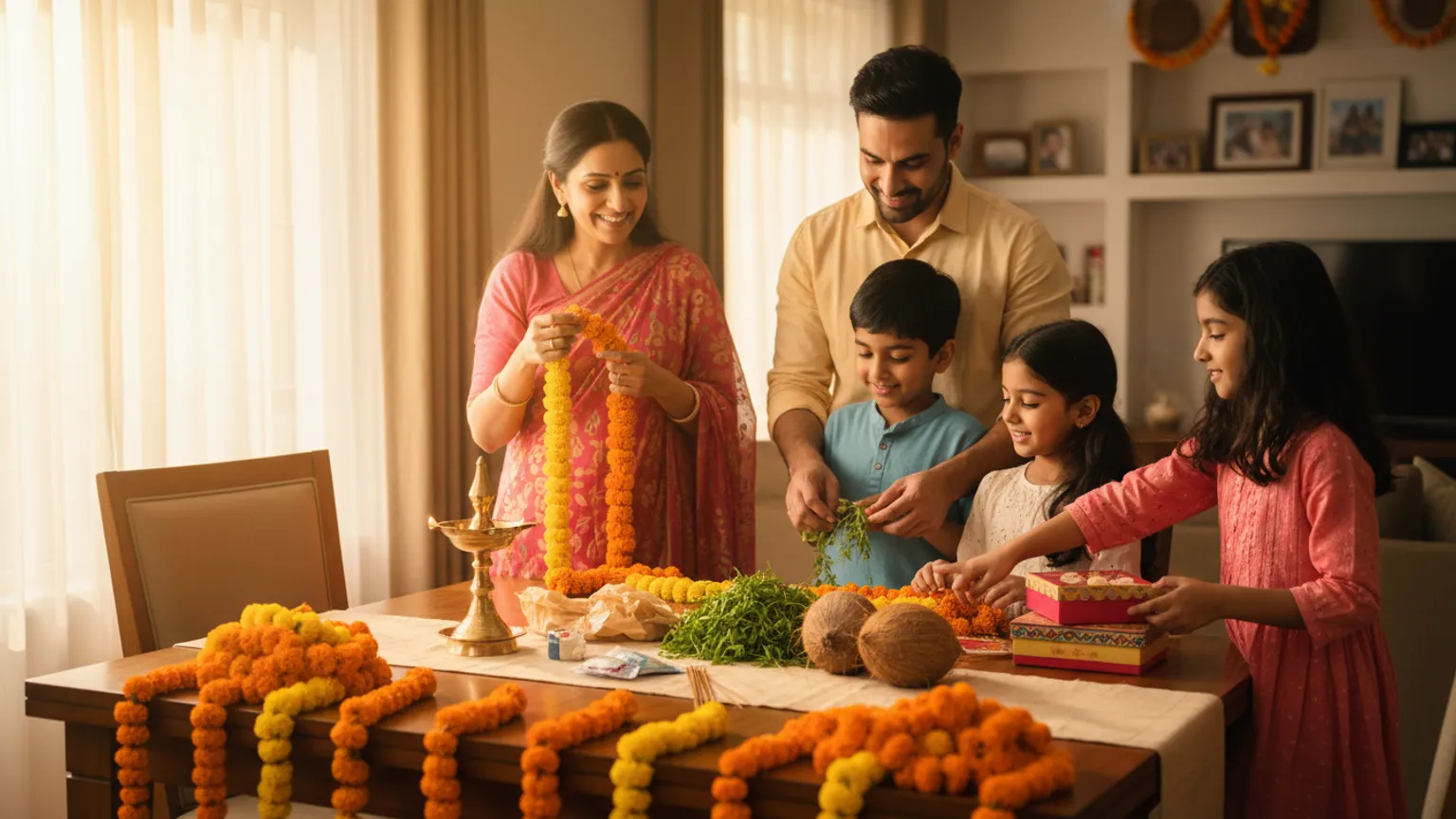
The first year my wife and I hosted Ganpati at our own flat — not at her parents' place, ours — I made a list on the back of an electricity bill. Diya, agarbatti, phool, modak, done. I felt very organised. Then, on sthapana morning, standing in front of Bappa with the pandit waiting, my mother-in-law asked for durva. I didn't have durva. I didn't know durva was a whole separate thing you had to go find — twenty-one specific blades of a specific grass, the one offering Ganesh cares about most. I sent my cousin running down to the flower vendor at the corner while the muhurat ticked away, and he came back with the wrong grass first.
That electricity-bill list taught me what no festival post had: a Ganpati samagri list isn't one shopping trip, and it isn't the same size for every house. There's the puja itself — a fixed set of items the pandit needs, roughly the same whether ten people come or sixty. And then there's everything that gets consumed — the oil, the camphor, the flowers, the modak, the prasad — which scales entirely with how many days Bappa stays and how many people walk through your door. Get the first list wrong and the aarti stalls. Get the second list wrong and you're doing a market run on day four while a room full of guests waits for prasad.
This is the full samagri list I use now, split the way it actually needs splitting, with real quantities for a home setup — plus a printable checklist and the messages that let you delegate the shopping without ten "yeh laana tha kya?" phone calls.
Two lists, not one
Before any quantities, hold this distinction, because it's the thing that keeps a Ganpati budget and a Ganpati kitchen sane.
The puja samagri is fixed. These are the items for the sthapana and the daily aarti — the diya, the roli, the akshat, the durva, the janeu, the murti itself. The pandit's requirement here barely changes with your guest count. A dedh-din Ganpati and a ten-day Ganpati need almost the same puja thali. You buy this list once, you buy it complete, and you buy it before sthapana day because there is no second chance on the morning.
The consumables scale. Oil for the diya, camphor for the aarti, agarbatti, fresh flowers and durva each day, and above all the modak and prasad — all of this multiplies by two numbers: how many days Bappa is home, and how many people come for darshan across those days. This is the list that quietly blows up if you don't plan it against your actual visiting pattern. It's the same host-logistics problem I wrote about in the per-day prasad and catering math, just extended to the whole samagri, not only the food.
If you only remember one thing: buy the fixed list completely and early, and estimate the consumables against your real footfall — not a round guess.
The fixed puja samagri list, with quantities
Here's the core list for a home Ganesh Chaturthi setup. Quantities assume a standard home puja with a small mandap; a pandit-led sthapana may add a few items specific to your family's vidhi, so always show this to whoever's conducting the puja and let them add to it.
| Item | Quantity for a home setup | Note |
|---|---|---|
| Ganesh murti (eco/clay preferred) | 1 | Book with your vendor a week ahead; popular sizes sell out |
| Chowki / wooden platform | 1 | For the murti to sit on, raised above floor level |
| Red cloth for the chowki | 1–1.5 m | Traditional colour for Ganpati's seat |
| Kalash (brass or copper) | 1 | With a coconut and mango leaves if your vidhi uses it |
| Diya (oil lamp) | 2 | One for aarti, one kept lit; brass lasts years |
| Cotton wicks (batti) | 1 packet | You'll go through more than you expect across the days |
| Roli / kumkum | 1 small packet | For tilak and puja |
| Haldi | 1 small packet | |
| Akshat (unbroken rice) | 100 g | Mix a pinch of haldi into it |
| Janeu (sacred thread) | 1 | Offered to Ganesh; ask your pandit |
| Durva grass (durva judi) | 21 blades per day, minimum | Ganesh's most-loved offering; buy fresh daily |
| Supari, whole | 5–7 | For the puja |
| Coconut (whole, with husk) | 2–3 | One for kalash, spares for prasad/aarti |
| Panchamrit ingredients | milk, curd, honey, ghee, sugar | Small quantities of each |
| Fruits for bhog | 5–7 pieces, mixed | Banana is traditional for Ganpati |
| Flowers & garland (fresh) | 1 garland + loose flowers, daily | Red hibiscus especially; buy fresh each morning |
| Modak for naivedya | 21 on day one | The offering count; separate from guest prasad |
| Camphor (kapoor) | 1 small packet | For the aarti flame |
| Agarbatti / dhoop | 1 pack each | Daily use adds up over ten days |
| Matchbox / lighter | 1 | The one thing everyone forgets |
| Aarti book / printout | 1 | So guests can sing along, not mumble |
| Steel bell (ghanti) | 1 | For the aarti |
That janeu, the durva, and the matchbox are my three "learned the hard way" items — the ones missing from every casual list, and the ones that stall a puja mid-flow. Circle them.
The consumables that scale with your days and your crowd
Now the list that actually needs your numbers. These are per-day items, so the total depends on your visarjan length — 1.5, 3, 5, 7, or the full 10 days. If you haven't fixed your length yet, do that first; I've laid out how the ten-day arc changes your whole plan in the Ganesh Chaturthi date and host schedule.
Here's roughly how the daily items multiply. Treat these as sensible starting figures for a modest home Ganpati, not a rule — your vendor and your family's appetite decide the real number.
| Daily consumable | Per day (approx) | For a 5-day Ganpati | For a 10-day Ganpati |
|---|---|---|---|
| Fresh flowers + 1 garland | 1 set | 5 sets | 10 sets |
| Durva (fresh) | 21+ blades | daily buy | daily buy |
| Diya oil | 100–150 ml | ~0.75 L | ~1.5 L |
| Cotton wicks | 8–10 | 1 packet | 2 packets |
| Camphor tablets | 4–6 | 1 packet | 2 packets |
| Agarbatti | 1 small pack | 1 box | 2 boxes |
| Modak/prasad for darshan | scales with visitors | see below | see below |
The oil and camphor look trivial until day six, when the corner shop is shut for the festival and you're rationing the aarti flame. Buy the ten-day quantity up front even if you're doing five days — it keeps, and there's always next year.
The modak and prasad line is the one that genuinely needs thought, because it's not driven by days alone — it's days times footfall, and Ganpati footfall is famously lumpy. A quiet Tuesday evening and a packed weekend darshan are the same festival but a completely different prasad requirement. The point at which you stop guessing and start counting per evening is exactly the wedge I wrote about in managing daily Ganpati footfall — because the samagri you consume is downstream of who actually shows up on which night.
The printable pre-sthapana checklist
Run this the day before sthapana, top to bottom. It's the difference between a calm morning and a cousin sprinting to the flower stall.
- Murti collected and its chowki, cloth and kalash ready
- Puja thali assembled — diya, wicks, roli, haldi, akshat, kumkum, camphor, agarbatti, bell
- Durva bought fresh and counted (21 blades minimum for day one)
- Janeu, supari, coconut, fruits set aside with the thali
- Panchamrit ingredients in the fridge and checked off
- Modak for naivedya (21) arranged, kept separate from guest prasad
- Flowers and garland ordered for morning delivery or an early pickup
- Oil and camphor stocked for the full length, not just day one
- Matchbox/lighter located and placed with the thali
- Aarti printout ready so guests can actually sing
- Pandit's timing and any extra vidhi items confirmed with them directly
- Visarjan plan noted — date, who's coming, how you'll carry the murti
The last two are the ones people skip and regret. Confirm the pandit's specific additions the evening before, and don't leave the visarjan logistics for the last day.
Delegating the shopping without ten confused phone calls
A samagri list this long is not a one-person job, and it shouldn't be. But the moment you split it across your spouse, your cousin and your mother, you get the classic Indian-household failure: three people buy agarbatti and nobody buys the durva. The fix is to send the list already divided, with names against items.
Template 1 — splitting the list on the family group (Hinglish)
Ganpati samagri baant rahe hain, taaki koi cheez double na ho aur koi chhoot na jaaye 🙏 • [Name] — murti pickup + chowki, cloth • [Name] — phool, garland, durva (fresh, sthapana subah) • [Name] — diya oil, kapoor, agarbatti, batti (pura stock, 10 din ka) • Main — modak, fruits, panchamrit Jo apna part le aaye, yahan ✅ kar dena. Missing kuch ho toh abhi bolo.
Template 2 — the fresh-items reminder, sent sthapana morning (Hinglish)
Aaj subah bas do fresh cheezein: durva (21+ patti, taazi) aur phool + ek garland. Vendor 8 baje tak khula milega. Baaki sab kal hi aa gaya hai, toh sirf yeh dono confirm kar do 🙏
Template 3 — asking relatives not to duplicate the prasad (Hindi)
अगर कोई प्रसाद या मोदक साथ ला रहे हैं तो बता दीजिए, ताकि हम उसी हिसाब से बनाएँ और बेकार में ज़्यादा न हो जाए। बप्पा के लिए जो भी लाएँगे, प्रेम से स्वीकार है।
That third one does quiet work: at a home Ganpati, half a dozen relatives each bring a box of modak "just in case", and you end up with four kilos nobody can finish. Asking up front turns a pile of duplicate sweets into a coordinated bhog.
When a list is enough, and when it isn't
Here's the honest part. For a small home Ganpati — a dedh-din or three-day one, twenty or thirty people you know by name — the checklist above is the entire system. Print it, tick it, split the shopping over WhatsApp, done. You do not need an app to host a family Ganpati, and I'd sooner you keep the notebook on the fridge than reach for software that a warm, small gathering never asked for. Reaching for a tool here is like weighing your durva on a kitchen scale.
Where it stops being a checklist problem and becomes a counting problem is the longer, larger Ganpati — a seven or ten-day one where forty-plus households drift in across different evenings, some saying "aayenge zaroor" without ever saying which night. There, your samagri isn't fixed by a list; it's driven by a footfall you can't see coming, and the flowers, oil and prasad you burn through each day depend on it.
That specific gap — a live, per-day count of who's actually coming so you can stock prasad against real numbers instead of scrolling three chat windows — is what Inyeet is built for. Each guest gets a private link over your own WhatsApp, marks which evening they're likely to visit, and you read a running per-day count instead of reconstructing it from memory. It's made for the multi-day, multi-circle version of hosting, not for a fifteen-person living-room aarti a notebook handles perfectly. If your Ganpati this year is the big, uncertain kind, early access is open here. If it's the small kind, use the checklist and enjoy it.
The invitation side of spreading that crowd across days — nudging neighbours toward one evening and family toward another so no single aarti is a crush — I covered separately in the Ganpati sthapana and darshan invitations guide.
FAQ
What is the most important item on a Ganesh Chaturthi samagri list?
Durva grass. It's Ganesh's most-loved offering, traditionally given in bunches of 21 fresh blades, and it's the item most likely to be forgotten because it's bought fresh rather than stocked. Alongside it, don't skip the janeu (sacred thread) and — practically — a working matchbox or lighter, the three items that most often stall a puja mid-flow.
How much modak should I make for Ganpati?
Keep two counts separate. The naivedya offering is traditionally 21 modak on day one, placed before Bappa. The prasad for guests is a completely different number, driven by how many people come for darshan across your festival days — which is lumpy and hard to guess. Plan the prasad against your real footfall, not the offering count, and see the prasad and catering math for the per-person working.
Do I need to buy the whole samagri list before sthapana?
Buy the fixed puja items — diya, roli, akshat, durva, janeu, camphor, coconut, murti — complete and before sthapana morning, because there's no second chance once the muhurat starts. The daily consumables like oil, wicks and agarbatti are worth buying for your full festival length up front too, since local shops often close during the festival. Only the fresh flowers and durva need a daily buy.
The one thing to take away: a Ganpati samagri list is two lists wearing one name. Buy the fixed puja items complete and early so the aarti never stalls, and estimate the daily consumables — oil, flowers, modak, prasad — against how many days Bappa stays and how many people actually come. Ganpati Bappa Morya — may your durva always be fresh and your matchbox always be findable.
Related reading

Ganesh Chaturthi 2026 date and 10-day schedule: what a host needs to plan
Ganesh Chaturthi 2026 falls on 14 September. A host's day-by-day breakdown of the ten-day arc, the common visarjan lengths, and what to plan for when.

How many people come for Ganpati darshan: estimating daily footfall at home
How many people actually come for Ganpati darshan? A host's method to estimate daily footfall at home, a per-day forecast table, and templates to gauge it.
Dahi handi day: coordinating a society gathering the whole building turns up to
Dahi handi in a housing society is a coordination job, not a puja. A host's plan for the chanda, the govinda troupe, the prasad count and the whole crowd.