
Surprise party invitations: keeping 40 people quiet on WhatsApp
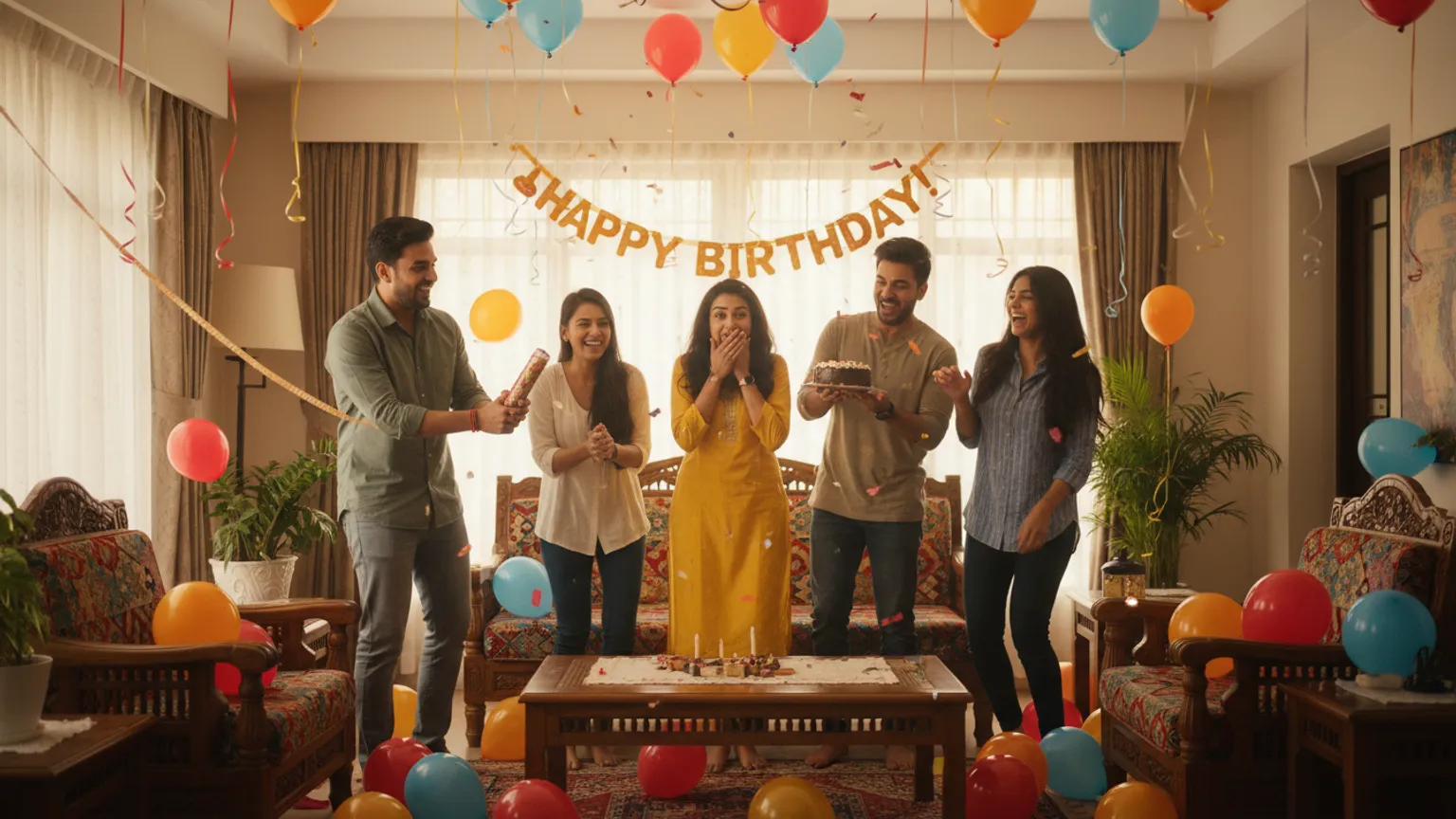
Two years ago my wife decided to throw a surprise 30th for her best friend Ananya. Forty people, one restaurant terrace, one strict rule: Ananya must not have the faintest idea. We built the whole thing on WhatsApp, because of course we did — a group of forty, a shared list of who's bringing the cake, another chat for the gift pool. It worked. Ananya walked in at 8:15, screamed, cried, the whole reel-worthy thing.
But it worked despite WhatsApp, not because of it. Three times that fortnight the surprise nearly collapsed. Once, a cousin nearly added Ananya to the planning group by tapping the wrong name. Once, a well-meaning uncle replied "happy advance birthday Ananya beta 🎂" on the wrong chat. And once, Ananya asked my wife point-blank, "tu itni busy kyun hai aaj kal?" — because forty people quietly coordinating gives off an energy a sharp friend can smell.
A surprise party is the hardest RSVP problem there is. In a normal invite, silence is your enemy — I've written a whole post on why guests don't RSVP. Here it's the opposite: you need forty people to commit loudly to you while staying invisible to one specific person, on an app built for everyone to talk to everyone. Here's what I've learned running it twice for family, and now watching other hosts attempt it.
Why WhatsApp is the wrong tool that everyone still uses
Let me be honest before I give you templates: WhatsApp was not built for secrets. It shows "last seen," it auto-suggests contacts when you add members, it forwards messages with one careless tap, and every notification pops a preview on a lock screen someone might glance at. A surprise needs compartmentalised information; WhatsApp wants to broadcast everything.
And yet we all use it, because the alternative — calling forty people one by one and hoping they remember — is worse. So the game isn't "avoid WhatsApp." It's "use WhatsApp with a discipline it doesn't enforce for you." That starts with knowing exactly how these things leak.
The six ways a surprise leaks — and the fix
I've seen every one of these happen. This is the table I wish someone had handed me before Ananya's party.
| How it leaks | Why it happens | The fix |
|---|---|---|
| Wrong person added to the group | WhatsApp auto-suggests contacts alphabetically; "Ananya" sits right next to "Anand" | One person is the sole admin and adds members slowly, reading each name twice. Nobody else adds anyone. |
| A stray "happy birthday" on the main chat | Guests forget which chat is which and reply on a family group the honouree is in | Never plan in any group the person belongs to. Make a fresh group with a boring, unrelated name (see below). |
| Lock-screen preview | The person picks up a friend's phone, sees "CAKE — who's collecting at 6?" flash | Ask key people to mute the group and hide previews. Keep the group name generic. |
| The forwarded invite | A guest forwards the plan to a mutual friend who's also close to the honouree | State clearly: do not forward. New people get added by the admin only. |
| The behaviour tell | You're suddenly evasive, cancelling plans, whispering on calls | Have a cover story ready and keep your normal rhythm with the person. |
| Location or tagging slip | Someone checks in at the venue or tags the honouree in a "planning" story | A one-line ground rule: no check-ins, no tags, no stories until after the reveal. |
Notice that only two of these are technical. The other four are human — and humans are exactly what forty-strong WhatsApp groups amplify. Ground rules matter more than any setting.
Set up "operation quiet" before you invite anyone
Do this first, in order, and half your risk disappears.
1. Make a new group with a decoy name. Not "Ananya Surprise 🎉". Call it "Sunday Trek Plan" or "Society Diwali Committee" or "Book Club" — something nobody would look at twice. If the honouree ever glimpses it on someone's screen, it means nothing.
2. Appoint one admin, one co-host. The admin adds every member personally and slowly. Two people own the secret; forty people merely keep it.
3. Send the ground rules as the very first message, pinned. Here's the one I use:
Namaste all 🙏 Welcome to [Ananya's surprise — 30th!]. Three rules, please read:
- Do NOT wish her, tag her, or mention this anywhere she can see. Not even "advance HBD".
- Do NOT add anyone yourself — tell me and I'll add them.
- Mute this group + turn off previews. If she picks up your phone, we're finished 😄 RSVP below with a simple ✅ (coming) or ❌ (can't). Details to follow. Chalo, mission mode on!
Getting the rules in before the excitement keeps it inside the walls you built.
The invitation message that gets a real headcount
For a normal party I'd tell you to send private, one-to-one invite links — group blasts kill RSVP accountability. A surprise is the rare exception where the group is a feature, because the shared secret is the bonding. But you still need clean numbers, so ask for a specific, low-effort reply.
The core invite (English + Hinglish):
Hi everyone! We're throwing Ananya a surprise for her 30th 🎂 📅 Saturday, 2 Aug 🕗 Reach by 7:45 PM sharp (she arrives at 8:15 — more on the plan later) 📍 [Venue], [area] Reply here so I have a count: ✅ = I'm in ❌ = Can't make it, but shhh Ek baar aa jao, phir pura plan bhejungi. Aur haan — ekdum silent rehna. 🤫
Two things make this work. First, "reply with ✅" is one tap — the same low-friction ask that gets honest RSVPs anywhere. Second, "reach by 7:45 sharp" isn't the real party time; it's the hide-and-be-ready time. Always invite people 30 minutes early, because a third of any Indian guest list runs on IST — Indian Stretchable Time.
The arrival choreography — the part people forget
Getting forty yeses is easy. Getting forty people hidden and quiet at 8:14 PM is the actual test. A surprise dies not from a bad invite but from a chaotic entrance — cars still parking, someone loudly asking "aa gayi kya?", the lights half-on.
Send this as a separate, pinned message two days before:
🎯 Arrival plan — please read twice: • Reach by 7:45. If you're late, WAIT outside and text me — do NOT walk in after 8:10. • Park away from the entrance. Her car should see an empty lot. • Inside: phones on silent, lights dim, everyone away from the door. • I'll send "SHE'S IN THE LIFT 🛗" on this group. After that: total silence. No typing, no notifications. • On my "SURPRISE!" — go loud. Not before.
That "she's in the lift" message is the single most useful thing in this post. One person by the entrance, one thumb, one signal — it turns forty nervous people into one coordinated room.
Here's the timeline I run against:
- 2 weeks out: decoy group made, admin set, ground rules pinned, invites sent
- 1 week out: chase the non-repliers once, privately (silence is a soft no — plan for confirmed heads plus a couple)
- 3 days out: confirm cake, food count, and who's bringing the honouree
- 2 days out: send the arrival choreography
- Day of: decoy plan with the honouree active; "she's in the lift" signal ready
- T-minus 5 min: lights, silence, positions
The decoy: your most important guest is the birthday person
You can plan flawlessly and still get caught if you don't manage the one person who isn't in the group. Someone — usually the co-host — needs a believable reason to have Ananya dressed nicely and walking into that venue at 8:15.
For Ananya's party, my wife's cover was "chal, ek quiet dinner, just us two, I've had a long week." Simple, in-character, no red flags. The decoy fails when it's too elaborate — a sudden fancy plan makes a sharp friend suspicious. Keep it boring and true-adjacent, and keep your own behaviour normal. If you've gone cagey for two weeks, the surprise is already half-guessed.
When you should NOT throw a surprise (be honest)
I'd be a bad host to skip this. Surprises are not universally loved, and forcing one can backfire.
Skip the surprise if the person hates being caught off-guard, has anxiety, or would want to choose their own outfit and headspace for photos. Skip it if the guest list has genuine tension — a surprise leaves no room to quietly manage who-sits-where. And skip it if keeping the secret means lying about something that matters to them; a small dinner-decoy is fun, cancelling something they care about is not.
A gentle middle path: a "soft surprise," where they know a party is happening but not the scale, the venue, or who's flown in. You keep the joy and lose most of the leak risk — for many adults, the better call.
Where a little tech quietly helps
I run the RSVP side of a surprise on a private list now rather than trusting a scroll of forty ✅s that I have to re-count every night. That's the itch Inyeet came from — you send invites your own way and get one live count of who's in, without the honouree ever appearing on the list. But I'll say plainly: for a surprise, WhatsApp is the coordination layer, and no app replaces the "she's in the lift" moment or a good decoy. If you want the deeper mechanics of getting clean headcounts from a big, messy list, the features page has the honest version of what a tool does and doesn't do.
The truth from Ananya's near-misses is simple: the technology was never the hard part. The hard part was forty excited people trying to hold one small silence together — and the discipline to make that easy for them. Get the ground rules in first, invite for 7:45, keep one thumb on the lift signal, and give the birthday person the one thing they'll remember forever: that for two whole weeks, everyone who loves them managed, somehow, to shut up about it.
If you'd like the Android app we built for this, it's on Google Play and free to use.
Related reading

Adults-only functions: saying 'no kids' without causing offence
How to host an adults-only function in India and tell guests kids aren't invited — warmly, clearly, without offence. Scripts, a table and a checklist.
What makes guests actually open your invitation link
A beautiful invite link is useless if nobody taps it. The design and timing tricks that get guests to open your WhatsApp invitation — with copy-paste templates.
Caterer count tiers: how a 20-guest error can cost ₹15,000
Caterers price in slabs, not per head. Here's how a 20-guest estimate error quietly costs thousands — plus the plate math and RSVP messages that fix it.