
Caterer count tiers: how a 20-guest error can cost ₹15,000
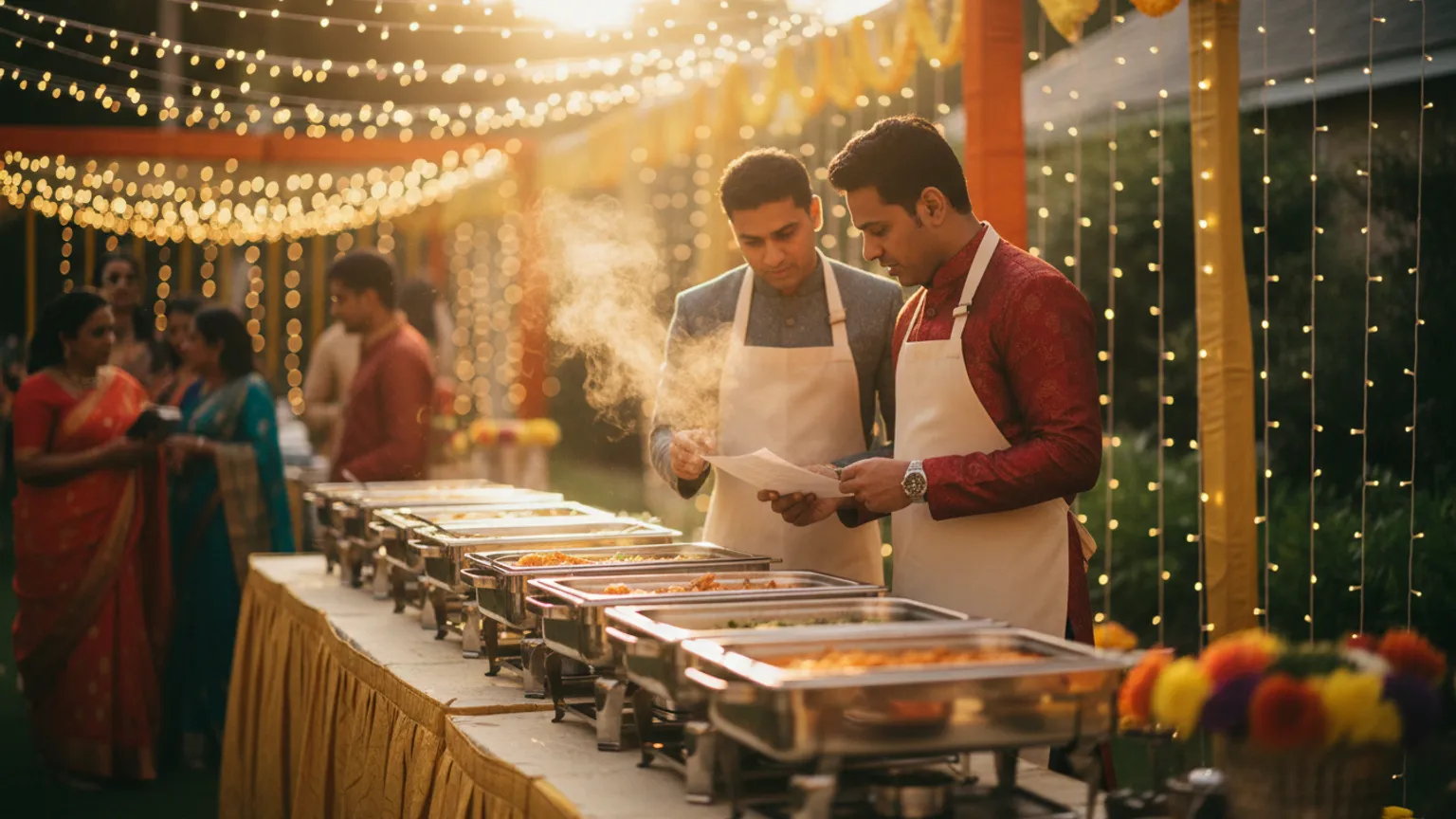
The number that cost me the most money at any function I've hosted wasn't the venue or the decor. It was a single line I said too casually on a phone call: "Bhaiya, count kar lijiye around 180." My daughter's mundan lunch. I felt precise saying 180 — it wasn't "about 200", it was a considered number. What I didn't know was that my caterer's rate card had a step at 200. Below 200 plates, he charged ₹520 a plate. At 200 and above, ₹470. I committed to 180, 164 people actually ate, and I paid for 180 at the higher rate. Had I understood how his pricing was built, I'd have committed to 200 at the lower rate and paid less for more food.
That gap — a few thousand rupees, gone because I misread how catering is priced — is the thing nobody explains before your first big function. The guest count you give the caterer is not a headcount. It's a commercial commitment, and it lands on a pricing structure with invisible steps in it. This is the piece I wish someone had handed me: how caterers actually price, why a 20-guest error can swing ₹15,000, and how to turn your RSVP list into the right number to commit.
Caterers price in slabs, not per head
Most first-time hosts imagine catering as simple multiplication: rate × plates. If it were, a 20-plate error would only ever cost you 20 plates' worth of food. But most caterers I've dealt with — from a colony halwai to a proper event catering firm — quote in tiers. The per-plate rate drops as your committed count crosses certain thresholds, because their fixed costs (staff, transport, setup, the big degs) spread across more plates.
So the same menu can have a rate card that looks like this:
| Committed plates | Per-plate rate | What it costs you |
|---|---|---|
| Up to 100 | ₹560 | Small-batch rate — you carry the setup cost |
| 101–199 | ₹520 | Standard home-function slab |
| 200–349 | ₹470 | The sweet spot most families land in |
| 350+ | ₹440 | Bulk rate — negotiable further |
Look at what happens around 200. Committing to 199 plates costs 199 × ₹520 = ₹1,03,480. Committing to 200 plates costs 200 × ₹470 = ₹94,000. You pay ₹9,480 less for one more plate of food. That is not a rounding quirk — it's the whole game. The rate card is designed with these steps, and the host who doesn't ask where they are pays for the ignorance.
Your caterer may not volunteer the tiers. Ask directly: "Aapke rate mein slab kahan change hota hai? 150, 200, 250 par kya rate rahega?" A good caterer will tell you plainly. If they won't break it down, that itself is information.
Where the 20-guest error actually hurts
A 20-guest error costs you in one of two directions, and they're not symmetric.
Over-committing (you guessed high). You told them 180, 160 came. You still pay for 180 plates. At ₹520, those 20 phantom plates are ₹10,400 of food nobody ate — some of it packed off, most of it wasted. Straightforward loss.
Under-committing (you guessed low, then scramble). You told them 180, 205 turned up. Now two bad things happen at once. First, the extra 25 plates are often charged at a walk-in or last-minute rate, higher than your slab, because the kitchen has to stretch. Second — and this is the one that stings — you may have missed the lower slab entirely. Had you committed to 200 upfront at ₹470, you'd have paid ₹94,000. Instead you committed 180 at ₹520 (₹93,600) and paid a premium on 25 emergency plates. The food ran thin at the buffet for twenty minutes, someone's plate had no paneer, and you paid more for the privilege.
Here's the same scenario side by side, on the rate card above:
| Your committed count | You expected | Actually came | What you pay | Notes |
|---|---|---|---|---|
| 180 @ ₹520 | 180 | 160 | ₹93,600 | 20 plates of waste |
| 180 @ ₹520 + 25 walk-in @ ₹600 | 180 | 205 | ₹1,08,600 | Missed the 200 slab and paid premium |
| 200 @ ₹470 | 200 | 205 | ₹94,000 | 5 extra absorbed, everyone ate, cheapest of the three |
Same function, same guests, and the spread between the best and worst outcome is ₹15,000. Not one rupee of that is about the food. It's entirely about how well you read the pricing and how honest your count was.
The number you commit is not the number you expect
The fix is to separate two numbers that first-time hosts collapse into one.
- Expected attendance — your best, honest estimate of how many will actually eat. This comes from your RSVP tracking.
- Committed plates — the number you give the caterer, chosen deliberately against the rate card and a small buffer.
These are rarely equal. My rule, learned the expensive way:
- Get your expected attendance as tight as you honestly can (more on this below).
- Look at where the nearest slab boundary sits above that number.
- If the boundary is within about 10% of your expected count, commit up to the boundary — you get a lower rate and a built-in buffer in one move.
- If the boundary is far above, commit to expected-plus-a-buffer of roughly 5–8% for a home function where a few relatives always spring a surprise.
In my mundan example: expected ~170, the slab sat at 200, and 200 was within reach. The right move was to commit 200, pay the lower rate, and treat the extra plates as insurance. Instead I anchored on "precise 180" and lost on both counts.
One honest caveat: this assumes leftover food isn't a total write-off. If your caterer packs unused plates to send home or donate — many do, just ask — over-committing to hit a lower slab is close to free insurance. If the food is genuinely wasted, be more conservative. Padding to a slab only makes sense when the extra plates aren't pure loss.
Getting your expected count honest enough to bet on
None of this works if your expected number is fiction. And for most of us, it is — because the guest list lives in a WhatsApp group where 47 people saw the invite and 3 replied. You can't commit plates against blue ticks.
The single highest-leverage thing you can do is give one clear, early RSVP cut-off tied to the real reason:
Namaste sab log 🙏 Aarav ke mundan ka lunch 17th ko hai. Caterer ko final count Wednesday shaam tak dena hai. Please bas ek "haan aa rahe hain, kitne log" ya "nahi aa paayenge" reply kar dijiye — taaki khaana kam-zyada na ho. Aapki ek line se poora hisaab set ho jaata hai 🙏
Notice it asks for how many people, not just yes/no. "Haan" from a cousin can mean one person or a family of five, and that ambiguity is exactly what a 20-guest error is made of. Ask for the number.
For the "maybe" and the silent ones, a short nudge 48 hours before the caterer deadline does most of the work:
Bhaiya sirf ek haan ya na — Wednesday raat ko count lock kar raha hoon, uske baad add karna mushkil ho jaata hai. Aap dono aa rahe ho na?
If the psychology of the non-reply is what's tripping you up, I've written separately about why guests don't RSVP and the scripts that convert "dekhte hain" into a real number. The catering count is the moment that vagueness turns into rupees, which is exactly why it's worth chasing.
A pre-count checklist to run before you call the caterer
Run this the day before you commit. It takes ten minutes and it's the cheapest insurance in the whole event.
- I have the caterer's slab boundaries written down (where the rate changes).
- I know the walk-in / last-minute plate rate — the price of guessing low.
- I've asked whether unused plates are packed for me or wasted.
- My expected count asks for headcounts, not just yes/no (families counted as families).
- I've decided my committed number against the nearest slab, with a 5–8% buffer.
- I've confirmed the cut-off time to adjust the count without penalty.
- Kids and elders who eat lightly are counted, but I haven't quietly padded twice.
- I've separated the meal count from the prasad/snack count if it's a puja — those are different numbers.
That last point matters more than people expect. If your function has a puja or a tea-and-snacks window around the meal, the number who eat lunch and the number who take prasad or chai are two different figures. I've broken that arithmetic down in prasad math for puja catering — worth a read if your event is ritual-first.
When the tiers don't matter (and you should stop optimising)
Not every function needs this. If you're feeding 25 people at a small home puja, there is no slab, no premium, and no ₹15,000 swing — your caterer or the halwai down the lane will make a deg and it'll be fine. Spending an evening optimising plate tiers for 25 guests is effort spent where there's nothing to save. A notebook and a rough count do the job.
The tier math earns its keep somewhere north of 80–100 guests, where a real rate card exists and the slabs are wide enough to swing serious money. Below that, put the calculator down and enjoy your own function.
And a plain truth about tools, including ours: if your list is small enough to hold in your head, you don't need an app to count it. Where a live count genuinely helps is the 150-plus function spread across families, where you're chasing headcounts from four different WhatsApp threads and the caterer wants a number tonight. That's the exact spot we built Inyeet for — each guest gets a personal invite link, replies land as real headcounts on one dashboard instead of scattered "haan" messages, and the number you commit is a number you can actually trust. If you're hosting something that size soon, you can get the app free. If you're not, a shared sheet and a firm deadline will serve you just as well.
The one thing to take away
Your caterer's price is a staircase, not a ramp. Before you commit a single plate, find out where the steps are, ask what guessing low costs you, and get your expected count honest enough to bet real money on. Do that, and the difference between a smooth buffet and a ₹15,000 lesson comes down to one well-informed phone call — the one I wish I'd made before saying "around 180".
Related reading

The forwarded-invite problem: who's actually coming to your event?
One invite you sent to 40 people quietly reaches 200. Why WhatsApp forwarding breaks your headcount — and how to keep an honest guest list without seeming rude.

When guests bring extra people: preventing the +4 surprise politely
The 'haan aa rahe hain' that quietly becomes six people. How to ask headcount without sounding stingy — with WhatsApp scripts, a table and a checklist.

Prasad math: how your headcount decides puja catering quantities
Turn a puja guest count into real prasad and catering quantities — per-person math, a ready quantity table, WhatsApp headcount templates, and honest trade-offs.