
Mehndi at home vs venue: let your guest count decide
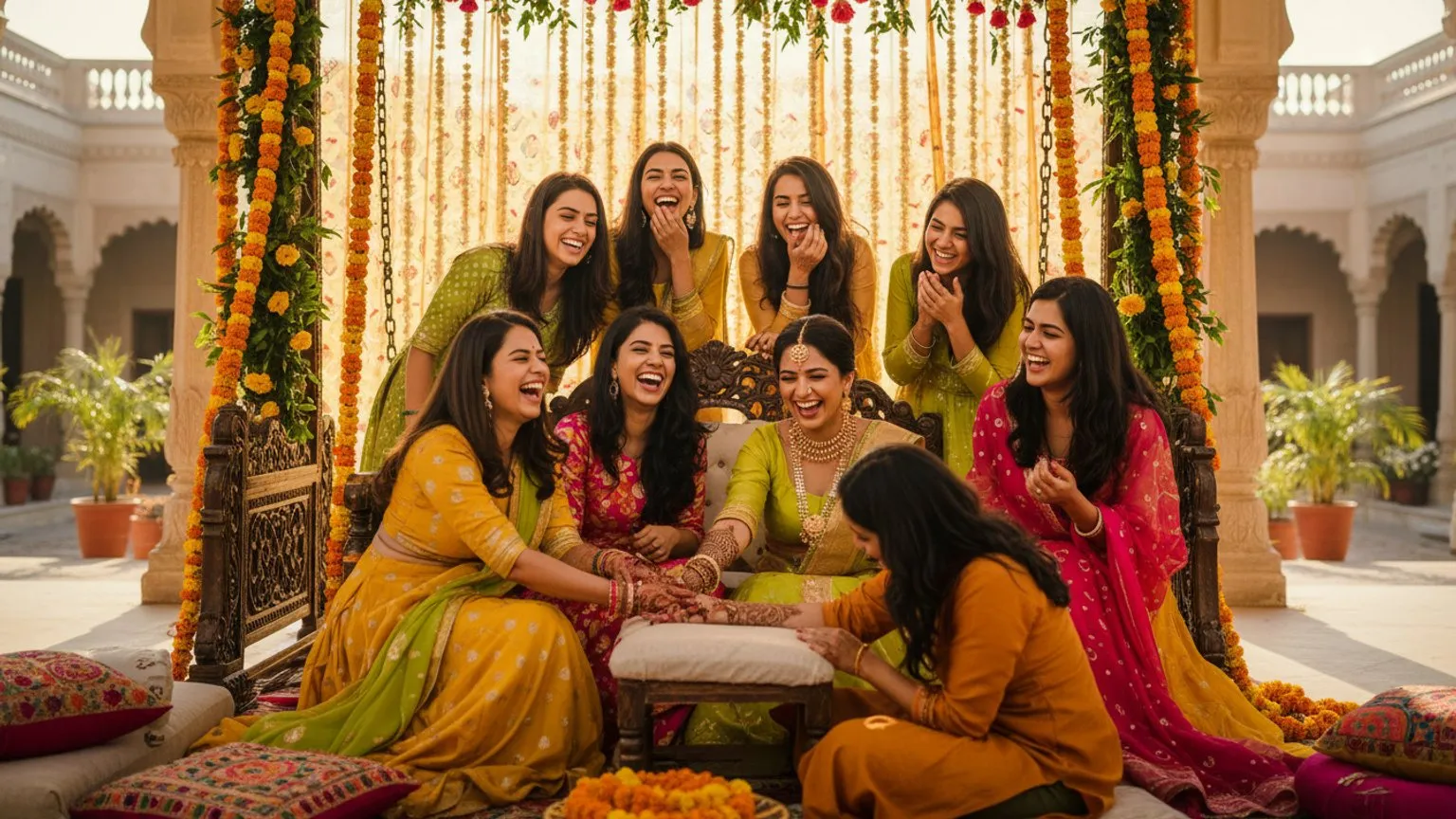
At my cousin's mehndi last spring, we made the classic mistake in reverse. We booked a banquet hall for what was, honestly, forty women, two mehndi artists, and a dhol. The hall was built for two hundred. By 4 PM that beautiful empty space had swallowed the whole mood — the music echoed, the aunties clustered in one corner like a waiting room, and my cousin kept asking why it felt "so thanda." We'd chosen the venue off a photo we liked, and skipped the one calculation that actually decides a mehndi: how many people, in how much space.
That's the thing nobody tells you. The home-vs-venue debate gets argued on aesthetics — the marigold backdrop, the low seating, the Instagram grid — when it should be argued on arithmetic. A mehndi is a daytime, sit-down, long function where guests park themselves for hours while henna dries. Get the guest-count-to-space ratio wrong either way and no amount of decor saves it. This is the framework I wish we'd used before we signed that hall booking.
Why a mehndi is a space problem, not a decor problem
A mehndi behaves differently from every other wedding function, and the difference is all about how bodies occupy a room.
- People sit, and they stay seated. Once henna is on, a guest is anchored for 30–90 minutes. You need actual seating for a large fraction of the room at once — not standing space, seating.
- It runs long and slow. Unlike a reception where guests flow through, mehndi guests arrive and linger for the whole afternoon. Your peak headcount and your total headcount are almost the same number.
- The artists create a bottleneck. Two mehndi artists can do maybe 15–20 pairs of hands in an afternoon. Beyond that, you either add artists or people wait — and waiting guests need somewhere comfortable to be.
So the real question isn't "which looks nicer." It's "can this space seat my peak crowd comfortably for four hours, and can I afford to make it feel full rather than empty?" Home and venue answer that differently depending on one number.
The number that decides: peak seated guests
Forget total invites for a second. The figure that matters is peak seated guests — the most people who'll be physically present and wanting to sit at the same time. For a mehndi, that's usually 60–75% of everyone you invite, because people come and stay rather than dropping in.
Here's the rough space math I now use. A comfortable mehndi with low seating (gaddas, bolsters, floor cushions) needs about 12–15 square feet per seated guest once you account for the artists' station, a snacks corner, and a small dance patch. Chairs-and-tables seating needs more — closer to 18–20 sq ft per head.
| Peak seated guests | Space you need (floor seating) | Home realistic? | Better fit |
|---|---|---|---|
| Up to 25 | ~350 sq ft | Almost always yes — a large drawing room or terrace | Home |
| 25–50 | ~600–750 sq ft | Yes, if you have a terrace, courtyard, or society lawn | Home (with rented seating) |
| 50–90 | ~1,000–1,300 sq ft | Only with a big terrace or society party area | Toss-up — decide on cost & help |
| 90–150 | ~1,500–2,200 sq ft | Rarely — most homes can't seat this | Venue (small banquet / farmhouse lawn) |
| 150+ | 2,500+ sq ft | No | Venue, full stop |
Measure your actual usable space before you fall in love with a plan. A "big" terrace is often 400 sq ft once you subtract the water tank, the plant pots, and the bit no one will sit on because it's in full sun. Walk it with a measuring tape, not a memory.
The cost trade-off nobody itemises
People assume home is cheap and venue is expensive. Sometimes. But a home mehndi has hidden line items that add up, and a small venue can bundle things you'd otherwise chase separately. Here's an honest, illustrative breakdown — your city and vendors will shift these, so treat them as a shape, not a quote.
| Cost item | Home mehndi | Small venue mehndi |
|---|---|---|
| Space rental | ₹0 (or society charge) | ₹15,000–60,000 for a half-day slot |
| Seating & tent/shamiana | ₹8,000–25,000 (you rent it all) | Often included or add-on |
| Decor | Fully your cost | Partly included; upgrades extra |
| Catering | Your caterer, flexible | Sometimes mandatory in-house menu |
| Cleaning & setup labour | Your problem, before and after | Handled by venue |
| Parking & crowd | Society politics, neighbour goodwill | Usually sorted |
| "Feels full" factor | Easy to achieve | Risk of a too-big hall |
The pattern I keep seeing: below ~50 guests, home usually wins on both cost and warmth. Between 50 and 90, the two converge — a home function that size needs so much rented seating, tenting, and hired help that a modest venue comes out even, with less stress on your family. Above 90, the venue wins because homes simply run out of seatable floor.
The five questions that break a tie
When the guest count lands you in that 50–90 "toss-up" zone, run these. Three or more "yes" answers point home; three or more "no" point venue.
- Do I have a genuinely usable 1,000+ sq ft of shaded, seatable space (terrace, courtyard, society lawn)?
- Is there someone in the family who'll happily own setup, cleanup, and vendor coordination on the day?
- Can guests park without a war with the neighbours or the society secretary?
- Is the weather safe — no peak-summer afternoon sun, no monsoon gamble — for the date?
- Do I actually want the intimacy of home more than the convenience of a venue?
That last one matters more than hosts admit. A home mehndi has a texture a hall can't buy — your grandmother's own sofa pushed to the wall, the smell of your kitchen's chai reaching the terrace, cousins raiding the fridge. If that warmth is the whole point, weight it heavily. But if you'd rather not have fifty people tramping through your bedroom to reach the only bathroom, that's a perfectly valid reason to book a venue and enjoy your own function.
Managing the count either way
Whichever you pick, the plan only holds if your headcount is honest — and mehndi counts are slippery, because it's the "ladies and close friends" function where a cousin quietly brings two more cousins. You need a real number, not a hopeful one. This is the same discipline I've written about in guest list planning for family functions: sort your list into must-come, should-come, and nice-to-have, and treat the must-come as your seating floor.
The mehndi-specific trap is the vague "haan aa jayenge" that never becomes a real yes. If your seating and artist bookings hinge on the number, you can't let soft answers survive till the last week. I've unpacked why in why guests don't RSVP and what actually fixes it — the short version: ask a specific question with a specific deadline, not "are you coming?"
Copy-paste WhatsApp templates
Swap the names, date, and venue, and send.
Template 1 — home mehndi invite (Hinglish, warm)
Mehndi lag rahi hai! 🌿 [Aanchal]'s mehndi is at our home this [Saturday, 9 August], [11 AM se shaam tak] — aao, baitho, mehndi lagwao, khao, gao. Ghar pe hi hai toh full aaram se. Address: [Flat 4C, Green Meadows, opposite Reliance Fresh — Maps pin below]. Terrace pe function hai, comfortable kapde pehen ke aana. Bas ek chhoti si request — reply karke bata do kitne log aa rahe ho, taaki seating aur mehndi artist ka count sahi rakh sakein. 💛
Template 2 — venue mehndi invite (Hinglish, clear logistics)
You're invited to [Aanchal]'s mehndi! 🎨 [Saturday, 9 August], [11 AM onwards] [Sunveda Banquet, 2nd floor, near Nehru Park — Maps pin] Ladies' afternoon of henna, snacks and lots of dhol. Two mehndi artists on site, so aao thoda jaldi taaki mehndi sookhne ka time mile. Parking in the basement, tell security it's for the [Aanchal] mehndi. Please reply with your headcount so we can plan seating and food. 🌸
Template 3 — the honest headcount nudge (Hinglish, 3 days before)
Chhoti si baat — mehndi ke liye artist aur seating ka final count [Wednesday] ko de rahe hain. Aap kitne log aa rahe ho, bas ek number bata do (aap + kitne aur). Haan ya na, dono chalega, bas pakka bata dena taaki kisi ko wait na karna pade. 🙏
Template 4 — venue-change / weather update (so nobody misses it)
UPDATE for [Aanchal]'s mehndi 🌧️ Baarish ki wajah se hum terrace se shift kar rahe hain — ab function [same date, 11 AM] par [Sunveda Banquet, near Nehru Park] mein hai. Time wahi, sirf jagah badli hai. Maps pin: [link]. Please is message ko apne ghar walon ko bhi forward kar dena. See you there!
A quick pre-decision checklist
- Estimated peak seated guests (60–75% of invites), written down
- Usable space measured with a tape, sun and clutter subtracted
- Home vs venue matched against the space table above
- Rough cost compared on both sides, hidden items included
- Weather and date sanity-checked (summer sun, monsoon risk)
- Parking and neighbour/society goodwill confirmed (if home)
- Mehndi artist count matched to guest count (15–20 pairs per artist)
- A real RSVP deadline set before any booking is locked
When you shouldn't overthink this at all
If your mehndi is twenty women in your living room with one artist and your mother's playlist, stop reading planning guides — you already have everything you need: home, a paper list, one WhatsApp group. The whole home-vs-venue calculation only earns its keep once you cross fifty-odd guests and the count starts deciding money — seating rentals, artist bookings, catering plates. That's the exact point where a hopeful number becomes an expensive one.
That's the seam where a tool like Inyeet helps — each guest gets a personal invite link over your own WhatsApp, and a live dashboard shows the real headcount, so your seating and artist bookings rest on a true number instead of a guess. You can see the kind of functions it's built for, or walk through how it works. But if a notebook is holding the count honestly, keep the notebook — the goal is a warm afternoon, not a clever system.
The one thing to take away
A mehndi isn't decided by which backdrop photographs better. It's decided by one number — your peak seated guests — measured against the space you actually have and the budget the two options really cost. Do that maths first, honestly, and both a full, humming home terrace and a right-sized venue become good answers. Skip it, and you end up where we did: a beautiful hall built for two hundred, forty people, and a bride asking why it feels so cold.
Related reading
Kids' birthday party math: siblings, plus-ones and the cake problem
One kid invited rarely means one guest. A host's guide to counting siblings, parents and plus-ones so your cake, food and return gifts actually add up.
Shraddh bhoj: how many to invite and what to serve at the meal
A shraddh bhoj is a measured satvik meal, not a party. How many brahmins and family to invite, the traditional menu, real quantities, and copy-paste messages.

Visarjan day with a house full of people: an hour-by-hour plan
The day Bappa leaves is the busiest of the whole festival. A host's hour-by-hour plan for the final aarti, the visarjan procession and the goodbye crowd.