
Kids' birthday party math: siblings, plus-ones and the cake problem
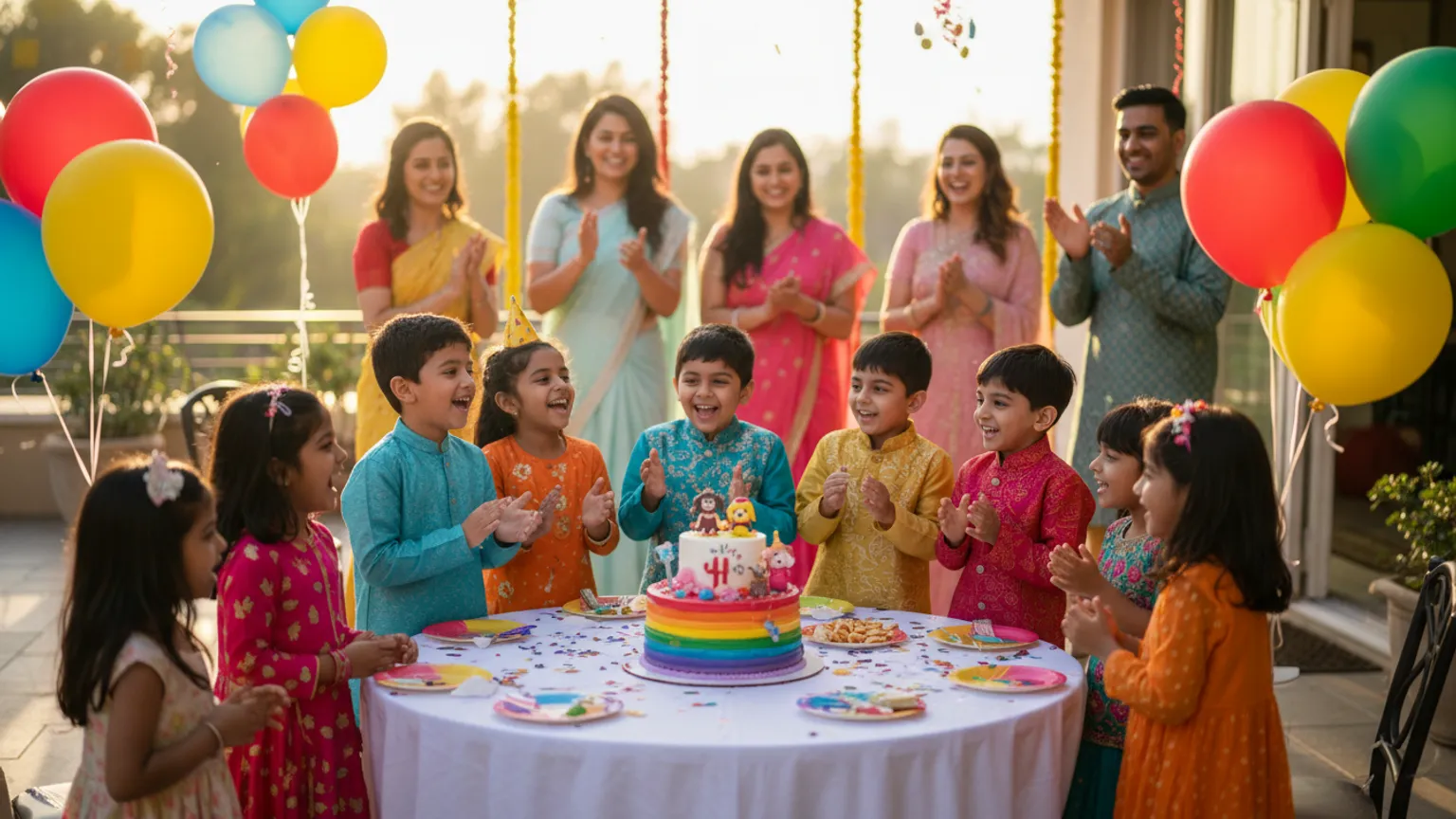
My sister handed me the guest list for my niece Kiara's 6th birthday and said, "Bas twenty kids hain, simple hai." I counted twenty names, told the baker twenty portions, and felt very organised.
On the day, forty-nine people walked in.
Each classmate came with a parent. Nine of them brought a younger sibling. Four families sent both mummy and papa because it was a Sunday. Two kids came with their grandmother because the parents had a wedding to attend and the child couldn't be left home. My "twenty" was never twenty. It was twenty invitations, and every invitation is a little maths problem wearing a party hat.
If you've hosted a kids' party in India, you already know this in your gut. The invite goes to one child, but the door opens for a whole cast. This post is the counting method I wish I'd had that day — the multipliers, a cake-and-food table you can copy, a return-gift rule, and the one WhatsApp question that turns a guess into a number.
Why "one invite" is never one guest
An adult RSVP is roughly honest: an adult knows if they're coming. A child's RSVP is a family decision, and children don't travel alone. So every name on a kids' list quietly expands. Here's what's actually attached to it.
Siblings ride along. If a family has two young kids and only one is invited, the other is coming too — you cannot ask a five-year-old to sit in the car. That sibling eats, plays, and expects a return gift, whether or not their name was on the list.
At least one parent stays. Below the age of seven or eight, most Indian parents don't drop and leave. They stay for the two hours, which means every small child roughly equals one adult plus one child at your venue.
Sundays double the parents. On a weekend, both parents often come, especially if it's a family they're friendly with. A weekday evening party quietly filters this down to one.
The grandparent wildcard. Every few families, a dadi or nani appears — because the parents are busy, or because they simply wanted to come. Lovely, and uncounted.
None of this is anyone being difficult. It's just how families move. The mistake isn't that guests bring people; it's that we count invitations and cater for humans, and forget they're different numbers.
The multiplier table: turning names into bodies
Here's the rough conversion I now use before I tell anyone a headcount. Treat these as planning estimates, not guarantees — adjust for your own circle.
| Who you invited | Kids likely to arrive | Adults likely to arrive | Plan for (people) |
|---|---|---|---|
| Classmate (weekday party) | 1–2 (child + maybe a sibling) | 1 (one parent) | 2–3 |
| Classmate (weekend party) | 1–2 | 1–2 (both parents) | 3–4 |
| Cousin / close family child | 1–3 (siblings very likely) | 2 + sometimes a grandparent | 4–5 |
| Neighbour / colony kid | 1–2 | 0–1 (may drop and go) | 1–3 |
| Your child's best friend | 1–2 | 1–2 (parents stay to chat) | 3–4 |
Run your list through this and you'll get a range, not a single number. For Kiara's party, twenty names honestly worked out to somewhere between forty and fifty-five people. The baker needed to hear that, not "twenty".
The single most useful habit: count adults and kids separately. They eat differently, they need different food, and only the kids get return gifts. One blended number hides both problems.
The cake and food problem, solved with a table
Once you have a bodies estimate split into kids and adults, the catering falls out of it. This is the table I keep on my phone now.
| Item | Rule of thumb | For ~15 kids + ~20 adults |
|---|---|---|
| Cake | 100–120g per person, count everyone | ~4 kg (kids barely finish a slice, adults do) |
| Savoury snacks | Adults eat 3–4x what kids do | Plan mostly for adults, small kid-friendly plates |
| Kids' food | 1 plate per child, simple + familiar | ~15 kid plates (many eat half — order for the count, not the appetite) |
| Cold drinks / juice | 1.5 servings per child, 1 per adult | ~23 kid + ~20 adult servings |
| Return gifts | 1 per child present, +2–3 spare | ~18 (15 + siblings + buffer) |
Two things this table quietly fixes. First, cake is counted for everyone — the classic mistake is ordering a "kids' cake" for the kids only, then watching thirty adults politely take a slice. Second, return gifts are counted per child who walks in, not per child invited — which is why the siblings matter so much. Nothing sours a happy party like a small guest watching others get a gift bag and going home empty-handed.
The one WhatsApp question that does the counting for you
Most RSVP messages ask "aa rahe ho na?" — which gets you a yes and zero useful data. The fix is to ask for the number in the same breath, framed as helping you plan the food. Copy these, change the name, send from your own chat, not a group.
English, warm:
Hi [Name]! Kiara's 6th birthday is this Sunday, 4–7 pm at our place 🎉 Would love for you all to come. So I can plan the food and return gifts, could you tell me how many kids and how many adults to expect from your side? Even a rough number is perfect 🙂
Hinglish, family tone:
Namaste [Name] ji! Ravivaar ko Kiara ka 6th birthday hai, shaam 4 se 7. Aap sab zaroor aaiye 🎂 Bas khaane aur return gifts ka intezaam theek se ho jaaye, isliye ek baat — aapki taraf se kitne bacche aur kitne bade log honge, approx bata dijiyega? Andaaza bhi chalega.
Short, for close friends:
[Name] Sunday 4 baje Kiara's bday, ghar pe. Tere ghar se kitne log — bacche + adults? Cake aur gift bag order karne hain, isliye number chahiye 😄
The word "approx" is doing real work here. It signals you're not pinning anyone down, which makes parents comfortable enough to actually answer. And asking specifically about kids and adults is the difference between a headcount and a headache. If you want more ready-to-send wording for the invite itself, I collected a set in WhatsApp birthday invitation messages.
A pre-party headcount checklist
Run this three days before, when there's still time to change an order.
- List every invited child by name (the base count).
- Beside each, note likely siblings coming along.
- Mark which families are likely to send one parent vs two (weekend = more likely two).
- Flag the two or three "grandparent might come" families.
- Add up two totals: kids and adults, separately.
- Cake and drinks: order for kids + adults combined.
- Return gifts: order for kids present + a 2–3 buffer.
- Chase the non-repliers with the number question above, 48 hours out.
- Add roughly 10% to food for the walk-ins you didn't hear back from.
That last line is the honest one. On a kids' party, you will always have a family that never replied and shows up beaming — and you'd rather feed them than not. A small buffer is cheaper than the embarrassment, and much cheaper than the guilt.
When you don't need any of this
Be honest with yourself about scale. If it's eight kids from the same building and everyone's mother is already in your daily chai group, you don't need a system — you need a phone and ten minutes. Over-planning a tiny party just steals joy from it. The maths matters when the list crosses the point where you genuinely can't hold it in your head: a class of thirty, cousins from three cities, a hall booking with a per-plate rate that punishes a wrong guess.
That's the threshold where I started building Inyeet for myself — a way to send each family their own invite, ask "how many kids and adults" as a one-tap question, and watch the two totals add up live instead of scrolling a group chat counting emojis. You can see the kinds of events it's built for on the use cases page. But I'll say the same thing I say about every tool: it earns its place only past that "can't hold it in my head" line. Below it, a warm phone call beats any app, and always will.
The deeper reason people don't hand you clean numbers isn't laziness — it's the same soft-commitment habit that makes adults dodge every RSVP. I unpacked that psychology in why guests don't RSVP, and it applies doubly to parents, who are juggling one more small human's schedule than everyone else.
The takeaway
The trick to a kids' party that doesn't run out of cake isn't more work — it's counting the right thing. Not "how many did I invite," but "how many bodies will walk in, split into kids and adults." Ask each family for both numbers as a favour to your planning, add a small buffer for the ones who ghost, and order cake for the whole room. Do that once and the day stops being a gamble. Kiara's next birthday, I counted bodies, not names — and for the first time, we had exactly enough gift bags, and one slice of cake left over for me.
If an Android app that keeps these two numbers straight for you sounds useful, we built one — it's free to use.
Related reading

Your first guest list from scratch: the master-list method
First time hosting? The master-list method helps new hosts capture every guest before you cut anyone: sources, a ready template, and family-sweep scripts.

Venue advance vs headcount: the booking decision timeline
Your venue advance is a non-refundable bet placed before you know your headcount. Here's the booking timeline that gets the number right without overpaying.
Mehndi at home vs venue: let your guest count decide
Home or venue for the mehndi? Your guest count, not a Pinterest board, should decide. Here's the space math, cost tiers, and rules to pick without regret.