
Guest list planning for family functions: the circles method
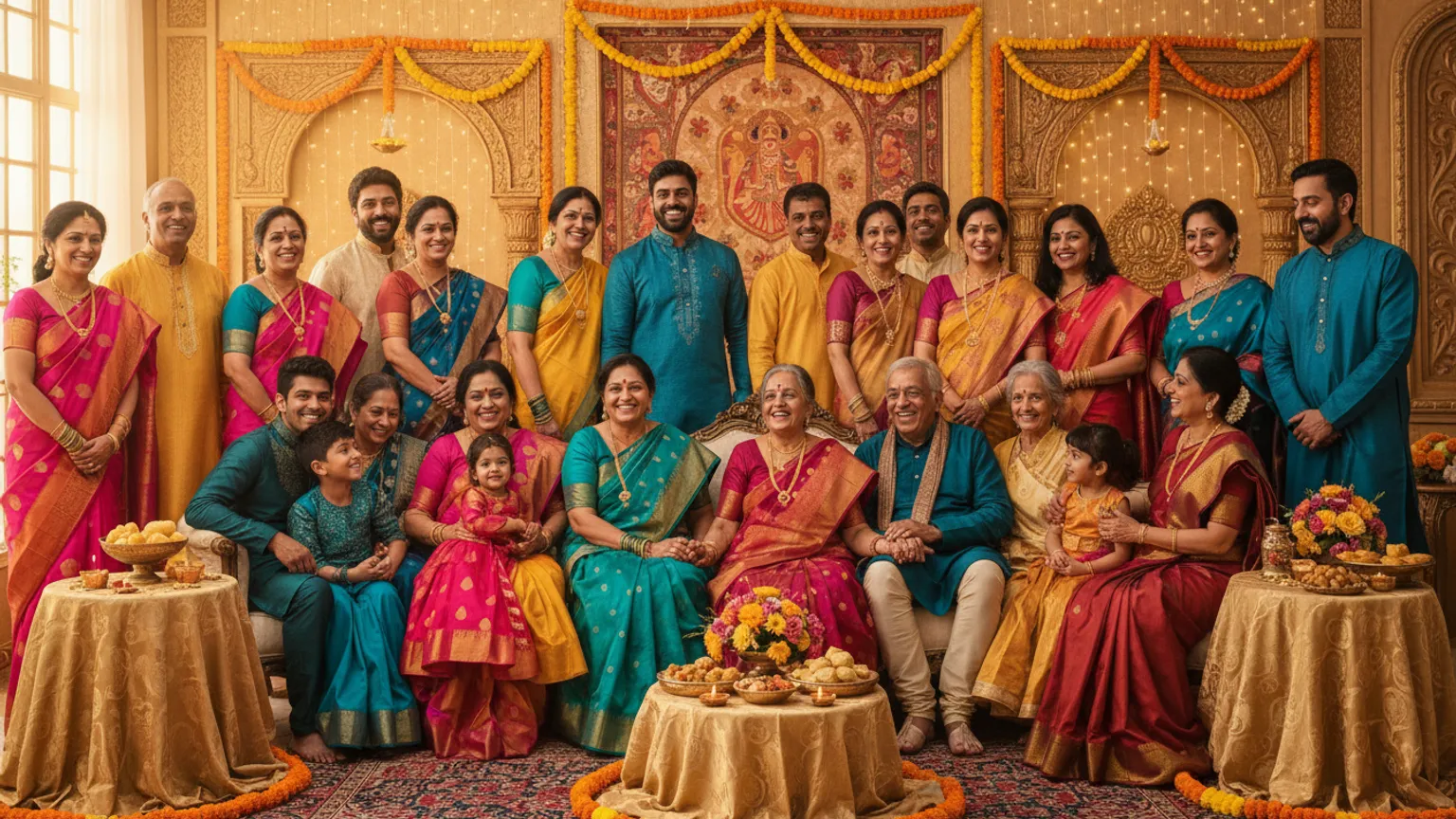
Last December, my sister decided to get married in January. Within two hours, our family WhatsApp group went from "venue shortlist" to a full-blown war room. My mother had a red diary open; my father was calling the caterer; I had a sticky note with 17 names of people I think my sister said we had to invite. Then bua called. "Mere sasural ke chaar log hain, unhe bulana padega." That's when I realised we weren't just making a guest list — we were running a mini parliament without a speaker.
I've since planned or helped with enough griha pravesh pujas, birthdays, anniversaries, and one more family wedding to know one thing: the guest list is never just names. It's relationships, headcounts, caterer plate counts, and the potential for someone's feelings to be hurt. The circles method is the simplest way we've found to bring order to that chaos. No complicated tools, no corporate event-planning jargon — just three circles, some honest math, and a few WhatsApp templates you can steal.
The circles method: three buckets before anything else
When you sit down to make a list, the instinct is to either dump every contact you've ever saved or to freeze up because you can't decide between 80 and 220 people. The circles method forces you to sort every name into one of three buckets before you even look at a venue capacity chart:
- Must-invite — people whose absence would genuinely change the event or cause lasting family tension.
- Should-invite — people you truly want to see and who'd expect an invitation if they knew the function was happening.
- Nice-to-invite — everyone else you'd be happy to see, but no one's calling you rude if they don't get a card.
This isn't a cold ranking of who matters. It's a practical sorting mechanism that ties directly to budget, venue, and the sequence in which you'll send invitations. Once every name has a bucket, decisions that used to be emotional become mechanical: who gets the card first, who gets a phone call, and whose headcount goes into the caterer's guarantee.
Sorting your people into circles
Here's how the circles break down — with the kind of clarity you'll need when you're staring at a list at 11 PM and the caterer wants the guarantee count by tomorrow.
| Circle | Who typically lands here | Invite timing (before the function) | Follow-up intensity | Headcount rule |
|---|---|---|---|---|
| Must-invite | Immediate family, the core wedding party, the aunt who will phone you 10 times anyway, closest friends who'll help set up | 4–6 weeks | Call or personal voice note if no reply in 5 days; another reminder 2 weeks before | Confirm exact number individually; assume anyone can bring a plus-one if not clearly stated |
| Should-invite | Extended family (cousins you see yearly), close colleagues, neighbours you know by name, your mother's kitty group | 3–4 weeks | One friendly WhatsApp reminder about a week before | Ask directly "aap kitne log aa rahe hain?"; expect some families to declare more than the 2 you assumed |
| Nice-to-invite | Distant relatives, your father's office acquaintances, colony-wide invitations, friends' plus-ones | 2–3 weeks (only after must- and should-invite RSVPs are stabilising) | One polite nudge if you need to fill seats; otherwise respect silence | Plan for roughly half to come; keep them off the mandatory headcount until they confirm |
The timing column isn't rigid — it shifts based on how far in advance you're planning. The principle is simple: the more essential someone is, the earlier they get the invite and the warmer the follow-up.
Chasing RSVPs across three circles sounds like more work, not less — but most of the chasing exists because of how we invite, not how many. We've written before about why guests don't RSVP even when they fully intend to come, and a lot of it comes down to the medium. A group message to 80 people won't get you an honest "yes" count; a personal invite that asks "how many of you are coming?" almost always does.
The "2 ya 4?" curse and how to break it
In every Indian family function, there's a hidden number that can blow your budget: the difference between the headcount you assume and the headcount that actually walks through the door.
You send one invitation to Sharma ji's family. Your mental math: Sharma ji + his wife = 2. But Sharma ji's family includes his mother who is visiting, the son who just came back from hostel, and sometimes a driver who'll need a meal. So 2 becomes 5. Multiply that by 10 families, and suddenly your 150-guest wedding is feeding 180 people while the caterer is staring at you.
The fix is to never assume a family size. In your invitation, ask a clear question:
"Thank you! Aapke family ke kitne log aa rahe hain, please batayein — exact number caterer ke liye chahiye."
If you're using a digital RSVP system that ties a unique link to each family, the guest confirms the count themselves. Even better, forwarded links can trigger an identity confirmation so the count stays honest — we built that into Inyeet's guest tracking after one function where the final plate count included several people none of us could name.
You don't need an app to do this, of course. A disciplined spreadsheet with phone calls works. But for any function above 50 guests, the tracking loop — send invite, note number, update sheet, follow up — eats time you'd rather spend on the mehendi or the puja.
Handling family politics without becoming a politician
The hardest part of guest-list planning isn't the counting; it's the delicate dance of who gets offended.
Here's a real situation: your father's elder brother (tauji) expects that his daughter's in-laws be invited because "family hai." You haven't met them. They're squarely nice-to-invite from your perspective, but in the family's emotional map, they're should-invite or worse. If you don't invite them, your mother gets an earful for the next three months.
The circles method doesn't eliminate family politics, but it makes the trade-offs visible. When tauji says, "unlogo ko bulao," you can show the list: "Dekho, must-invite mein already 80 log hain, aur venue mein 120 ki capacity hai. Agar inhe should-invite mein daalte hain, toh kisi must-invite friend ko drop karna padega." Suddenly, the invisible pressure becomes a clear yes-no decision. Often, that's enough to either adjust quietly or get everyone on the same page.
A rule we live by: if adding someone from nice-to-invite to must-invite will cause more drama than leaving them out, don't move them. The guilt of an unanswered RSVP is far lighter than a year of passive-aggressive comments at every Diwali lunch.
Matching numbers to the caterer's minimum and the venue advance
Most caterers in India quote a price per plate with a minimum guarantee headcount — usually 50, 100, 150, or 200 depending on the type of function. You pay for that minimum even if fewer mouths show up. That's why the circles method is a financial tool, not just a social one.
Here's the sequence that has saved our events:
- Add up your must-invite numbers, using conservative headcounts. This is the absolute floor. If your must-invite count is 60, a 50-minimum caterer deal is safe.
- Add your should-invite numbers at the optimistic end — assume more yes than no. If should-invite adds another 40, you're at roughly 100. That's when you book a 100-plate minimum.
- Nice-to-invite guests become your buffer. If the must and should circles alone get you to the minimum, every nice-to-invite guest who shows up is a bonus — you won't panic about empty seats, and you won't overpay for meals nobody ate.
- Final confirmation to the caterer 3–5 days before the event, based on the confirmed RSVP counts. Always keep a small buffer — 5–10% — for last-minute surprises (band baaja, a few distant relatives who tagged along).
Venues work the same way, one step earlier. Most halls and lawns quote against a headcount slab — up to 100, up to 150, and so on — and take a non-refundable advance against that slab months before your RSVPs exist. Book the slab your must-invite floor plus a realistic should-invite estimate justifies, not the dreamy total of all three circles. Moving one slab up "just in case" locks a serious chunk of money into an advance you can't recover if twenty families say no. It's almost always cheaper to negotiate a small flexibility clause than to prepay for optimism.
This spreadsheet-style math doesn't have to live in a fancy tool, but it does need updating in real time. When mami calls to say "hum teen aa rahe hain," that number must change immediately on the master list, because caterers won't accept "haan, almost 120 the" on Monday morning. This is the moment a live headcount dashboard pays for itself: as each family opens their private link and confirms "yes, 3 of us," the count updates on its own, broken down by family. But even with a paper diary and a phone, the principle stands: real-time headcounts, not fuzzy WhatsApp group replies.
A checklist you can use tonight
Take a photo of this, print it, or write it on the back of an old invitation card. This is the exact sequence we walk through:
- Dump every possible name — no filtering, no guilt. Use a notebook or a notes app.
- Tag each name/family as Must, Should, or Nice.
- For each must-invite family, note who needs a personal phone call beyond the invite.
- Next to each family, write an expected headcount range (e.g., Sharma: 2–4; guesstimate honestly).
- Add all must-invite minimum numbers. Check against venue capacity and caterer plate minimum.
- If must numbers cross 80% of the venue limit, freeze the should-invite list — no additions without dropping someone.
- Adjust should and nice lists to meet — but not wildly exceed — the caterer's minimum plus buffer.
- Choose the invite medium: printed card, e-card, or WhatsApp. If using a digital RSVP tracker, ensure every family unit gets a personal link, not a group broadcast.
- Draft circle-specific invitation messages (see templates below).
- Set calendar alerts: invite send-out dates, follow-up dates, final count deadline.
- Brief the decision-makers (parents, siblings, spouse) on the headcount rule: no spontaneous "aa jaana bhai, khaana kha lena" invitations unless they update the tracker.
- 3–5 days before the function, send the caterer the final number with the buffer, then close the nice-to-invite list.
Message templates: what to send to each circle
These are the drafts my own family uses. Copy, tweak, and make them sound like you.
Must-invite — personal and warm
Namaste Mausi ji! Aapko aur Uncle ji ko humari taraf se invitation. Shaadi ki khushiyon mein shaamil zaroor hona. Please link khol kar confirm karein ki aap kitne log aa rahe hain — caterer ko exact count dena hai. Link: [personal link]
Should-invite — friendly and direct
Hi [Name], we're hosting a function on [date] and would love to have you and the family. Aap kitne log aa rahe hain, please link khol kar bata do. Caterer Friday tak poochh lega. [personal link]
Nice-to-invite — low pressure, high warmth
Hi, we're having a get-together on [date]. Agar free ho aur mann ho, toh aa jaana — bohot khushi hogi. Bas ek baar link mein batana kitne log aa rahe ho, no pressure at all. [personal link]
Reminder for those who haven't opened the link
Namaste! Bas ek gentle reminder — invitation link khol kar batayein ki aap aa rahe hain ya nahi, aur kitne log. Count dena hai by [date]. Dhanyavaad! [link]
One quiet advantage of personal links over group chats: each RSVP stays private. Nobody else sees the response, and you won't have that one uncle replying "2 aayenge" in a group of 100.
3 questions hosts always ask
Our must-invite count is already 110. Venue holds 120. Should we skip the should-invite circle entirely? No, but handle it as a second phase. Wait until you've received most of your must-invite RSVPs — there are always genuine last-minute dropouts. Once you know the exact free slots, extend the should-invite circle to fill those seats. Phased, not simultaneous.
Mujhe sirf 15–20 log bulane hain. Kya yeh circles method overkill hai? Haan, bilkul. For a very small, intimate gathering, a single group call plus a basic list works better than any framework. You don't need an RSVP system for chai-samosa at home with 10 neighbours. The circles method earns its keep once you cross roughly 40 names and multiple family units start pulling you in five directions.
Should we still get printed cards if we're sending WhatsApp invites? That's a context call, not a rule. If your function has elders who value the physical card — and you know exactly who they are — print a small batch for that must-invite circle alone. For everyone else, sending the same card design (from your designer, Canva, or the print shop) as a WhatsApp image with an RSVP link saves money and makes headcount tracking instant. Full thoughts in our digital vs printed invitations guide.
The only number that matters
The morning after my sister's wedding, my father opened his diary and did his own audit: meals served versus names confirmed. The gap was three people — all absorbed by the buffer we'd already planned for. He didn't say "well organised." He said, "at least the caterer didn't shout at me."
That's the quiet win every host deserves. The circles method won't stop mausi from adding an extra cousin you've never met, but it will tell you exactly what that cousin costs and whether you can afford to smile and say "zaroor" without breaking the budget. Pair it with a clear RSVP system — a trusted diary, a shared spreadsheet, or something like Inyeet (free to use if you'd rather the counting happened on its own) — and you'll be the only person at the venue who actually knows how much food to order.
Go sort your names. The caterer is already waiting.
Related reading

Your first guest list from scratch: the master-list method
First time hosting? The master-list method helps new hosts capture every guest before you cut anyone: sources, a ready template, and family-sweep scripts.
Guest list politics: the aunt, the colleague, and the neighbour
The three hardest guest-list categories to handle without hurting anyone. Decision rules and copy-paste WhatsApp scripts for the aunt, colleague and neighbour problem.

Venue advance vs headcount: the booking decision timeline
Your venue advance is a non-refundable bet placed before you know your headcount. Here's the booking timeline that gets the number right without overpaying.