
Digital vs printed invitations in India: what to use when
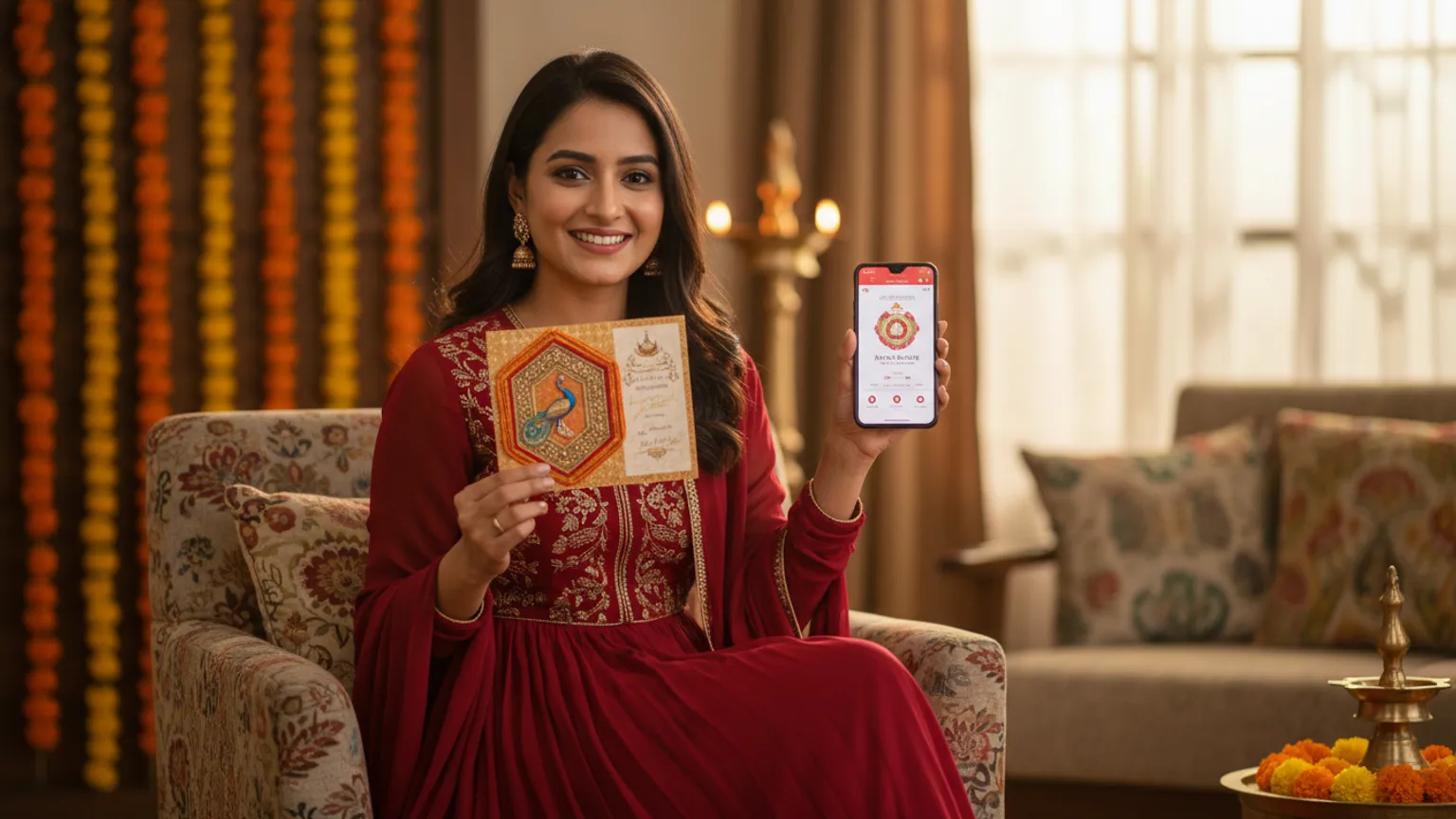
Last December, I sat with my Mama on his verandah in Lucknow, addressing a mountain of printed wedding cards. His daughter's wedding was six weeks away. The card was gorgeous — Ganeshji embossed on handmade paper, gold foil on the inside, a small pouch of haldi and kumkum tucked into each envelope. That evening a neighbour who had already received hers dropped by, saw the pile and said, "Card toh mil gaya, lekin aapke bete ne WhatsApp pe bhi bhej diya. Ab confirm kahan karein — printed pe ya digital pe?" Mama looked at me, half-smiling: "Beta, yeh naya zamana humein maar dega."
That confusion is real, and it's everywhere. Print still carries the weight of tradition in India — especially for weddings, griha pravesh, and milestone pujas. Digital feels practical, fast, and trackable. But neither is a clear winner across all guests. And if you're the host, you don't need a philosophical essay; you need a clear, honest decision framework. So here it is — from someone who has both addressed printed cards with trembling fingers and built a digital tool because the same people never RSVP.
Why we still print (and won't stop anytime soon)
I'm not here to trash print. In Indian celebrations, a printed card is more than an invitation — it's a ritual object.
Tradition and elders In many families, the first printed card is offered to the family deity before a single guest sees it — pehla card bhagwan ke naam. For a wedding, elders expect a physical card, delivered in person or by post, because that is how respect travels. My grandmother still measures the seriousness of an event by whether a printed card landed at her door. A WhatsApp forward, no matter how beautiful, doesn't carry the same bhaav.
Keepsakes and memory Printed cards end up in puja room drawers, wedding albums, and off-white envelopes marked "Ramesh ki shaadi ka card — 1997". A digital invite disappears the moment your cousin clears her chat. The card is a tangible memory, especially for close family.
The in-person handover In many Indian communities, delivering the wedding card with a box of sweets and a personal "aap zaroor aana" is a non-negotiable gesture. It's often the moment where the actual RSVP conversation happens. You look into someone's eyes, they say "aayenge, pakka", and you breathe easier. No link can replace that.
So print isn't dying. It's just serving a different purpose than headcount management. The problem starts when we expect the card to do both — carry emotion and produce a reliable guest count.
Where digital quietly wins
Once the inner circle receives their printed cards, reality kicks in. You've got distant relatives in four cities, school friends who need the date and venue faster than India Post can deliver, and a caterer who wants a firm number by Thursday evening.
Digital has stepped in for exactly these jobs, and honestly, it's a relief.
Speed and cost A modest print run of 150 cards with decent design and courier will set you back ₹8,000–₹12,000 easily; personalised envelopes or premium stock and the bill climbs past ₹15,000. A digital invite reaches the recipient in seconds and costs next to nothing beyond your existing data plan.
Corrections and last-minute panic I've watched my Bua correct the muhurat timing on 200 printed cards with a ballpoint pen because the panditji revised it a week after the cards came home. A digital invite you edit once, and the corrected version reaches everyone instantly — the muhurat shifting by 17 minutes is a classic, and it will happen to you. No pen, no apology calls.
Trackability — the part print simply can't do This is where I see the biggest shift. A printed card gives you zero data. You wait for people to call, text, or worse, just show up assuming someone in the family "must have counted them in". Why guests don't RSVP is a whole post on its own, but the short version is: they're not rude, they're overwhelmed. A digital invite link — opened, ignored, replied "yes" in one tap — turns guesswork into a live headcount. That number is gold when you're pre-paying for chairs, plates, and paneer tikka portions.
A quick, honest side-by-side:
| Factor | Printed invitation | Digital invitation |
|---|---|---|
| Cost for 150 guests | ₹8,000–₹15,000+ (print, design, courier) | Free or a small per-event fee |
| Time to reach guests | 2–5 days by post; longer if international | Instant, via WhatsApp |
| Corrections & last-minute changes | Expensive reprints or manual fixes | Edit once, everyone sees the update |
| Reach to outstation & NRI guests | Needs postage, can get lost | Reaches them where they are |
| Tradition-weight (elders, rituals) | High — expected for key events | Low — can feel impersonal if used alone |
| Trackability (RSVP count) | Almost none — you chase manually | Opens, yes/no/maybe, family headcounts |
| Keepsake value | High — becomes a memory | Low — an ephemeral chat artefact |
Neither column is "bad". They cover different needs. So the real question isn't "which one?" — it's "when do I use which, and can I combine them without complicating my life?"
The hybrid play that actually works in an Indian home
I've seen this pattern work across housewarming pujas, engagements, and one 400-guest Delhi wedding: print for the inner circle, a digital layer for everyone, and RSVP tracking across the board.
Step 1: Identify the inner circle — the card-worthy list
These are people for whom the absence of a printed card would hurt sentiments: immediate family, close relatives, family friends you'll visit in person, the family panditji, and a few neighbours who genuinely care. Usually 20–30% of your total list. Print and deliver these cards with the warmth they deserve. (If the list itself is the battlefield, I've written separately about guest list planning for family functions.)
Step 2: Put the same card behind a digital link
Don't design a new digital invite from scratch. You already spent weeks with your print shop or on Canva. Take the final JPEG or PDF of the card you have and put it behind a link. (I built Inyeet for exactly this step: you upload the card you already have — we never design cards — and each guest gets a personal invite link you send from your own WhatsApp. No broadcast, no business API.)
Step 3: Send digital links to the full list, including the card people
Yes, it feels double, but here's the nuance: the printed card carries the emotion and respect; the link does the administrative job. When I sent my cousin's engagement invite, I added a small handwritten note inside the printed card: "Details yahi hain, bas ek confirmation link WhatsApp pe aayega — pls ek tap de dena." Not a single elder felt offended; several said "bahut achcha, ab baar-baar phone karke poochna nahi padega."
For the outer circle — colleagues, batchmates, extended acquaintances — the digital link alone is more than enough. It's faster, more reliable, and doesn't cost a rupee in postage.
Step 4: Nudge gently (now that you have a link)
Once the invite link is out, you'll still need to remind people. A few go-to messages that sound human and land well in Indian family groups:
First reminder (3–4 days after sending) — Hinglish, soft:
"Namaste! Bas ek chhoti si confirmation chahiye taaki hum caterer ko final count de sakein. Yeh link kholke haan/na bata dein, ek second lagega: [link]"
Last nudge before the caterer deadline — Hindi, for elders:
"कल शाम तक कैटरर को फाइनल नंबर देना है। कृपया इस लिंक पर जाकर बता दीजिए कि आप आ रहे हैं या नहीं, ताकि हम सबके लिए पर्याप्त व्यवस्था कर सकें: [link]"
For a mixed WhatsApp group — light, no pressure:
"Hi! Only sending this because the event is this Saturday and we're sorting transport and parking. If you opened the invite but forgot to tap yes/no, please do it now: [link]"
All three assume the RSVP page opens in a plain browser without logins or installs — because nobody in an Indian family group is downloading an app just to say they're coming. Whatever tool you use, test the link on your least techie uncle before sending it to two hundred people.
The result: the printed card keeps its honour, and the link removes the chasing. I've watched hosts go from sixty unanswered calls to a dashboard that shows, at a glance, how many people are actually coming — without disturbing anyone.
When you should skip the digital layer
Honest truth: if your entire guest list is under 20 people, all of whom you speak to on the phone anyway, you don't need a digital RSVP tool. Likh ke rakh lo, call karo, done.
The same goes for a deeply private function — a small puja, an intimate anniversary dinner — where every guest is confirmed through one-on-one conversation. There, the card plus a phone call is enough, and a link can feel like overkill.
But the moment your list crosses 30, or includes people you can't call directly, or lives in a family WhatsApp group where messages vanish into wedding-gif chaos, a digital RSVP layer saves real money and prevents last-minute khichdi.
A quick timeline for a hybrid plan
Assuming a 40-day run-up to a big event (shaadi, engagement, anniversary):
| Days out | Action |
|---|---|
| 40–35 | Finalise card design (designer/Canva) and guest list. Split it into card list and link-only list. |
| 35–30 | Send the card to print — inner-circle quantity only. Plan hand delivery or courier. |
| 30–25 | Upload the final card art to your digital invite tool. Generate personal invite links. |
| 25–20 | Deliver printed cards. In parallel, start sending digital links to the full list on WhatsApp. |
| 20–10 | Watch the RSVPs come in. Send the first gentle nudge to pendings. Fix any detail changes instantly on the digital side. |
| 10–3 | Final reminders. Confirm family headcounts. Share numbers with the caterer and venue. |
| 3–1 | Last confirmation nudge. The dashboard now shows a near-exact yes count. |
Shift the days to match your vendor deadlines, but the sequence holds.
3 questions I keep getting on this
Maine already printed cards order kar diye hain — ab digital invite kya zaroori hai?
Zaroori nahi, but useful. Print the card for respect, layer a link on top for the headcount — dono saath chal sakte hain with zero extra printing cost. Upload the same card art, send the links, and let guests tap to respond instead of you dialling the whole phonebook.
Mere yahan bade buzurg hain jo WhatsApp nahi dekhte — phir bhi digital kaam karega?
For those elders, the printed card plus a phone call remains primary — aur wohi sahi hai. If a family member (beta, bahu, grandkid) manages their phone, send the link there with a note: "Dadaji se poochh ke ek button daba dena." Choose warmth over tech when warmth is what's needed; over-optimising on elders backfires.
Kya printed card nahi bhejne se log bura maan jaayenge?
Context matters. For a big wedding, yes — close relatives expect a card. For a birthday party, an office event, or a baby shower, a lovingly worded digital invite works fine. My rule of thumb: if a guest has ever handed you a printed card in person for their event, print one for them. Everyone else will happily take the link.
The takeaway
Print isn't going anywhere, and it shouldn't. The smell of a freshly printed wedding card, the smudge of haldi-kumkum, the "aapke haathon se" moment — digital can't replicate that, and it shouldn't try.
But digital takes over exactly where print stops: knowing how many people will actually show up. Use the card for the heart. Use the link for the headcount. And if you've already poured your creativity into a beautiful card — most Indian families have, whether from a designer or Canva — don't start over. Put that same card behind a digital RSVP layer (how Inyeet works) and let the link do the chasing while you handle the aarti thalis and menu tastings.
Your job as the host is to make people feel welcomed, not to become the family's unofficial call centre. Blend both, and you land somewhere between tradition and sanity — the sweetest spot an Indian host can ask for.
Related reading
Surprise party invitations: keeping 40 people quiet on WhatsApp
Coordinate 40 guests for a surprise party on WhatsApp without the birthday person finding out — leak-proof templates, a decoy plan, and an arrival script.
Destination wedding logistics: tracking rooms, cabs and check-in
A destination wedding turns your guest list into a rooming chart. Here's how to track who needs rooms, cabs and early check-in — with copy-paste templates.
Reception RSVP chaos: why the last 100 confirmations land in the final week
A big reception's RSVPs always arrive back-loaded. Here's why the last 100 land in the final week — and how to plan catering, seating and reminders around it.