
Sangeet guest list: merging two families' friend circles without drama
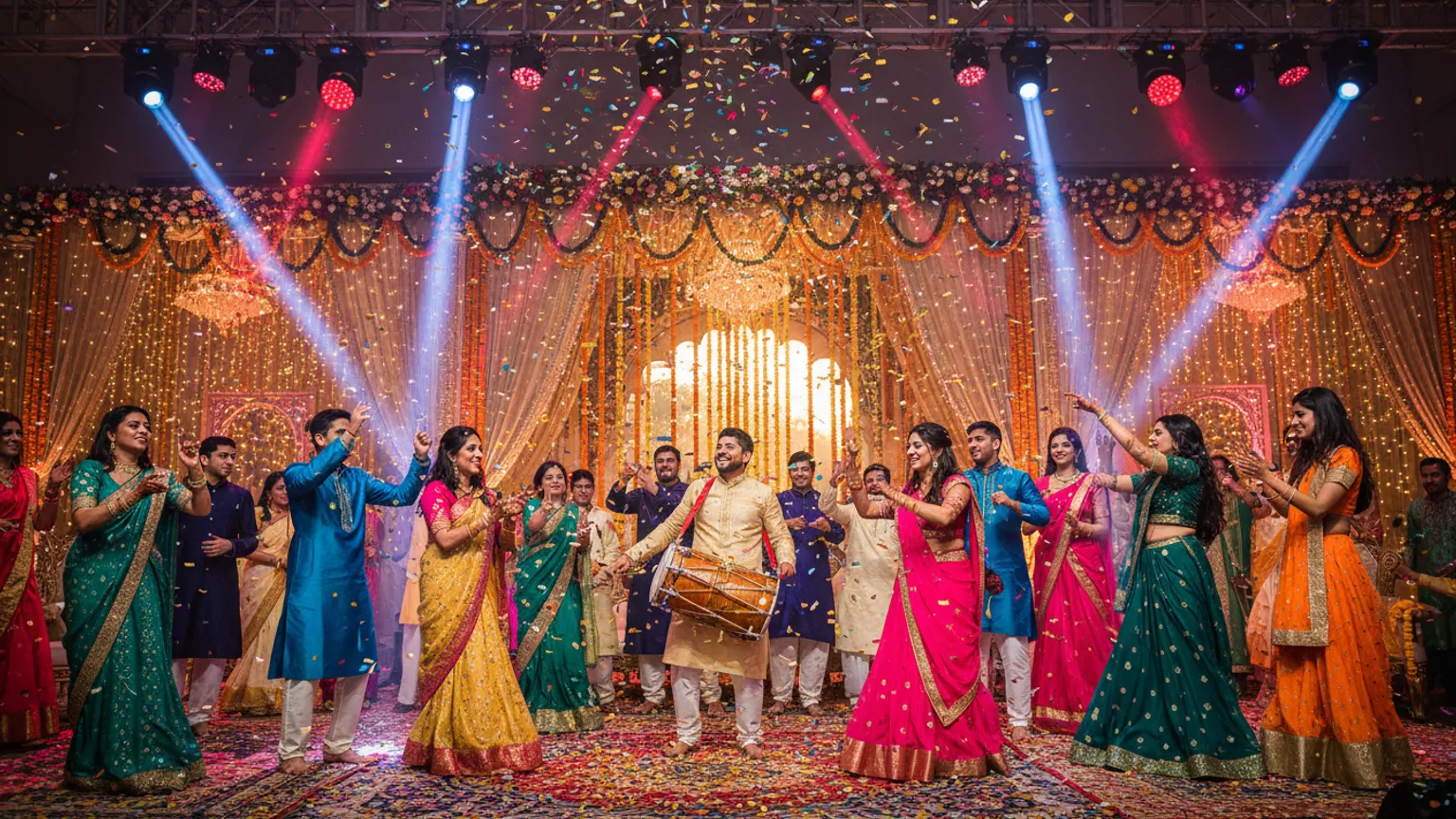
At my sister's sangeet in January, I counted the room at one point and realised something no guest-list spreadsheet had warned me about: there were four completely different friend circles in that hall, and three of them had never met each other. My sister's college gang was rehearsing a Bollywood medley in one corner. The groom's office crew was standing near the bar, politely clapping but clearly waiting for their own turn. My mother's kitty group had colonised the front two rows of chairs. And a floating cloud of cousins moved between all of them, unsure which side they belonged to.
A sangeet is not like a griha pravesh or a reception, where the guest list is mostly about headcount and food. A sangeet is the one function where both families' friend circles physically merge for a single performance-heavy evening — and the drama, when it comes, almost never comes from strangers. It comes from the seams where those circles meet. This is the playbook I wish I'd had that January: how to map the circles, run the rehearsal chaos, and invite each group in the way that keeps the night warm instead of tense.
Why a sangeet guest list is different
For most functions, the hard question is how many. For a sangeet, the hard question is who performs, who watches, and how the two sides balance. Three things make it its own beast:
- It's a performance, not just a meal. Some guests are dancing; most are audience. Those are two different invitations, and treating them as one is where confusion starts.
- Two friend circles meet as equals. Unlike the wedding day — where the couple is the centre — a sangeet puts the bride's friends and the groom's friends in direct, side-by-side comparison. Imbalance shows.
- There's a rehearsal life before the event. Half your guest list is in a separate WhatsApp group arguing about song choices for three weeks. That group is part of the guest experience, whether you plan it or not.
Get those three right and the night runs itself. Ignore them and you get what I nearly got: a groom's side of eight people watching a bride's side of forty, and a cousin quietly hurt that nobody put her in the dance.
Map the four circles first
Before you send a single message, sort every name into one of four circles. This isn't the must/should/nice ranking you'd use for a whole wedding — I've written that method up separately in guest list planning for family functions. A sangeet needs a different lens, because here the question is what will this person actually do that evening.
| Circle | Who's usually in it | What their invite must say | Balance to watch |
|---|---|---|---|
| Performers | Both sides' close friends, cousins who dance, the couple, siblings | Rehearsal dates, the shared song plan, "you're in the performance", dress/colour note | Keep bride-side and groom-side performer counts roughly even so no side "wins" |
| Front-row family | Parents, grandparents, tauji-bua-mausi, the elders being honoured | Reserved seating, timing to reach before the first act, a note that they'll be called on stage | Both sets of parents get equal stage time — don't let one side's aarti run twice as long |
| Audience friends | Office colleagues, neighbours, friends who won't dance | A clear "come, eat, cheer" invite; no rehearsal pressure; parking and start time | Invite comparable numbers from both sides, or the smaller side feels outnumbered |
| Floating cousins | Extended family who could go either way | A gentle ask: "want to join a dance or just enjoy?" | Let them self-select; forcing a cousin on stage backfires |
The single most useful thing this table does is separate performers from audience friends. Once you've drawn that line, every other decision — rehearsals, seating, the running order — gets easier, because you know exactly who needs to show up early and who just needs to know the start time.
The balance problem, and how to defuse it
The quietest source of sangeet tension is number imbalance between the two sides. If the bride grew up in the same city and the groom moved from another state, her friend circle might be four times the size of his. On the night, that gap is visible: her side dances for an hour, his side has one nervous group act. Nobody says anything, but the groom's mother notices.
You can't manufacture friends, but you can manage the optics:
- Pair the acts, don't stack them. Alternate bride-side and groom-side performances in the running order so the evening feels shared, not lopsided.
- Build one joint act. A single mixed group — cousins from both sides in one dance — does more for the "two families becoming one" feeling than any speech.
- Seat for mixing. Don't create a bride-side and groom-side of the room. Interleave the audience-friend tables so the smaller circle is never sitting alone.
When my sister's side clearly outnumbered the groom's, we fixed it with one joint dumroo-and-dhol act that put six cousins from each family on stage together. It became the video everyone reshared. Balance solved, not by counting, but by mixing.
The rehearsal group: the guest list nobody plans
Weeks before the sangeet, a WhatsApp group appears — "Sangeet Dance 💃🕺" — with thirty people, four song suggestions, and one increasingly stressed cousin who volunteered to choreograph. This group is where half your performer circle lives, and it's the part of the guest experience most hosts leave to chance.
A few things that kept ours sane:
- One coordinator, not a committee. Name a single person (often a cousin, not the couple) who owns song order and rehearsal timings. Decisions in a thirty-person group otherwise never close.
- Pin the essentials. Rehearsal dates, venue, the final song list, and who's in which act — pinned at the top, updated once, not re-typed every day.
- A firm "in or out" date. Two weeks before, ask everyone to confirm: dancing or not. People drift, and you can't choreograph around maybes. This is the same "dekhte hain" problem that wrecks food counts — I've written about why guests don't RSVP and what actually fixes it, and it applies just as much to who's actually turning up to practice.
Copy-paste WhatsApp templates
Swap the names, dates, and venue, and send.
Template 1 — performers (Hinglish, warm)
Hey! We want YOU in [Bride]'s sangeet performance on [15 August] 🎉 It's going to be a fun mixed group from both families. Rehearsals start [2 August], mostly weekends at [venue/home]. Song list and groups are pinned in the "Sangeet Dance" group — adding you now. Bas ek baat confirm kar do: dancing ho ya nahi, taaki hum choreography final kar sakein. Can't do this without you!
Template 2 — audience friends (Hinglish, no pressure)
You're invited to [Bride & Groom]'s sangeet! 💫 [Saturday, 15 August], [7 PM onwards] [Venue name, landmark, Maps pin] An evening of dance, dinner and a lot of noise — come cheer, eat, and dance if the DJ tempts you. No gifts, sirf aapki hasi chahiye. Parking available in the basement; tell security it's for the [Roy] sangeet. Please reply so we can plan seating!
Template 3 — front-row family (formal Hinglish)
Aadarniya [name], [Bride]'s sangeet [15 August] ko [7 PM] se [venue] par hai. Aapke liye aage reserved seating rakhi hai — kripya [6:45] tak pahunch jaayein, kyunki shuruaat mein aapko stage par bulaya jayega. Aapka aashirvad hi is shaam ki shaan hai.
Template 4 — rehearsal coordination (pinned message)
📌 SANGEET DANCE — read once, save time later Rehearsals: [2, 9, 16 Aug], 5–7 PM, [venue] Final songs: (1) [song] — bride's group, (2) [song] — groom's group, (3) [song] — JOINT act (both sides) In/out deadline: [1 Aug]. Reply ✅ dancing or ❌ just watching. Coordinator: [Name & number]. Song changes? DM them, not the group 🙏
Template 5 — the "just enjoy" nudge for floating cousins
Arre [name]! Sangeet ke liye ek chhota sa poochna tha — dance karna hai ya bas aaram se enjoy? Dono bilkul theek hai, koi pressure nahi. Bas count clear ho jaaye toh groups bana lein. Bata dena!
A quick pre-sangeet checklist
- Every name sorted into one of the four circles
- Performer counts roughly balanced across both sides
- At least one joint (both-families) act planned
- Rehearsal group has one named coordinator and a pinned message
- "In or out" dance deadline set, two weeks before
- Audience friends invited with start time, venue pin, parking
- Front-row elders given reserved seating and a reach-by time
- Running order alternates bride-side and groom-side acts
- Seating interleaves the two friend circles, not splits them
When you don't need any app for this
If your sangeet is thirty warm people in your own drawing room, a single WhatsApp group and a paper list is genuinely the right tool. Don't over-engineer an intimate evening. The tracking loop — invite, confirm, count, follow up — only starts to hurt when you cross fifty-odd guests spread across four circles and two families who don't share a contact list. That's the exact seam where a spreadsheet or a chat scroll stops cooperating: you can't tell whose friend replied, and forwarded invites make the count dishonest.
That's the problem Inyeet was built for — each guest gets a personal invite link over your own WhatsApp, and a live dashboard shows who's coming, with headcounts, split by whichever circles you set up. For a two-family sangeet, being able to see both sides' RSVPs in one place is the whole game; you can see more of the event types it's built for if that's your situation. But if a notebook is doing the job, keep the notebook — the goal is a good night, not a clever system.
The one thing to take away
A sangeet guest list isn't a single list — it's four friend circles from two families meeting for one night. Separate the performers from the audience, keep the two sides balanced in acts and seating, give the rehearsal group a real coordinator and a real deadline, and invite each circle in its own tone. Do that, and the seams where the circles meet stop being where the drama lives — and become the part of the night everyone films.
Related reading
The forwarded-invite problem: who's actually coming to your event?
One invite you sent to 40 people quietly reaches 200. Why WhatsApp forwarding breaks your headcount — and how to keep an honest guest list without seeming rude.
Diwali party at home: office friends and family in one guest list
Hosting office colleagues and family at one Diwali party? The circles behave differently. Here's how to plan timing, seating, food and invites so both feel at home.
Ganpati invitation message for WhatsApp: 50+ templates in Marathi, Hindi and English
Ready Ganpati invitation messages for every moment — sthapana, darshan, aarti, mahaprasad, Gauri and visarjan — in Marathi, Hindi and English, each written to get a countable reply instead of a thumbs-up.