
Diwali party at home: office friends and family in one guest list
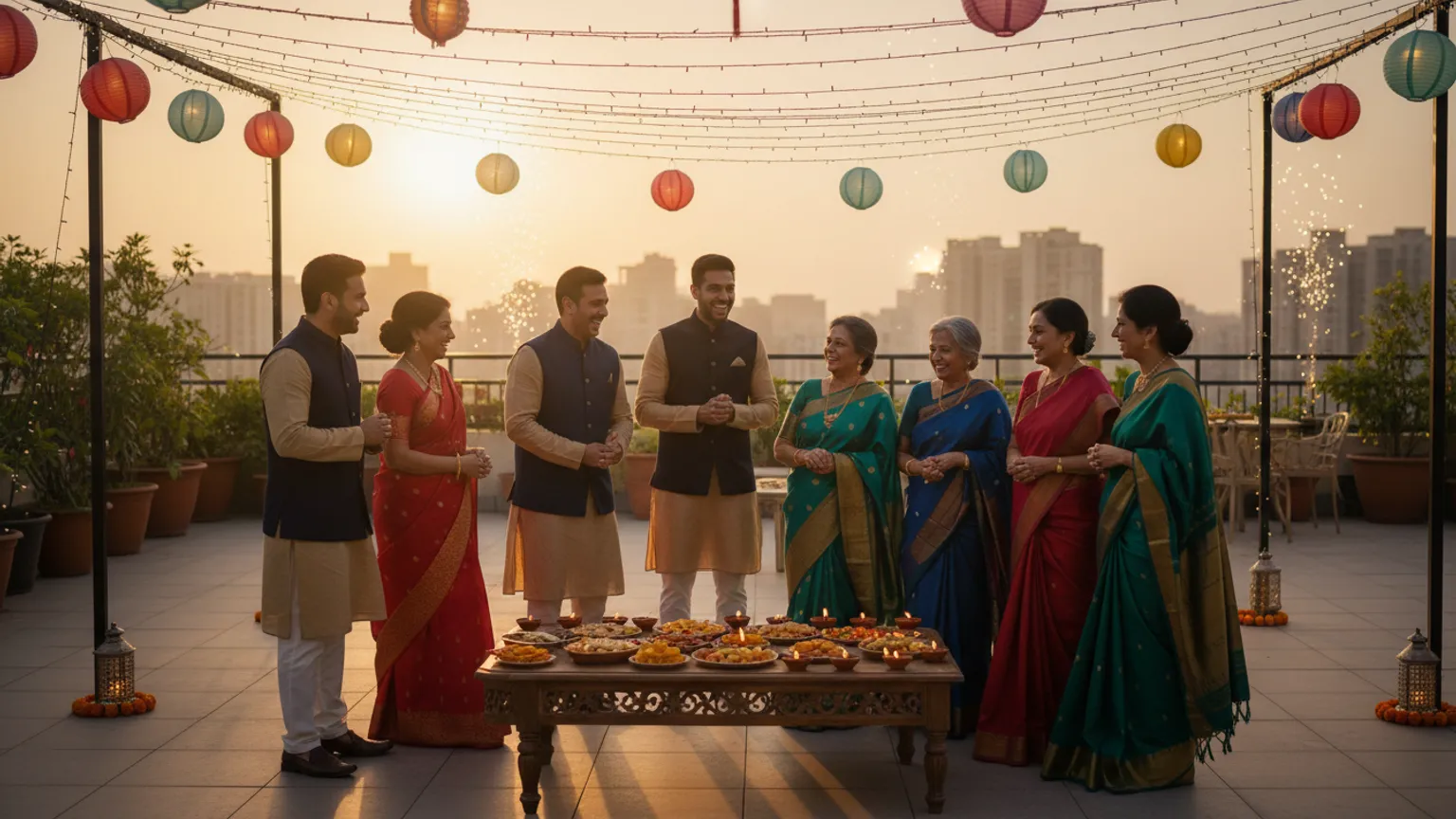
Two Diwalis ago I did something I'd sworn I never would: I put my office team and my extended family on the same guest list, same evening, same flat. The logic was tidy on paper — one round of cleaning, one lot of mithai boxes, one deep-breath of hosting instead of two. What actually happened was that my manager arrived at 7:02 PM sharp, rang the bell, and found me in a vest still stringing lights, while my chachi had already been in the kitchen for forty minutes telling my wife the poha was under-roasted.
Both groups were lovely. But they run on different clocks, different comfort levels, and different ideas of what a "party" even is. That night taught me the real skill isn't cleaning the house — it's designing one evening that holds two very different circles without either feeling out of place. This guide is exactly that: how to build one Diwali guest list from office friends and family, and host it so nobody's checking the time or the door.
Why the two circles don't mix on their own
Before any templates, understand the friction — because almost every awkward Diwali moment traces back to one of these gaps.
- Time. Office colleagues treat "7 PM" as 7 PM. Family treats it as "somewhere after we finish our own diyas at home." If you give both the same start time, your colleagues will sit through the empty-room hour while you're still setting up.
- Register. With colleagues you're a little bit "on" — it's warm but slightly professional. With family you're a nephew, a son-in-law, someone who gets teased. Those two versions of you in one room, unprepared, is where hosts freeze.
- Food and drink. This is the big one. Your office group may expect a drink; a good chunk of your family may quietly disapprove, or it may be a strict no in front of certain elders. Getting this wrong sours the room faster than anything.
- Duration. Colleagues do a polite 90 minutes and leave. Family settles in, opens the second box of kaju katli, and stays till the building's watchman does his round.
None of this means you can't combine them. It means you plan around the differences instead of hoping they dissolve.
The one decision that makes or breaks the evening: staggered arrivals
The single best thing I changed the next year was to stop pretending it was one start time. It's two.
I invited the office group for a defined window — 7:00 to 9:30 PM, framed clearly as "drinks, snacks and cards." I invited family from 8:30 PM onwards for dinner. That 90-minute overlap in the middle is the sweet spot: colleagues get their crisp, contained evening; family flows in as the energy peaks; and by the time my team is doing their goodbyes, the family dinner is just getting going.
This also quietly solves the food-and-drink problem. If anything is being served that some elders would rather not see, it lives in the earlier, colleague-heavy window and is wound down before the family crowd arrives. Nobody has to police anything. The clock does it for you.
Here's the shape I now plan every mixed Diwali around:
| Time window | Who it's really for | What's happening | What the invite should say |
|---|---|---|---|
| 7:00–8:30 PM | Office friends, close friends | Snacks, cards (teen patti), music, drinks if you serve them | A firm start time, a firm-ish end, "drinks & cards" so they know the vibe |
| 8:30–9:30 PM | The overlap — everyone | Aarti / diya lighting together, group photos, mithai | "Do join us for the diya lighting around 8:30" as the shared moment |
| 9:30 PM onwards | Family, relatives | Dinner, sitting around, kids running, the long goodbye | A softer "dinner se aana, aaram se" — no hard end time |
You don't announce this grid to anyone. You just send each circle the version that fits them.
The guest-list build: three columns, not one
When you list guests in a single flat column, you lose track of who needs what. I now split the sheet — or the notebook page — into three columns before I invite a soul.
- Office & friends — need a clear window, a clear "what kind of party," and a nudge on parking because they're coming from across the city.
- Close family in the same city — need warmth and a rough time, and will happily come early to help. Rope one or two in as your kitchen and door backup.
- Extended family & elders — need respect, a phone call rather than only a forwarded card, and zero pressure on timing.
Counting across those three columns is also how you get an honest headcount for mithai and dinner. My rule of thumb: colleagues RSVP close to accurate, family RSVPs optimistically and then brings one extra cousin. Plan dinner for your family count plus about 15%, and you'll rarely be caught short. (I've written separately about why guests don't RSVP and how to chase a real number without nagging — Diwali is peak season for the "dekhte hain" reply.)
Copy-paste WhatsApp invites for each circle
Swap the names, flat number and timings, and send. Two registers, because the same message can't do both jobs.
Template 1 — office friends (Hinglish, clear window)
Team, Diwali plans! 🪔 Come over to our place this Saturday for drinks, snacks and some teen patti.
When: Sat 24th, 7 PM (we'll do the diya lighting around 8:30) Where: Flat 4C, Sunrise Residency, opp. HDFC Bank, Sector 12. (Maps pin below.) Visitor parking in the basement — tell security you're here for Hrishikesh.
Aa jao, ache se manate hain. Bas ek line reply kar dena so I can plan the snacks count. 🙌
Template 2 — office friends (formal English, for seniors/managers)
Hi Sir/Ma'am, we're hosting a small Diwali get-together at home this Saturday and would be delighted if you could join us.
Saturday, 24th October, from 7:00 PM onwards. Flat 4C, Sunrise Residency, Sector 12 (Maps pin attached). Basement visitor parking is available.
Do let me know if you'll be able to make it — looking forward to celebrating with you.
Template 3 — family (warm Hinglish, softer timing)
Diwali ghar pe kar rahe hain is baar! 🪔 Aap sab zaroor aaiye.
Shanivaar, 24 tareekh. Diya jalane ka aur aarti 8:30 baje, uske baad dinner. Aaram se aana, koi jaldi nahi.
Flat 4C, Sunrise Residency, Sector 12 — Rekha aunty ke building ke saamne. Bacchon ko zaroor laana, patakhe ka intezaam hai. Bas confirm kar dena taaki khaane ka count set kar sakein. ❤️
Template 4 — elders (respectful, phone-first)
Send the card image, then follow with a voice note or call: "Namaste. Is baar Diwali hum ghar pe kar rahe hain, 24 tareekh ko. Aap aur uncle ji zaroor aaiye, 8:30 ke baad aarti aur khaana rakha hai. Aapka aana hi sabse badi baat hai."
That last one matters. For elders, a forwarded card alone reads as an afterthought. Thirty seconds of your voice reads as an invitation. (This is the same phone-first instinct I lean on for griha pravesh invitations — some circles simply respond to being called.)
A host's checklist for the mixed Diwali
Print this, tick it the morning of.
- Guest list split into three columns; dinner planned for family count + 15%
- Office window and family window set, with an 8:30 overlap for the diya lighting
- Parking line added to every invite (colleagues are driving across town)
- Maps pin pasted, not just a typed address
- Drinks question decided and, if serving, kept to the earlier window
- One or two family members briefed as kitchen + door backup
- A "landing zone" near the door — a bowl for phones, a spot for shoes, mithai within reach
- A rough seating instinct: don't seat your quietest colleague next to your loudest uncle
- Kids' corner sorted — a room with a cartoon on, or phuljhari supervised outside
- Mithai boxes for guests to take home, kept by the door for the goodbye
When you should NOT combine them
Honesty first: merging isn't always right.
- If your flat is small, two circles in one evening becomes a crush, not a party. Do office on Saturday, family on the Diwali day itself. Smaller and separate beats packed and stressful.
- If your office relationships are new, you may not want colleagues watching your family dynamics yet — or your family sizing up your colleagues. A year in, sure. Three months in, maybe keep them apart.
- If the drink question has no clean answer in your family, don't force it into the same room. The staggered window helps, but if you know it'll cause real discomfort, split the days.
There's no prize for doing it all in one night. The prize is a good evening.
Where a tool helps — and where it doesn't
For fifteen guests on one list, your notebook is genuinely fine; you don't need an app, including ours. The moment it earns its place is exactly this scenario — two circles, two windows, a headcount you actually have to get right for dinner. That's the problem Inyeet was built for: you send each guest a personal invite link over your own WhatsApp, and a live dashboard shows opened / yes / no / maybe with headcounts, so your office and family counts stay separate and honest without you scrolling through a fifty-message thread on Diwali morning. If that's the kind of hosting you do often, the use cases page shows how other hosts run it. But for a cozy fifteen? Save your energy for the mithai.
FAQ
Should office friends and family get the same invitation message?
No. Send colleagues a message with a clear window and the "kind of party" it is; send family a warmer, softer-timed message and, for elders, a voice note or call. Same event, two registers — that's the whole trick.
How do I handle drinks when some family disapproves?
Keep anything you serve to the earlier, colleague-heavy window and wind it down before the family dinner crowd arrives around 9:30. The staggered timing lets the clock manage it, so you never have to police the room. If even that feels risky in your family, host the two circles on different days.
What time should each group actually arrive?
Give office friends a firm start (say 7 PM) and family a softer "dinner ke liye 8:30 ke baad." Overlap the two around the diya lighting at 8:30 so there's one shared, warm moment before your colleagues head home and the family evening settles in.
The one thing to take away: you're not hosting one party for two lists — you're hosting two gentle windows that share a middle. Split the guest list into three columns, stagger the arrivals, put parking and a Maps pin in every invite, and let the 8:30 diya lighting be the moment everyone stands in the same warm light. Do that, and both your manager and your chachi go home saying the same thing: acha laga, phir bulana.
Related reading
Gauri aavahan: the day your Ganpati guest list doubles
Gauri brings married daughters and half the family back home mid-Ganpati — the day a host's guest list quietly doubles. A plan for who comes and feeding them.
Godh bharai invitation messages families actually like: 9 templates
Copy-paste baby shower and godh bharai WhatsApp invitations — traditional, modern, co-ed and virtual versions in English and Hinglish, with a tone guide and RSVP nudge.
The forwarded-invite problem: who's actually coming to your event?
One invite you sent to 40 people quietly reaches 200. Why WhatsApp forwarding breaks your headcount — and how to keep an honest guest list without seeming rude.