
Raksha Bandhan at home: hosting siblings and cousins who all arrive together
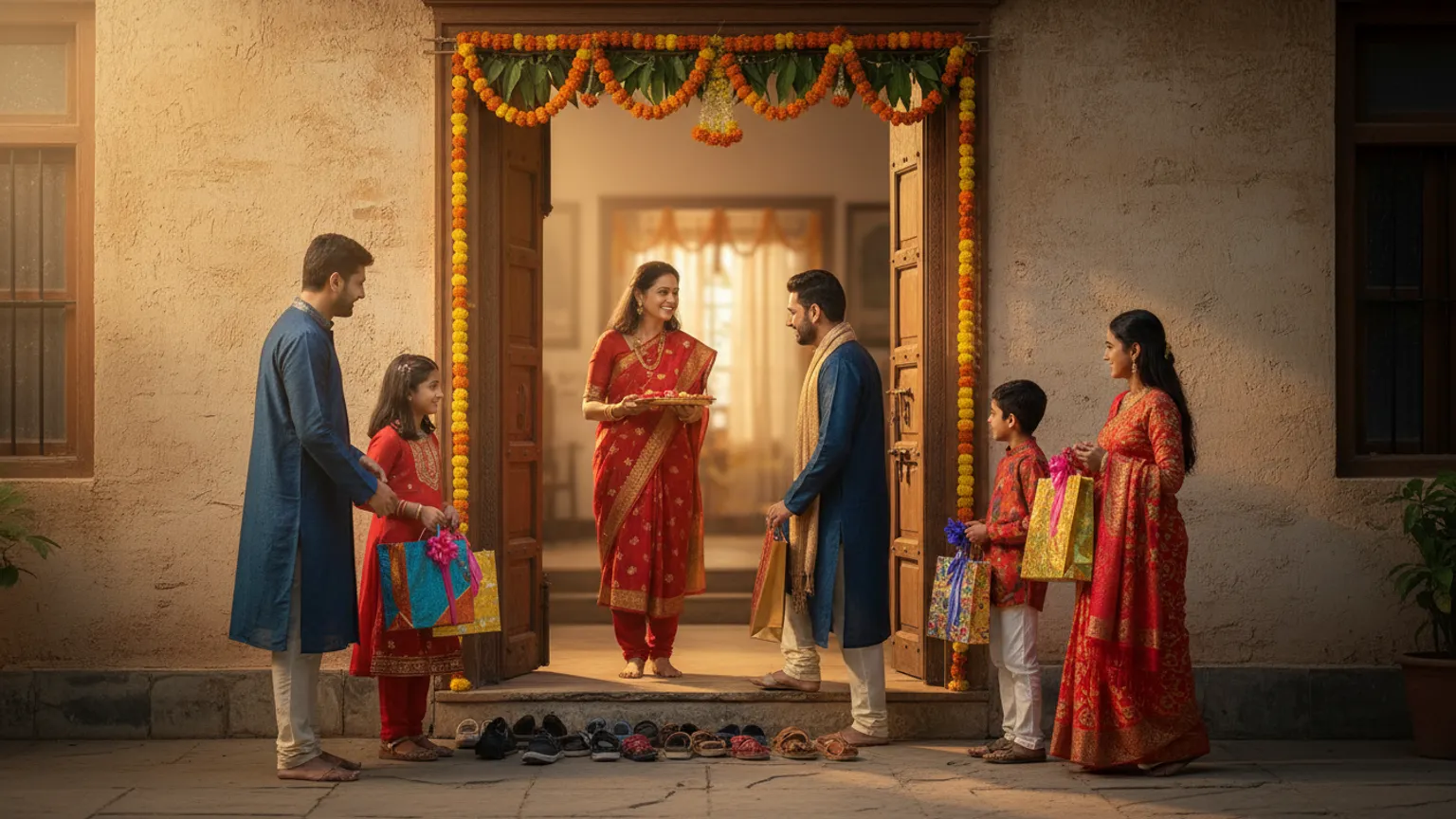
Every Raksha Bandhan of my childhood happened at my nani's house in Guwahati, and the part I remember is not the tying — it is the fifteen minutes when everyone arrived. Three of my mamas, their wives, a swarm of cousins, and a grand-aunt who lived two lanes away but still came by car, all landing in the same short window because they had each left home the moment the muhurat "started". The gate would be open, then suddenly there were four cars half-blocking the lane, a pile of chappals at the step, and Nani calling for more chairs before a single person had sat down.
That is the real shape of Rakhi for a host. The ceremony takes ninety seconds. The bottleneck is the doorway.
If you are the house everyone is coming to this year, the problem you are actually solving is not the thali — I wrote about the thali, the timing and the food quantities separately. The problem is that siblings and cousins from four different homes are about to converge on your door at nearly the same minute. And a house absorbs a slow trickle far more gracefully than one big wave.
Why "same muhurat" quietly means "same fifteen minutes"
Raksha Bandhan usually opens with a Bhadra period, and most families will not tie during it. So everyone waits for the same shubh window — and everyone leaves home when that window begins. Four households, one signal, one departure time. They don't mean to arrive together; the calendar arranges it for them.
The result is predictable if you have hosted it once: an empty house at 10:30, then eleven people at 11:40. Kitchen, seating and your one bathroom all hit peak demand in the same quarter-hour, and the ceremony you were calm about becomes a scramble.
You cannot change the muhurat. What you can change is the instruction attached to it. "Aa jao muhurat pe" tells four families to leave at the same time. A reach-by time, sent separately to each household, spreads that same wave across forty minutes instead of five.
Decide whose house before you decide the time
The convergence gets worse when there is more than one sibling set in play — say your kids will tie to each other, and your sister's kids are coming to tie to yours. Two ceremonies, two natural "host" homes, and a quiet tug-of-war over who travels to whom.
Sort this a week ahead, not on the morning. The honest questions are simple: whose house has the elders who shouldn't travel, whose has the parking, and whose is on the way for the most people. Pick one house as the anchor and say so plainly. The families who would otherwise each assume they are hosting will happily converge on a decided address — what they cannot plan around is ambiguity.
A stagger that keeps the door sane
Here is the whole trick: give different households slightly different reach-by times, tied to what they'll actually do when they land. The ones eating lunch come earlier; the tie-and-run cousins come for the ceremony itself. Nobody notices the stagger — they just notice that the house felt calm.
A rough shape for a mid-morning tying, adjust to your own window:
| Who | Ask them to reach by | Why this slot |
|---|---|---|
| Elders and anyone helping in the kitchen | 60–75 min before the tying | They settle, tea happens, help is in place before the rush |
| Households staying for lunch | 30–40 min before | Seated and fed into the flow before the ceremony crowd |
| Tie-and-leave cousins | 10–15 min before | They arrive close to the muhurat, tie, eat a laddoo, go |
| The one relative who is always late | Told the actual tying time | They will arrive 20 minutes after it regardless — plan for it |
That last row is not a joke. Every family has one household that runs late; giving them the real muhurat time (not an earlier one) means they land roughly when the ceremony is happening, instead of an hour after everyone has eaten.
The cousins-tying-cousins matrix
When it is not just sisters-to-brothers but a whole generation of cousins tying to each other, the rakhi count stops being obvious. The clean way to get it right is to count pairs, not people: every sister–brother pair needs one rakhi, and you keep two spares on the tray for the child who drops one and the cousin who was forgotten in the maths.
Two things that go wrong here, both avoidable:
- Kids tie in a chaotic round-robin and someone gets missed. Line them up by pair before the thali comes out. A thirty-second roll-call beats a crying seven-year-old at 12:30.
- A cousin arrives whom nobody counted. This is the single most common Rakhi surprise. It's the same reason extra guests turn up at every function — nobody confirmed a number, so everybody guessed. Two spare rakhis and two spare lunch plates cover it without drama.
Parking, chappals, and the first ten minutes
The wave hits hardest in the entryway, so that is where a little prep pays off most. Before anyone arrives:
- Sort parking out loud, in advance. If four cars are coming to a lane that holds two, say so in the message: "gaadi society gate ke paas laga dena." A blocked neighbour on a festival morning is the one sour note you can fully prevent.
- Clear the shoe zone. A mat or basket by the door stops eleven pairs of chappals from becoming a hazard the elders step over.
- Put someone on the door. A cousin or your spouse who greets, points to where to sit, and takes the mithai boxes off arriving hands — the difference between a warm welcome and a jam.
- Set the ceremony tray before guests come, not during. Rakhis, roli, rice, a diya, and the ceremony mithai in a separate katori — assembled and waiting, so the rush doesn't collide with a hunt for the matchbox.
- Keep the first round of tea or nimbu paani ready to pour. Something in people's hands in the first two minutes settles the whole room.
The message that does the staggering for you
You cannot announce a stagger to a family group — it reads as ranking people. You do it in individual messages, and it never feels like management. A few you can copy tonight:
To the household staying for lunch (Hinglish): "Bhaiya, kal Rakhi humare yahan. Aap log thoda jaldi aa jaana, 11 baje tak — aaram se baith ke, khaana bhi saath mein. Muhurat 12 ke aaspaas rahega."
To the tie-and-run cousins: "Rakhi tying around 12 at our place — reach by 11:45 so we tie together on time. Chai-mithai ready rahega, jitna ruk sako ruk jaana 🙂"
To decide the anchor house, in the sibling group: "Is baar sab log humare yahan aa jao — Papa-Mummy travel nahi kar payenge, aur parking bhi theek hai. Time alag se bhej raha hoon har ghar ko."
Notice the last one is the only message in the group. The times go out privately, one household at a time.
When you don't need any of this
If your Rakhi is six people in one flat, ignore all of the above. A stagger for a gathering that small is over-engineering — you'll all be in the room anyway, and a plan gets in the way of the morning. This only earns its keep when three or more households are converging on one door and you are the door.
And if you are the person in your family who ends up anchoring every festival — Rakhi now, Janmashtami next week, Ganpati after that — the same convergence problem is about to repeat itself right through to Diwali. It is worth getting a real master guest list going once rather than reconstructing the headcount from four WhatsApp chats each time. When those lists get long enough that you have genuinely lost track, a shared count where each household fills in its own number is the quiet way Inyeet handles it — but for one calm morning with your own siblings, a few individual messages the night before will do the job just as well. Reach for the tool when the list outgrows your memory, not before; the kinds of functions it actually helps with tend to be the larger, multi-family ones.
The ninety seconds of tying will take care of themselves. It is the fifteen minutes at the door — the ones nobody plans for — that decide whether the morning feels like a celebration or a scramble.
Related reading
Raksha Bandhan at home: the thali, the timing, and feeding everyone afterwards
A host's guide to Raksha Bandhan: why Bhadra sets your timing, what belongs on the thali, and how much mithai and lunch a house that fills in waves needs.
Onam sadya at home: serving a full thali to a house of guests
A sadya is a serving problem, not a cooking one. A host's guide to the banana-leaf layout, the order dishes go down, and seating a full house in calm rows.
Navratri 2026 dates and the nine-day plan for a home host
Navratri 2026 runs 11 to 20 October: the full nine-day tithi calendar, how hosting differs by tradition, and where guest-list pressure actually lands.