
Naamkaran invitation: customs, timing, and message templates
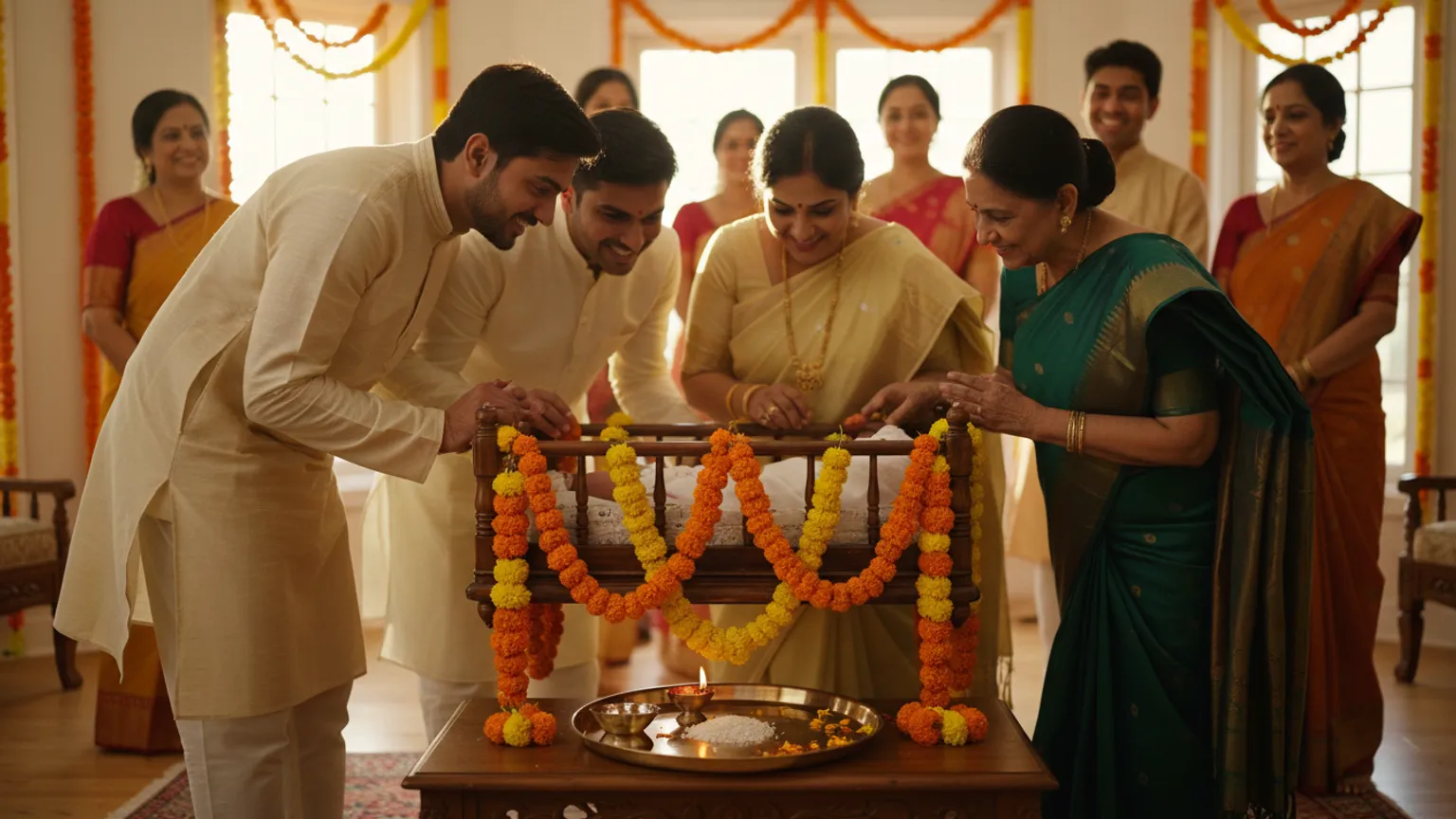
On the twelfth morning after my daughter was born, our family pandit sat cross-legged on the floor of my parents' living room, a small brass thali of rice in front of him, and asked me to whisper her name into her ear four times — once for each direction. My mother had strung marigolds across the doorway at 6 AM. My wife, running on ninety minutes of sleep, was trying to keep the baby calm while a cousin filmed everything on a phone held sideways. And my own phone, face-down on the sofa, was buzzing — because two of the fifteen people we'd invited had shown up an hour early, and three others were messaging to ask whether small kids were welcome around the newborn.
That morning taught me that a naamkaran invitation is nothing like a wedding invite. It's smaller, more tender, and quietly full of landmines — a sleepless house, a fragile newborn, elders who arrive first, and a name nobody outside the family has heard yet. This guide is the invite I wish I'd sent: the customs that shape the guest list, what every message must carry, and copy-paste templates in Hindi and Hinglish you can send tonight.
Why a naamkaran invite is different from every other function
Most Indian functions are about scale. A naamkaran is about restraint. Three things make it its own kind of invitation.
There's a newborn in the room. You can't pack forty people into a flat where a twelve-day-old baby is sleeping. Many parents — rightly — want fewer visitors and no unwell guests. The invite has to communicate an intimate scale without sounding like you're keeping people out.
The timing is fixed and often very early. The naamkaran traditionally happens on the 11th or 12th day (families vary — some do the 21st day, some a later muhurat around the mother's recovery). Like a griha pravesh, the muhurat can fall before sunrise, and only a few people need to be present for the ritual; everyone else comes for blessings and lunch.
The name is a reveal. In many families the baby's name isn't shared until the pandit announces it — a lovely bit of suspense you can use in your invitation, or protect, as your family prefers.
Because of all this, the guest list stays small and the tone stays warm — you're not managing a crowd, you're inviting a circle.
Decide these five things before you send a single message
New parents are exhausted, so make the decisions once and let the invite carry them.
- Muhurat and date — get the exact time from your pandit, not a rough "subah." Whether it's the 12th day or a later one, lock it.
- Home or hall — most naamkarans are at home or a parent's home. If the flat is small and the guest list creeps past twenty-five, a community hall or a booked restaurant lunch is kinder on everyone.
- Name reveal: teaser or secret? Decide whether you'll hint at the name in the invite ("the name starts with a 'V' — come find out") or keep it fully private until the ceremony.
- Kids and unwell guests — decide your comfort level and say it gently. A newborn's first weeks are not the time for a chesty cough in the room.
- Lunch count and menu — usually a simple satvik or home-style vegetarian lunch. You still need a headcount for the caterer or the cook, even at twenty guests.
Who to invite to a naamkaran (and what their message needs)
A naamkaran breaks into three natural circles, just smaller and gentler than a wedding's. Treat them as three short messages, not one broadcast.
| Circle | Who | What their invite must carry |
|---|---|---|
| Ritual circle | Grandparents, the baby's bua/mama, the pandit, one or two helpers | Exact muhurat time, request to arrive 15 minutes early, address, a note that the puja part is family-only |
| Blessings + lunch | Close relatives, the parents' closest friends | Ritual time and lunch time separately, address with landmark and parking, a firm RSVP date for the cook, gentle "unwell? please rest and bless from home" line |
| Warm well-wishers | Neighbours, wider friends, colleagues | A relaxed drop-in window (say after lunch), flat number, "no gifts needed" note, no headcount pressure |
A practical truth: for the first circle you barely need to "invite" anyone — they're family, they'll be there before you wake up. Your real effort goes into circles two and three, where a clear message prevents the early-arrival and "can I bring the kids?" scramble I lived through.
What every naamkaran invitation must include
Six details, missing any one of which triggers a phone call you'll take while holding a baby:
- Baby's arrival + parents' names — "We've been blessed with a baby girl" and both parents named, so distant relatives place who this is.
- Date, day, and the exact muhurat — spelled out, e.g. "Naamkaran puja: 8:15 AM, Lunch: 12:30 PM onwards."
- Full address with a landmark and a Maps pin — a blue dot beats three lines of directions, especially for elders.
- Parking note — "Society parking is tight; please use the lane behind the temple."
- A gentle health line — one warm sentence protects the newborn without offending anyone (templates below).
- RSVP with a real deadline and a reason — "Please confirm by Thursday so the kitchen can plan a fresh, home-style lunch."
WhatsApp message templates you can copy tonight
Swap the names, timings, and flat number, and send. Keep them personal — one message per family, not one broadcast to a hundred people. If you want the deeper reasoning on why personal beats broadcast, I wrote about it in why guests don't RSVP.
Template 1 — formal Hindi (elders and ritual circle)
सादर प्रणाम,
हमारे घर नन्ही परी का आगमन हुआ है। उसका नामकरण संस्कार शनिवार, १६ अगस्त को प्रातः ८:१५ बजे शुभ मुहूर्त पर सम्पन्न होगा। यह पूजन परिवार के साथ है — आपकी उपस्थिति और आशीर्वाद हमारे लिए सौभाग्य होगा। कृपया १५ मिनट पूर्व पधारें।
स्थान: फ्लैट ४०२, आनंद अपार्टमेंट, शिव मंदिर के पास, इंदौर। भोजन दोपहर १२:३० बजे से।
— हृषिकेश एवं परिवार
Template 2 — warm Hinglish (close relatives and friends)
Hi everyone 🙏 Bahut khushi ke saath bata rahe hain — humari beti aa gayi hai! Uska naamkaran hum Saturday, 16th August ko kar rahe hain.
Naamkaran puja: 8:15 AM Lunch (ghar ka satvik khaana): 12:30 PM onwards
Address: Flat 402, Anand Apartments, Shiv Mandir ke paas, Indore. (Maps pin: paste your link.) Parking lane behind the temple.
Chhoti si baat — baby abhi bahut nanhi hai, so agar kisi ko halki si tabiyat kharab ho, please aaram karein, aashirwad door se bhi pahunch jaayega ❤️ Aur kitchen ko count dena hai, so kaafi hoga agar Thursday tak bata dein.
— Hrishikesh & family
Template 3 — the name-reveal teaser (for families who want the suspense)
Ek nanha mehmaan ghar aaya hai, aur uska naam humne chun liya hai — par bataayenge nahi 😄 Saturday, 16th ko naamkaran pe panditji announce karenge, aur aap sabse pehle sunenge. 8:15 AM puja, 12:30 PM lunch. Flat 402, Anand Apartments. Aa rahe ho na?
Template 4 — warm well-wishers (drop-in, no pressure)
Namaste! Humare ghar khushiyaan aayi hain — humari beti ka naamkaran hai Saturday, 16th August. Aap dopahar ke baad jab bhi free ho, mithaai khaane aa jaaiye — 1 PM se shaam tak ghar pe hi hain. Flat 402, Anand Apartments, Shiv Mandir ke paas. Koi gift-vift nahi, sirf aapki dua chahiye 🙂
Template 5 — the day-before reminder
Kal subah 8:15 baje naamkaran hai, yaad hai na? Flat 402, Anand Apartments, temple ke peeche parking. Lunch 12:30 se — aapki thaali ready rakhenge. Baby ke liye ghar thoda shaant rakhna chahte hain, so thoda samay se aa jaana. Milte hain! 🌸
The gift question — handle it in one line
Almost every guest wonders what to bring for a newborn, and many feel awkward arriving empty-handed. A single warm line in your invite settles it for everyone. Pick one:
- "Aapka aashirwad hi humari beti ke liye sabse bada uphaar hai — koi bhet laane ki zaroorat nahi."
- "No gifts please — bas baby ko pyaar aur dua de dijiyega."
- If your family does the traditional silver/clothes shagun and you'd rather not refuse it, simply stay silent on gifts; guests will follow custom.
Being honest about this early is the same etiquette that makes elders comfortable — and if calling elders to confirm feels like a separate challenge, I put together a whole piece on following up with elders, phone-first.
When you need a system — and when you truly don't
Here's the honest part. A naamkaran is often the one function where you don't need any tool at all. Fifteen people, all family, half of them staying in your house anyway — a notebook and two phone calls will do. Don't let anyone, including me, sell you software for a fifteen-person puja.
The moment it changes is when the "warm well-wishers" circle balloons — when the naamkaran doubles as a wider celebration, and suddenly you've got sixty people across family, a friends' group, and the society, plus a newborn and no sleep. Scrolling three WhatsApp chats for a lunch count stops working. That specific mess — you already have a nice card, you just need to send it personally and see one honest count — is what we built Inyeet for: each guest gets a private invite link over your own WhatsApp, and a live dashboard shows opened / yes / no / maybe with family headcounts. It's free to use; you can get the app if that sounds useful.
But use the smallest tool that solves your problem. For a quiet twelfth-day puja, that tool is your voice.
FAQ
When is the naamkaran usually held?
Traditionally on the 11th or 12th day after birth, though many families choose the 21st day or a later muhurat once the mother has recovered. Ask your pandit for the exact date and time, and build the invite around that — never around a rough "morning."
Should I reveal the baby's name in the invitation?
It's entirely your family's call. Some keep the name secret until the pandit announces it — and you can turn that into a lovely teaser (see Template 3). Others share it warmly in the invite. Neither is more "correct"; do what feels right for your family.
How do I politely keep the guest count small around a newborn?
Lead with warmth, not rules. One gentle line — "baby abhi bahut nanhi hai, so hum ise thoda intimate rakh rahe hain" — tells people the scale without making anyone feel excluded. Invite the wider circle to a relaxed drop-in window after the puja instead of the ritual itself.
Is a naamkaran the same as a baby shower invite?
No — a baby shower (godh bharai) happens before the birth and celebrates the pregnancy, while a naamkaran happens after and names the child. The tone and guest list differ. If you're planning the earlier function, see baby shower (godh bharai) invitation messages.
The one thing to take away: a naamkaran invitation works best as a small, gentle set of personal messages — not a broadcast. Lock the muhurat, split your list into a ritual circle, a lunch circle, and warm well-wishers, add a kind line about the newborn, and give one real RSVP date. Do that, and the only thing left to manage on the morning is whether the rice stays in the thali when the baby's tiny fist reaches for it.
Related reading

Mundan ceremony invitation and small-gathering planning guide
Plan a mundan (first haircut) ceremony: home vs temple decision, who to invite, a day-of checklist, and copy-paste WhatsApp templates in Hindi and Hinglish.

Farewell party invites: office and college messages from casual to formal
Copy-paste WhatsApp farewell invitations for colleagues, teams, seniors and classmates — casual to formal, with Hinglish variants, a tone table and RSVP nudge.
Engagement announcement and invite messages for both families
Copy-paste WhatsApp engagement announcements and invites — joint, formal, roka/sagai and friends' versions in English and Hinglish, coordinated across both families.