
Engagement announcement and invite messages for both families
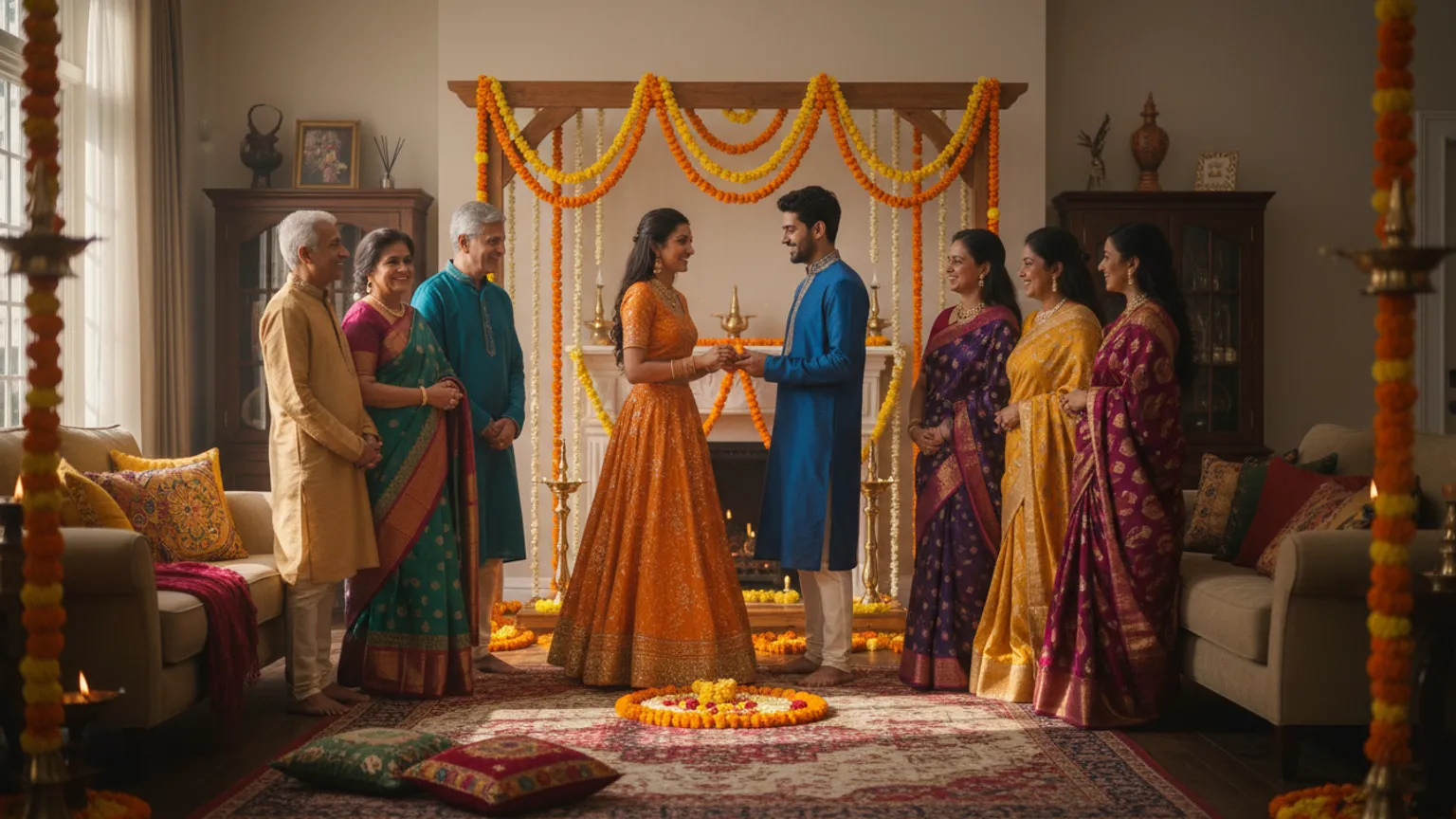
When my closest friend got engaged, he messaged me at midnight with one line: "Bhai, kaun sa message bhejun — aur pehle kiske group mein?" He wasn't joking. He had two WhatsApp announcements to write, one for his family and one for hers, and a real fear that if his side broke the news thirty minutes before her side, someone would notice and quietly feel it. An engagement isn't one family's news — it's the first thing two families ever do together, in public, on WhatsApp. And everyone is watching the tone.
That's what makes an engagement message trickier than it looks. A birthday invite goes out from one home. An engagement announcement has to feel equal — same warmth on both sides, whose name comes first handled with care, and the actual event (roka, sagai, ring ceremony, "engagement party") named the way both families would name it. Get it right and two families exhale together. Get it careless and your first joint act becomes your first small misunderstanding.
So here is the toolkit I've since built for friends and cousins: copy-paste engagement announcements and invitation messages, English and Hinglish, sorted by who's sending and who's reading — with the coordination notes that actually keep the peace. Swap the names, and send from your own WhatsApp.
First, one five-minute conversation between the two sides
Before anyone types a word, the two families need to agree on three tiny things. This is the conversation that prevents 90% of engagement-message awkwardness, and it takes five minutes on a call.
| Decide together | Why it matters | Safe default |
|---|---|---|
| What are we calling it? | Roka, sagai, ring ceremony and "engagement" all carry different formality | Use the word both families already use at home |
| Who announces when? | A 30-minute gap between the two sides reads as one side "leading" | Both sides post within the same hour, or agree one joint message goes to both groups |
| Whose name first? | In a joint line, order is read as precedence | Alphabetical, or "bride's family hosts, so groom's name is welcomed in" — pick one and tell both sides |
None of this is superstition — it's just courtesy. When both families have said "haan, yahi theek hai" out loud, every message below becomes easy, because the hard part is already settled.
1. The joint announcement (one message, both family groups)
The cleanest option: one agreed message that goes into both family WhatsApp groups at the same time. Nobody leads, nobody follows.
English:
With hearts full of joy, both our families are delighted to share that Aarti & Rohan are engaged! 💍 Two families becoming one — and we couldn't be happier. Function details to follow soon. For now, please shower them with your blessings. 🙏
Hinglish:
Dono parivaaron ki taraf se ek pyaari si khushkhabri — Aarti aur Rohan ki sagai pakki ho gayi! 💍 Do ghar ab ek rishte mein bandh rahe hain. Function ki details jaldi bhej rahe hain. Filhaal bas dono ko dil se aashirwad dijiye. 🙏
The trick is the phrase "both our families" / "dono parivaaron ki taraf se" right at the top. It signals equality in the first four words, before anyone can wonder whose announcement this "really" is.
2. Formal invite from the bride's / groom's side (for elders)
Once it's an actual function with a date, each side often invites its own elders and relatives. Keep the facts identical across both sides; only the "from" line changes.
English:
Respected [Uncle/Aunty] ji, sadar pranam. With great joy and the blessings of our elders, we invite you to the engagement ceremony of our [daughter/son] Aarti with Rohan on Sunday, 21st September at [Venue], [City]. The ceremony begins at 7:00 PM, followed by dinner. Your presence and blessings would mean the world to us. 🙏
Hinglish:
Aadarniya [Naam] ji, sadar pranam. 🙏 Bade harsh ke saath aapko humari beti Aarti aur Rohan ki sagai mein sadar aamantrit karte hain. Samaroh 21 September, ravivar ko shaam 7 baje [Venue], [City] mein hoga, jiske baad bhojan ka prabandh hai. Aapka aashirwad hi humari sabse badi nidhi hai.
For elders, keep it complete and blessing-forward, and expect many to confirm by phone rather than typing "yes." That call is their RSVP — note it down and move on.
3. The roka / sagai invite (intimate, family-first)
A roka is usually smaller and more sacred than a big engagement party — often just the two families and a handful of closest people. Say that plainly, so nobody assumes it's the wide-open function.
English:
We're taking the first step! 🌸 Please join us for Aarti & Rohan's roka — an intimate ceremony with just our two families and closest loved ones — on Saturday, 6th September, 11 AM onwards, at [Home/Venue]. Lunch to follow. This one's small and close to our hearts, and we'd love you in the room.
Hinglish:
Pehla kadam! 🌸 Aarti aur Rohan ke roka ke liye aapko sasneh invite karte hain — sirf dono families aur khaas log — Saturday, 6 September, 11 baje se, [Ghar/Venue] par. Lunch bhi yahin. Yeh function chhota aur dil ke kareeb hai, isliye aapka hona zaroori hai.
4. The couple's own announcement (to friends)
When the newly-engaged couple tells their own friend circles, drop every bit of formality. This is the fun one.
English:
It's official — we're engaged! 💍😄 [Aarti] finally said "haan" (after making me sweat a little). Function details coming soon, but I wanted my people to hear it from me first. Get ready to dance.
Hinglish:
Ho gaya official — hum engaged hain! 💍😄 [Aarti] ne aakhirkaar "haan" keh diya (thoda tarsaya, par keh diya). Function ki details jaldi, par sochha apne logon ko khud se batau. Naachne ki taiyaari kar lo!
Send these as individual messages, not one blast to a 60-person group. An engagement dropped into a big group reads as "announced to everyone, my reply doesn't matter" — and you get silence instead of the flood of voice notes you actually want. I wrote about exactly why crowds stay quiet in why guests don't RSVP; a person feels responsible to reply, a crowd never does.
5. Both-families joint invite (for the shared guest list)
For the big engagement party, many families now send one card jointly — cleaner, and it models the union the day is about.
English:
The [Sharma] & [Verma] families joyfully invite you to celebrate the engagement of Aarti & Rohan 💍 on Sunday, 21st September, 7 PM onwards, at [Venue], [City]. Come bless the beginning of a beautiful journey — dinner, music and much love await. Kindly let us know if you'll join us. 🎉
Hinglish:
Sharma aur Verma parivaar aapko Aarti aur Rohan ki sagai ki khushi mein sasneh aamantrit karte hain 💍 — Sunday, 21 September, 7 baje se, [Venue], [City]. Aaiye, ek nayi shuruaat ko aashirwad dijiye — dinner, music aur dher saara pyaar. Aa rahe hain, zaroor bata dijiyega. 🎉
6. The RSVP nudge (because "zaroor aayenge" is not a number)
Every engagement I've helped with had the same last-week problem: two families' worth of warm, useless "aa jaayenge" and a caterer wanting one final count. This nudge fixes it without nagging. Send it three to four days before your caterer's cut-off.
English:
Hi [Name] 😊 quick one — we're giving the caterer final numbers on Thursday. Could you confirm if you're coming, and roughly how many from your side? Even a "sorry, can't make it" genuinely helps us plan. No pressure at all! 🙏
Hinglish:
Hi [Name] 😊 bas ek chhota reminder — Thursday tak caterer ko final count dena hai. Aap aa rahe hain kya, aur apni taraf se approx kitne log? "Nahi aa paayenge" bhi bata dein toh planning aasaan ho jaati hai. Koi pressure nahi! 🙏
It gives a real reason (the caterer's deadline) and openly permits a no — which, counterintuitively, gets you more honest answers than a cheerful "aa rahe ho na?" ever will.
A pre-send checklist (run it once for both families)
Before you hit send on any of these, especially the joint ones, run down this list. It has saved more than one couple from an awkward correction message in front of two families.
- Both surnames spelled right — and any Ji-suffix on elders' names.
- Name order agreed — the same order in every message, both sides.
- The right word used — roka vs sagai vs engagement, matched to both families.
- Date, day and time all match — "Sunday the 21st" only works if the 21st is a Sunday.
- Venue has a landmark — "near the old temple" beats a bare address for elders.
- Intimate functions marked as intimate — so no one assumes the roka is open to all.
- Sent personally, not just dropped in a group — a named message lands completely differently from a broadcast.
That last point matters more than the wording. The most beautiful engagement message in a 90-person group still feels mass-produced. The same words sent one-to-one feel like being personally told good news — which is exactly what an engagement is.
When two families' lists get too big to hold in your head
For a small roka of twenty, none of this needs a tool — a notebook and a few personal texts, and you're done. Genuinely, don't overthink it. But an engagement party is the first time two full guest lists collide: your side, their side, and the overlap you didn't know existed. Both families are chasing confirmations in different chats, and on catering day nobody has one honest number.
That collision is the specific problem we built Inyeet for — you send your card through your own WhatsApp so it stays personal, and one shared dashboard quietly tallies who's coming and how many from each side. It's free to use if you'd like to try it. But I'll say the honest thing I always say: no app writes the warmth for you. The reason both families showed up beaming wasn't a dashboard — it was two sets of people who typed a name and meant it. The templates above are the actual gift; the tech just counts.
The takeaway
An engagement announcement is the first thing two families do together in front of everyone — so lead with "both our families," settle name order and the function's name in one five-minute call, and send every message personally. Pick the template that fits your moment, change the names, and send it tonight. And if you're the one at midnight wondering kaun sa message pehle — relax. "Dono parivaaron ki taraf se, ek khushkhabri" is already the whole thing. For the wedding messages that come next, I've got you covered in wedding invitation messages for WhatsApp.
Related reading
Farewell party invites: office and college messages from casual to formal
Copy-paste WhatsApp farewell invitations for colleagues, teams, seniors and classmates — casual to formal, with Hinglish variants, a tone table and RSVP nudge.
Godh bharai invitation messages families actually like: 9 templates
Copy-paste baby shower and godh bharai WhatsApp invitations — traditional, modern, co-ed and virtual versions in English and Hinglish, with a tone guide and RSVP nudge.
Anniversary party invitation messages: 8 templates with Hinglish variants
Copy-paste WhatsApp anniversary invitations — silver, golden, surprise and couple's-own versions in English and Hinglish, plus a tone guide and an RSVP nudge.