
First birthday invitations: annaprashan rituals meet a modern party
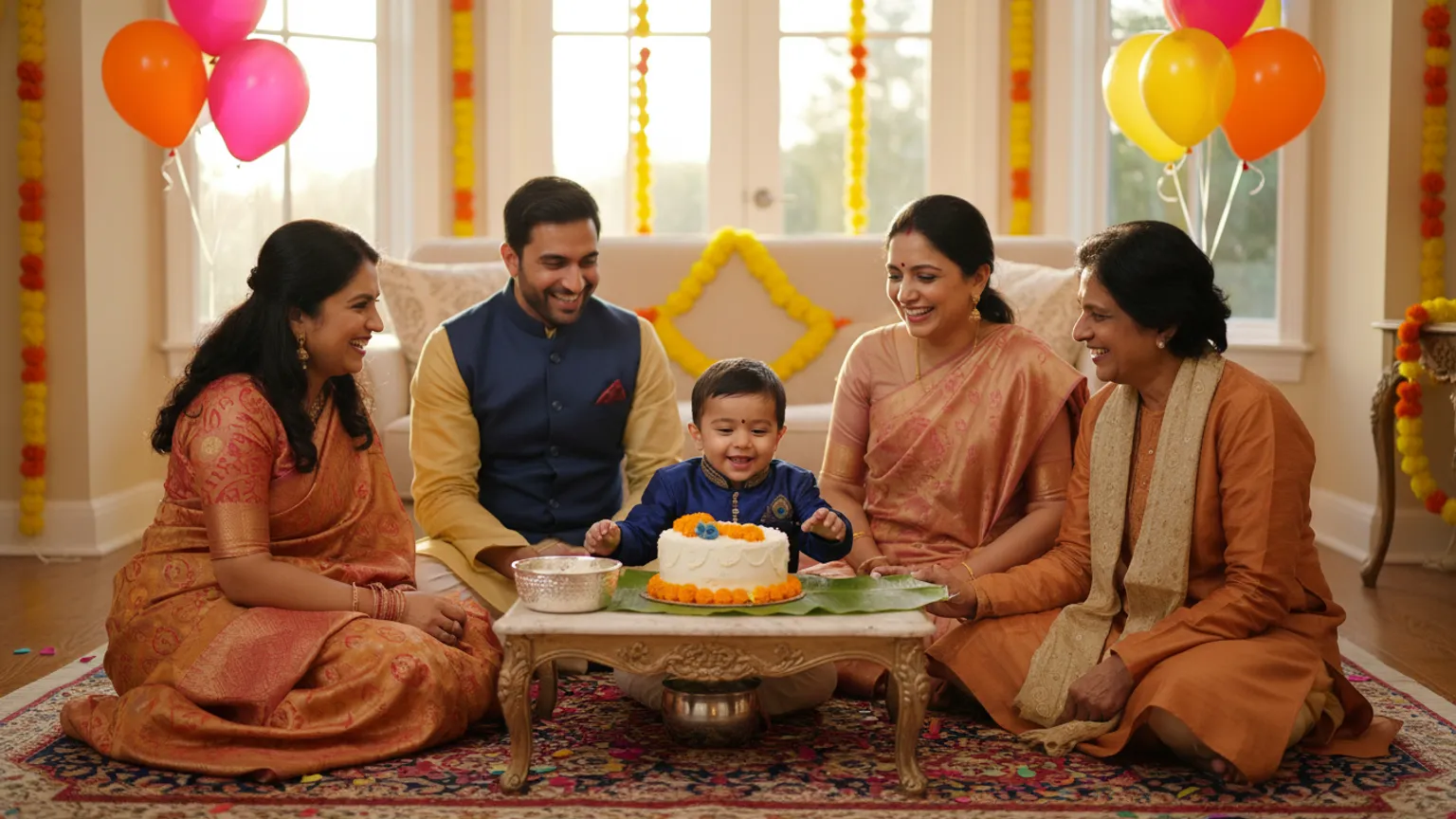
The evening we sat down to plan my nephew Vivaan's first birthday, two people at the dining table were planning two completely different events. My mother had the panchang open and was asking the pandit's name so she could fix the annaprashan muhurat — the first-rice ceremony her mother had done for her, and her mother before that. Across the table, my bhabhi was showing me a jungle-theme reference on her phone: balloon arch, a cake-smash corner, a photo booth with little animal ears, "aur woh evening wali soft light, jungmch pe."
Both were completely right. And the invitation — one message, going out to the same seventy people — had to somehow carry both. That's the real puzzle of a first birthday in an Indian family: it isn't a party you're inviting people to, it's a ritual and a party, and the two halves speak to two different circles who read invitations in two different ways.
This is the guide I wish I'd had that evening. Not theme ideas — those are everywhere. This is about the invitation itself: what the ritual half must carry, what the modern half must carry, and how to write one set of messages that keeps your dadi and your college group equally sorted.
Why a first birthday is really two events wearing one date
Walk through who's actually reading your invite and you'll see the split immediately.
Your parents, uncles, aunts and older relatives read it as a ceremony invitation. To them the centre of the day is the annaprashan (or mundan, or a simple naamkaran-style blessing) — a puja with a fixed muhurat, elders feeding the baby the first grain, a satvik lunch, and blessings. If your message skips the muhurat, half of them call to ask "puja kab hai?" and the other half assume there's no puja and turn up in jeans at 6 PM.
Your siblings, cousins and friends read the same message as a party invitation — theme, venue, evening slot, parking, and whether it's kid-friendly enough to bring their own toddler. The muhurat means little to them; the vibe means everything.
Neither group is wrong. The mistake is one flat message — "Vivaan's 1st birthday, Sunday, come home" — that under-serves both, and leaves you answering the same six questions on the phone all week.
The fix is the same one that works for a griha pravesh: stop thinking of it as one invitation and start thinking of it as circles and waves. I unpacked that idea in the griha pravesh invitation guide, and it maps almost perfectly onto a first birthday.
The ritual half: what the elders' invite must carry
If there's a puja, this is the half that has to be precise, because a muhurat is a fixed clock, not a "onwards".
- The exact ritual and its muhurat. "Annaprashan pujan: 11:15 AM" — not "morning". If elders are meant to feed the baby the first grain, say so plainly.
- Who the ritual part is for. Often the puja is close family and a few elders, the wider party in the evening. Spell it out so a distant relative doesn't feel they missed the "main" thing — or sit through a puja they weren't expecting.
- Satvik lunch, if that's the plan. Many families keep the ritual-day meal vegetarian, no-onion-no-garlic. Elders plan their day around it.
- Dress note, if it matters. "Pujan ke liye traditional preferred" saves an aunt the worry of showing up underdressed for photos she'll frame.
- A gentle blessing line. "Aapka aashirvaad hi Vivaan ke liye sabse badi bhet hai" lands better with elders than any theme.
The modern half: what the party invite must carry
Same date, different language. The evening crowd needs logistics and vibe, not muhurat.
- The theme and the fun bit. "Jungle theme, cake smash at 6:30, chhoti si photo booth" — one line that tells friends what kind of evening it is.
- A real time window. "6 to 9 PM" beats "evening onwards". People plan their Sunday around a slot.
- Parking and venue clarity. A landmark and a Maps pin, every single time. If it's a society hall, the "tell security it's for Vivaan's party" line saves ten calls.
- Kid-friendliness. Friends with their own toddlers want to know if they can bring them. Usually yes — say it, because it decides whether they come at all.
- The gift signal. More on this below, but the party crowd especially wants a hint so nobody arrives empty-handed or over-shops.
One event, two waves: who gets which invite
Here's the split I now use, laid out the way I'd hand it to you on a napkin.
| Wave | Who | What their invite leads with |
|---|---|---|
| Ritual wave (late morning) | Grandparents, close family, elders who bless the baby | Exact muhurat, that this is the annaprashan/pujan, satvik lunch time, dress note, a blessing line. Light on "theme". |
| Party wave (evening) | Cousins, friends, colleagues, neighbours | Theme, evening time window, venue + parking + Maps pin, kid-friendly note, gift hint. Light on muhurat. |
| Both-in-one (overlap circle) | Family who'll come for puja and stay till evening | Both halves in one message, clearly sectioned: "Pujan 11:15 AM · Party se 6 PM". |
A practical note: most of your list falls cleanly into wave one or wave two. Only the overlap circle — your Mama's family who'll come at 11 and leave at 9 — needs the full two-part message. Don't send everyone the long version; it buries the one detail each circle actually needed.
And a counting warning that catches every first-time host: a first birthday is exactly the event where "one invite" quietly becomes four people — the child, both parents, and a tagging-along sibling or grandparent. I wrote the whole multiplier method in kids' birthday party guest math; read it before you give the caterer a number, because the ritual lunch count and the evening count are usually two different figures.
Copy-paste WhatsApp templates
Change the name, date, timings and venue, and send from your own chat — not a fifty-member group.
Template 1 — ritual wave, Hinglish (elders and close family)
Namaste [Name] ji 🙏 Vivaan ka annaprashan pujan is Sunday, 3rd August ko subah 11:15 baje ke shubh muhurat par hai. Aap sabhi bado ka aashirvaad Vivaan ke liye bahut zaroori hai, isliye aapse anurodh hai ki pujan ke samay zaroor padhare.
Pujan: 11:15 AM · Satvik lunch: 1:00 PM se Venue: [flat/hall + landmark + Maps pin]
Aapki upasthiti hi hamare liye sabse bada uphaar hai. — Hrishikesh & family
Template 2 — party wave, Hinglish (friends and cousins)
Hey [Name]! Vivaan turns 1 this Sunday and we're throwing him a little jungle-theme evening 🦁🎂 Would love for you all to come.
Sunday 3rd August · 6 to 9 PM · [venue + landmark] Maps pin: [paste link] · Parking in the basement, bolo security ko "Vivaan's party" Cake smash around 6:30, so come a little before if you want the photos. Apne bachchon ko zaroor laana — kids welcome!
No gifts please, bas aa jao — that's the whole plan 🙂 — Hrishikesh
Template 3 — both-in-one, for the overlap circle
Namaste [Name]! Vivaan's first birthday is this Sunday, 3rd August, and we'd love you with us for the full day.
🪔 Annaprashan pujan: 11:15 AM (blessings + satvik lunch at 1) 🎂 Evening party: 6 to 9 PM (jungle theme, cake smash, kids welcome) Venue: [same venue + Maps pin] · Basement parking available
Come for the pujan, stay for the cake — poora din aapke saath. Aur please koi gift ki tension mat lena. — Hrishikesh & family
Template 4 — the day-before reminder (short)
Kal Vivaan ka big day! Pujan 11:15 (jo aa rahe hain subah), party 6 baje se. [Venue], basement parking. Agar plan change hua ho toh ek line bata dena, warna plate ready rakhenge 😄
The gift question nobody wants to raise
For a first birthday, the gift confusion is real: elders often want to give shagun or gold, friends want to know if there's a "list", and you genuinely may not want a mountain of soft toys the baby will outgrow by Diwali. Be the one who says it first.
| If you want… | Put this in the invite |
|---|---|
| Truly no gifts | "No gifts please — aapka aana hi kaafi hai." (Elders may still bring shagun; accept it graciously.) |
| Something useful instead | "Agar kuch dena hi ho, toh Vivaan ke naam ek book — hum ek chhoti library bana rahe hain." |
| Only blessings from elders | "Bado se sirf aashirvaad chahiye, aur kuch nahi." |
| You're fine either way | Say nothing about gifts — silence reads as "as you wish." |
The honest bit: you can't fully control what elders bring, and you shouldn't try. The line isn't there to police anyone — it's there so the friends who'd otherwise panic-buy have an easy out.
A first-birthday invite checklist
Run this before you hit send.
- Muhurat / ritual time stated exactly (not "morning onwards")
- Evening party window stated as a real slot (e.g. 6–9 PM)
- Venue with landmark + Maps pin + parking line
- Clear which circle each message is for (ritual / party / both)
- Satvik lunch and dress note included for the ritual wave
- Kid-friendly line for the friends wave
- Gift signal chosen (or deliberately left silent)
- Separate rough headcounts for lunch and for evening
- Day-before reminder drafted for the non-repliers
When you don't need to split anything
Be honest about scale before you build a system around it. If it's fifteen people, all family, all coming for the whole day, you don't need waves or a dashboard — you need one warm message and a phone. A first birthday where everyone already knows everyone is meant to be simple; keep it that way.
The split earns its keep when the list crosses what you can hold in your head — seventy people across two very different circles, a hall with a per-plate rate, cousins driving in from another city who need the ritual timing and the party timing. That's the exact mess I kept hitting as a host, and it's why we ended up building Inyeet — so each family gets their own invite link over your WhatsApp, and you can see who's coming for the puja versus the party without scrolling a group chat counting emojis at midnight.
The takeaway
A first birthday isn't one invitation — it's two, wearing one date. The elders came for the ritual; write them the muhurat, the blessing, the satvik lunch. The friends came for the party; write them the theme, the slot, the parking. Send each circle the half it actually reads, give the overlap crowd both in one clean message, and settle the gift question yourself. Do that, and the only thing left to manage on the day is a one-year-old with cake in his hair — which, honestly, is the whole point.
If a simpler way to send each family their own invite and keep two headcounts straight sounds useful, we built exactly that, and it's free to use. And if the deeper problem you're fighting is people who see the invite but never reply, that's a whole psychology of its own — I wrote about it in why guests don't RSVP.
Related reading
Godh bharai invitation messages families actually like: 9 templates
Copy-paste baby shower and godh bharai WhatsApp invitations — traditional, modern, co-ed and virtual versions in English and Hinglish, with a tone guide and RSVP nudge.
Farewell party invites: office and college messages from casual to formal
Copy-paste WhatsApp farewell invitations for colleagues, teams, seniors and classmates — casual to formal, with Hinglish variants, a tone table and RSVP nudge.
Engagement announcement and invite messages for both families
Copy-paste WhatsApp engagement announcements and invites — joint, formal, roka/sagai and friends' versions in English and Hinglish, coordinated across both families.